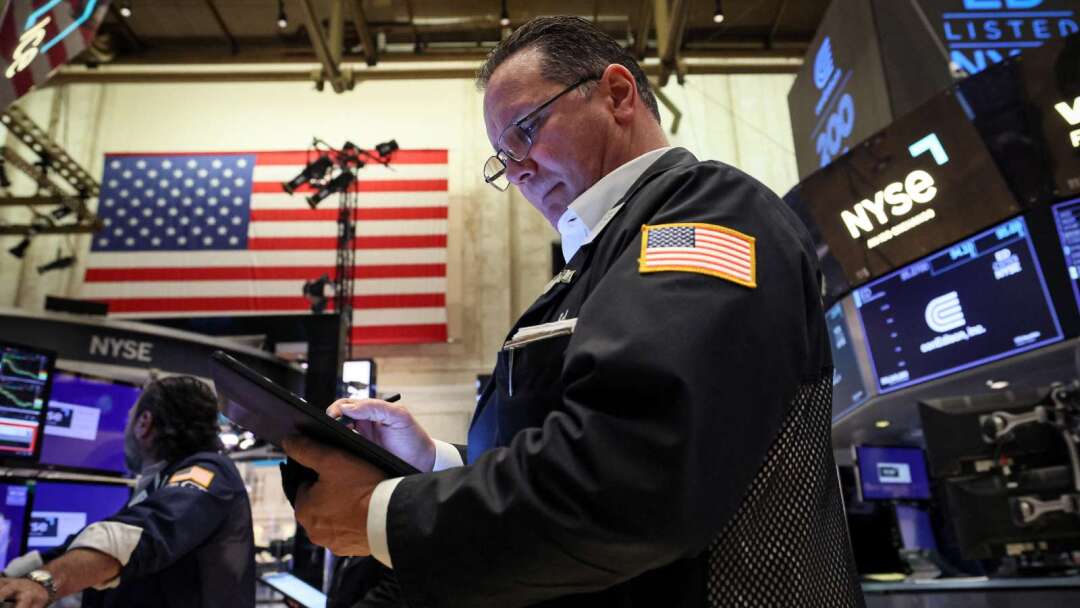
US stock indices opened with mixed performance on Tuesday (28th), as robust corporate earnings spurred capital rotation into sectors benefiting from economic growth prospects, lifting the Dow Jones Industrial Average. However, concerns over massive artificial intelligence (AI) spending by tech giants and intensifying competition from China continued to pressure semiconductor stocks, dragging down the Nasdaq Composite Index.
While most components of the S&P 500 Index rose, with its equal-weighted version hitting a new all-time high, the market-cap-weighted index fluctuated near the flat line due to declines in large-cap chipmakers. Falling international oil prices eased inflation concerns, contributing to a pullback in US Treasury yields ahead of the Federal Reserve’s interest rate decision.
At the time of writing, the Dow Jones Industrial Average was up nearly 280 points, or 0.5%; the Nasdaq Composite Index was down nearly 200 points, or 0.8%; the S&P 500 Index was down 0.2%; and the Philadelphia Semiconductor Index had plunged over 5.0%. TSMC ADR fell 3.8%.
US equity futures were volatile on Tuesday, with selling pressure in chip stocks intensifying. However, investors rotated into sectors reporting stronger-than-expected quarterly earnings, partially offsetting the tech-led downturn. US Treasury prices rose, while international oil prices declined after the US and Iran extended their ceasefire.
S&P 500 futures fluctuated around the flat line, while Nasdaq 100 futures dropped 0.6%, potentially marking the index’s fifth consecutive losing session—the second such streak this year. A major ETF tracking semiconductor stocks tumbled 3.6% pre-market, while healthcare and materials sector ETFs showed relative strength.
A similar sector rotation was observed in European markets. ASML’s weekly losses widened to 11% amid progress by Chinese competitors in lithography equipment. The pan-European Stoxx 600 Index was volatile but saw more gainers than losers; earnings from Barclays (BCS-US), LVMH, and Unilever (UL-US) triggered varied market reactions.
Chip stocks have experienced sharp volatility recently, as investors grow wary not only of the sustainability of AI spending growth but also of rising Chinese competition. Capital has therefore shifted toward sectors with a higher proportion of companies beating earnings expectations. According to Bloomberg Intelligence, all companies in the real estate, materials, and utilities sectors that have reported so far have exceeded market estimates.
Olivier David, fund manager at Vega Investment Solutions, said the market is clearly rotating out of overcrowded semiconductor positions. “With overall corporate earnings strong this quarter, investors have other sectors to choose from.”
On the individual stock front, Coca-Cola (KO-US) rose 4% in pre-market trading after raising its full-year outlook. Companies like KLA (KLA-US) are also set to report earnings, while markets await key results and capital expenditure guidance from Amazon (AMZN-US), Meta (META-US), and Microsoft (MSFT-US).
Asian tech stocks faced even steeper selling pressure on Tuesday, with SK Hynix (SKHY-US) and Samsung Electronics plunging over 13% in Seoul, dragging regional benchmark indices toward correction territory.
Falling oil prices eased some inflation concerns, with Brent crude dropping 1.6% to around $87 per barrel—its third consecutive daily decline—after the US and Iran extended their pause in hostilities. Markets will now watch negotiations between Iran and Oman to see if shipping through the Strait of Hormuz can resume.
Ahead of the Fed’s rate decision, US Treasuries extended their rebound, as investors dialed back expectations for further tightening over the next 12 months. However, with inflation risks still elevated, money markets still price in about a 35% chance of a rate hike this week.
Citadel Securities expects the Fed to raise rates, believing the move would help Chair Kevin Warsh strengthen credibility on inflation control. ING strategist Vincent Juvyns expects a hold but warns that stagflation risks remain, urging investors not to become complacent.
As of around 9:00 PM Taipei time on Tuesday (28th):
Dow Jones Industrial Average up 303.53 points, or 0.58%, at 52,513.61
Nasdaq Composite Index down 158.38 points, or 0.64%, at 24,773.70
S&P 500 Index down 10.05 points, or 0.14%, at 7,403.13
Philadelphia Semiconductor Index down 444.78 points, or 3.85%, at 11,110.10
TSMC ADR down 2.86% to $387.86 per share
10-year US Treasury yield fell to 4.62%
NYMEX crude down 1.92% to $81.02 per barrel
Brent crude down 1.90% to $86.68 per barrel
Gold down 1.06% to $4,033.80 per ounce
Dollar index down to 101.51
Key stocks:
Coca-Cola (KO-US) up 3.41% to $86.94 per share
Coca-Cola (Coca-Cola) rose 2% pre-market after reporting better-than-expected Q1 results and raising its full-year outlook. Adjusted EPS was $0.97, above the LSEG analyst consensus of $0.93; revenue reached $13.38 billion, exceeding the expected $13.16 billion.
Cadence Design Systems (CDNS-US) up 0.13% to $339.04 per share
Cadence Design Systems (Cadence Design Systems) rose 3% pre-market. Q2 adjusted EPS was $2.11, beating LSEG estimates of $2.05; revenue was $1.58 billion, in line with expectations.
Johnson & Johnson (JNJ-US) up 1.71% to $270.50 per share
Johnson & Johnson (Johnson & Johnson) rose over 2% pre-market after agreeing to pay $5.5 billion to settle thousands of lawsuits alleging its talc-based products caused ovarian cancer.
Today’s key economic data:
None
Wall Street analysis:
JPMorgan stated its internal market indicator has flashed a “buy” signal, which historically suggests the S&P 500 is poised for gains. Despite risks such as overcrowded semiconductor trades and the aftermath of US-Iran tensions, the bank remains optimistic about the near-term outlook for US stocks. It expects lower Treasury yields, a weaker dollar, and strong corporate earnings to support equities.
FACT BOX
- Source: PR Times
- Category: News
- Organizations: ASML / Barclays / LVMH