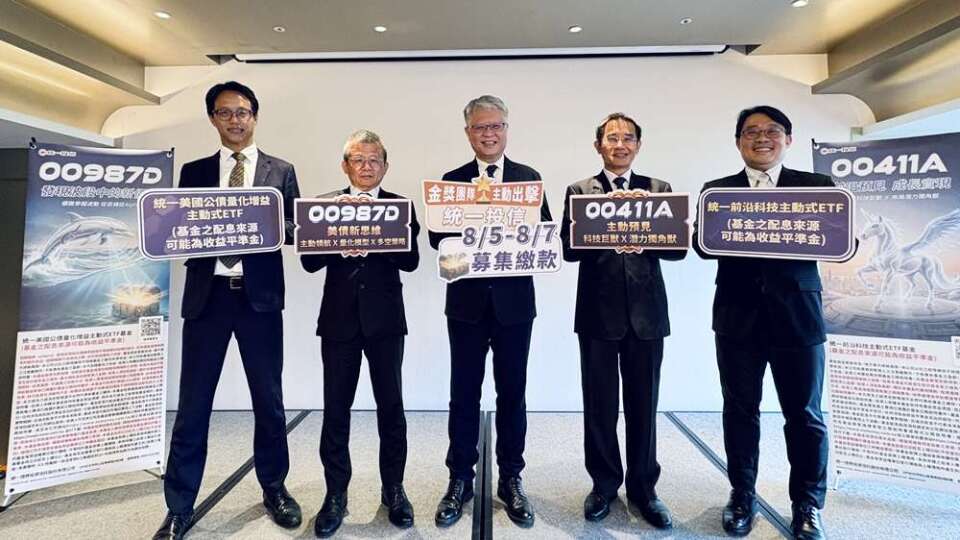
Following the strong active ETFs 00981A and 00403A, Uni Securities is launching the 'Uni Frontier Technology Active ETF (00411A-TW)' to ride the new wave of technology, with fundraising scheduled from August 5 to 7. CEO Tung Yung-Kuan stated that market volatility is a normal phenomenon, and the current environment presents an excellent opportunity for active management teams to generate alpha. Kuo Chih-wei, the designated manager of 00411A, said the fund plans to initially allocate 70% to the U.S. and 30% to Asian supply chains, extending from AI infrastructure to emerging applications to precisely capture long-term growth opportunities in the global tech industry.
Asian equities plunged again today (28th), with South Korea's market hitting a circuit breaker and Taiwan's stock market crashing 2,069 points—the third-largest single-day drop in history. Regarding market turmoil, Tung Yung-Kuan said stock market fluctuations are like natural earthquakes—normal market reactions. He believes current market volatility actually provides an opportunity for the next round of product positioning. The core value of active products lies in leveraging the team's stock and bond selection capabilities to generate excess returns.
Tung further pointed out that in addition to maintaining its existing market strengths, Uni Securities is actively expanding into the high-net-worth and family office markets. Aligning with the government's asset management center policy, Uni leverages its investment research team with over 30 years of experience to provide targeted products and services, aiming to drive business growth and internationalization.
Regarding the recent correction in tech and semiconductor stocks, Kuo Chih-wei analyzed that the market rose too quickly over the past few months, and the short-term pullback is a reasonable 'mean reversion' rather than a deterioration in fundamentals. From indicators, the Philadelphia Semiconductor Index's corporate earnings (EPS) for this year have been revised upward by 80–90%, while valuation upgrades have been relatively limited. The overall P/E ratio remains at the five-year average level, showing no sign of being overvalued.
He noted that funds are merely taking profits ahead of Q2 earnings reports and rotating into lagging sectors like software, not exiting the market. Once earnings risks are clarified and fundamentals confirmed, the current pullback presents an excellent entry point.
On the investment strategy and allocation of 00411A, Kuo Chih-wei said that most of the world's most influential tech giants originate in the U.S., so the fund plans to initially allocate about 70% to the U.S., with 13% to Taiwan, 8% to Japan, 6% to South Korea, and 3% to China/Hong Kong, capturing long-term business opportunities from global innovation sources and Asian tech supply chains.
In terms of thematic allocation, the fund plans to initially allocate 35% to AI infrastructure, 25% to energy infrastructure, and the remainder to space economy (13%), AI software applications (10%), autonomous driving (6.5%), quantum computing (6%), and humanoid robots (4.5%). Kuo pointed out that the current AI wave is still primarily driven by infrastructure, but as infrastructure matures, applications will rapidly expand. Through active management and systematic screening, the fund can more effectively respond to investment changes brought by technological generational shifts.
On the long-term development of the tech industry, Kuo noted that global tech stock earnings have gradually decoupled from overall economic growth since 2010, a trend that has become more pronounced since the emergence of AI large language models. Currently, tech giants like Microsoft, Google, and Meta continue to expand capital expenditures because no absolute industry monopolist has emerged, prompting major cloud service providers (CSPs) to aggressively invest to solidify leadership.
As hardware infrastructure gradually comes online, capital will accelerate its shift toward software applications, including emerging technologies like autonomous driving and humanoid robots. These technologies will not only effectively solve the world's long-standing labor shortages but also become the next core driver of tech industry growth.
Backed by Foxconn Experience! Kuo Chih-wei, with 17 Years of Industry Insight, Leads Frontier Tech ETF
Manager Kuo Chih-wei graduated from National Cheng Kung University's Department of Mechanical Engineering and National Taiwan University's Graduate Institute of International Business, combining engineering and financial management expertise. Before entering the asset management industry, he served as a product manager at Foxconn Precision Industry and spent three years at the Shenzhen Guanlan plant, gaining rich on-site experience in the tech industry.
After transitioning to finance, Kuo has accumulated about 17 years of investment research experience, having worked at Fuhwa Securities and Uni Securities. He currently manages multiple funds, including Uni Global New Technology and Uni New Asia Technology & Energy. During his tenure managing the Uni Global New Technology Fund, he grew its assets from 1 billion to nearly 30 billion NTD, demonstrating strong industry research and portfolio management capabilities.
Kuo Chih-wei, designated manager of Uni Securities' 00411A. (Photo by Chen Yu-Ching, Cnyes.com)
FACT BOX
- Source: PR Times
- Category: New Product
- Organizations: Google / Meta
- Products / services: 00411A-TW