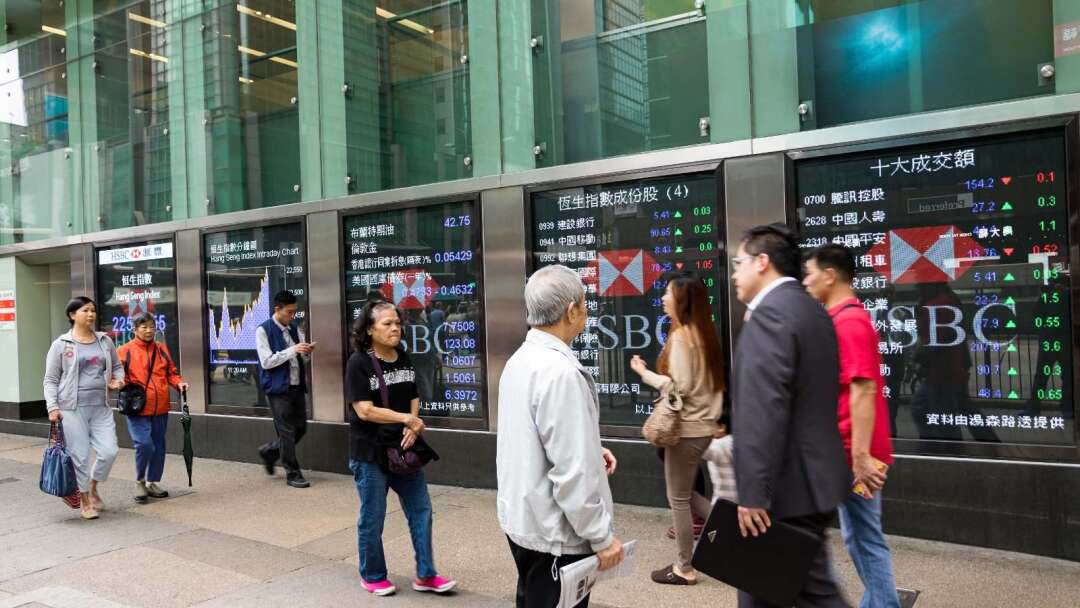
Recent statistics released by the Hong Kong Stock Exchange show that during a six-month observation period, IPO fundraising by companies related to the AI value chain reached approximately HK$97.9 billion, accounting for 55% of total new equity financing in the Hong Kong stock market during the same period.
The significance of this ratio does not lie in providing valuation support for any single entity, but in the clear tilt of Hong Kong's new listing market structure toward the artificial intelligence industry chain: from large model platforms, to applications such as autonomous driving and robotics, to chips, sensors, and advanced hardware, capital is beginning to re-identify AI assets from a full-stack perspective.
The 'AI value chain' is not a single thematic stock, but a three-tier industrial structure.
From the exchange's classification logic, the AI value chain broadly covers the platform layer, application layer, and infrastructure layer. The platform layer is represented by providers of general models and foundational capabilities; the application layer includes commercialization scenarios such as robotics, autonomous driving, enterprise solutions, and AI-driven drug discovery; the infrastructure layer includes semiconductor, computing hardware, sensors, and related manufacturing enterprises. Placing these three layers within the same capital framework means the market is no longer just chasing model narratives, but also beginning to focus on computing power, data, delivery, and industry-specific deployment synergies.
Revival of Hong Kong IPOs: A+H Listings and Tech Financing Drive Scale
According to multiple public statistical sources, the scale of new equity financing in the Hong Kong stock market in the first half of 2026 was approximately between HK$208 billion and HK$210 billion, a significant increase compared to the same period last year. Large-scale A+H projects contributed substantial volume, while AI-related companies strengthened the market's growth attributes.
For enterprises that already have a domestic listing foundation and wish to expand international institutional coverage, Hong Kong offers a pricing venue closer to global investors; for technology companies that are not yet profitable but have a clear technological roadmap, the specialist tech listing regime has also increased financing options.
This structural shift explains why, beyond the 'number of listings,' the market is increasingly focused on fundraising quality, cornerstone investor structure, and industry distribution. Large projects enhance liquidity and market attention, while technology projects expand the imagination of future growth. The combination of both is driving Hong Kong's evolution from a traditional hub for financial and consumer assets to a regional platform for hard tech financing.
From Large Models to Physical AI: Valuation Divergence Becomes the Norm
AI companies will not follow the same capital path simply because they belong to a popular sector. Large model companies are significantly affected by commercialization progress, inference costs, and free float structure; autonomous driving and embodied intelligence companies must prove mass production, customer collaboration, and safety capabilities; infrastructure companies depend more on product iteration, production capacity, and downstream capital expenditure. Market valuations will increasingly rely on cash flow trajectories and verifiable orders, rather than purely on technological labels.
In public markets, small free floats, lock-up expirations, and sentiment-driven trading can amplify price volatility in the short term. For investors, a high fundraising ratio at the industry level is not a buy signal; for companies, going public is not the end of technological capability, but the beginning of continuous scrutiny of disclosure quality, governance, and performance delivery.
Hong Kong's Next Step: Becoming a Market Connecting Technology and Long-Term Capital
Whether the热度 of AI financing can be sustained ultimately depends on Hong Kong's ability to continuously attract high-quality enterprises, international long-term capital, and industrial investors, and to establish a positive cycle among issuance mechanisms, liquidity, and research coverage. If platform, application, and infrastructure companies can achieve more effective capital allocation within the same market, Hong Kong has the opportunity to form an AI asset pricing ecosystem with Asian characteristics. The HK$97.9 billion figure is more like a阶段性 milestone: it indicates that capital is gathering, but also reminds the market that enthusiasm must be transformed into sustainable industrial returns.
FACT BOX
- Source: PR Times
- Category: Funding