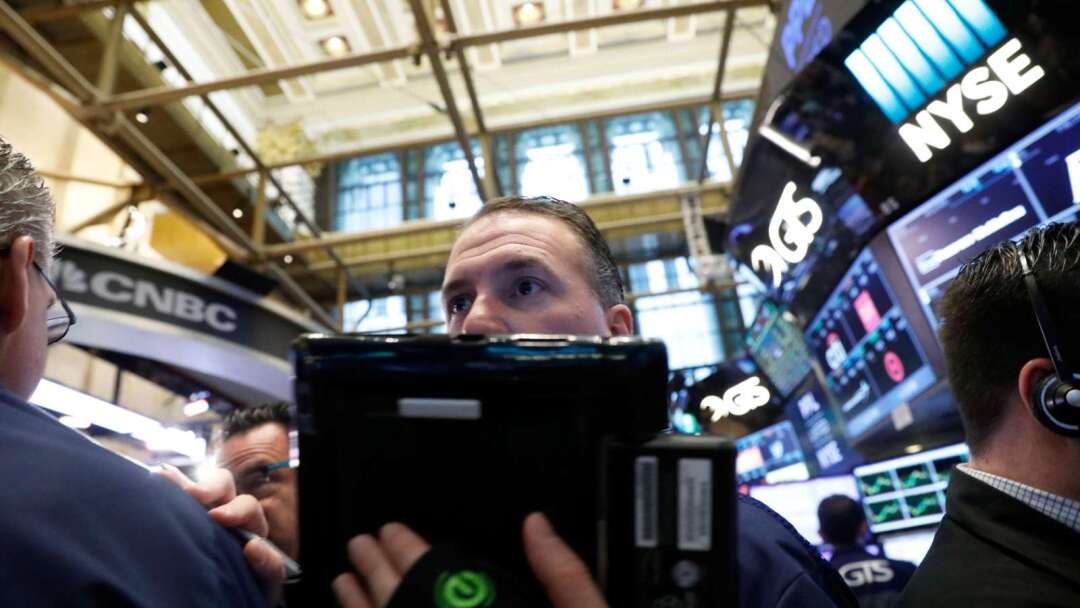
U.S. stocks traded mixed on Tuesday (28th), as the Dow Jones Industrial Average surged 537 points, or 1%, driven by positive corporate earnings. The S&P 500 rose 0.2%, while the tech-heavy Nasdaq Composite declined 0.2%, reflecting a continued global withdrawal of capital from semiconductor and technology stocks, signaling a shift in market sentiment.
Markets opened under heavy selling pressure, with both the S&P 500 and Nasdaq initially falling. The Nasdaq一度 dropped as much as 1.4%, but losses narrowed as large-cap tech and software stocks recovered late in the session.
According to Barron's Business Weekly, the Dow's strength was fueled by better-than-expected earnings from companies like Sherwin-Williams (SHW-US), along with strong performance in healthcare and consumer staples sectors. Statistics show that about 71% of S&P 500 components closed higher on Tuesday, with healthcare stocks rising 2.3%—the best-performing sector. Energy stocks fell 1.4%, the worst performer, while tech stocks continued to face selling pressure.
Despite a late rebound in the 'Magnificent Seven' and some software stocks, gains were insufficient to offset the broad sell-off in global semiconductor equities.
Asian markets led the decline. South Korea's KOSPI index plunged approximately 10.84%, with Samsung Electronics down 13.4% and SK Hynix falling 14.7%. SK Hynix's ADR (SKHY-US) also dropped 9% in U.S. trading.
Taiwan's market was similarly impacted, with the TAIEX index falling about 4.7%. Japan's semiconductor sector weakened as well, with Kioxia Holdings plunging 18% and Tokyo Electron down 11%.
Peter Boockvar, Chief Investment Officer at BFG Wealth Partners, stated that the current semiconductor correction is not isolated to one market but represents a 'global trade,' with capital worldwide simultaneously adjusting AI and semiconductor positions, causing tech stocks in Asia and the U.S. to move in tandem.
Meanwhile, the U.S. market capitalization rankings shifted.
Apple (AAPL-US) briefly surpassed Nvidia (NVDA-US) on Tuesday, reclaiming the title of the world's most valuable company with a market cap of approximately $5 trillion—the first time since May 2025. However, analysts believe AI themes will continue to drive Nvidia's long-term growth, suggesting the leadership battle between the two may persist.
On individual stocks, clinical research provider IQVIA Holdings (IQV-US) surged 13.9%, the best performer in the S&P 500, while SanDisk (SNDK-US) plunged 14.3%, the worst performer.
Tesla (TSLA-US) CEO Elon Musk's wealth has also sharply declined due to falling stock prices of his companies.
According to Barron's Business Weekly, Tesla's stock has fallen 17% cumulatively since its Q2 earnings release on July 22. SpaceX, since peaking after its June IPO, has seen its share price drop 45%.
Barron's estimates that Musk's combined equity value in Tesla and SpaceX has evaporated by approximately $660 billion—roughly equivalent to the combined wealth of Alphabet co-founders Larry Page and Sergey Brin, and Amazon founder Jeff Bezos.
Nonetheless, Musk's current net worth remains above $700 billion.
Analysts note that Musk's volatile wealth stems from the high valuations of his companies. Tesla currently trades at around 175 times its estimated 2026 earnings per share, far exceeding the Magnificent Seven average of about 24 times. Even after significant corrections, SpaceX's valuation remains around 40 times its estimated 2026 revenue, highlighting how high-growth stocks are inherently sensitive to market sentiment.
Markets now approach this week's most critical 'Super Earnings Week'.
Major companies including Microsoft (MSFT-US), Meta Platforms (META-US), Qualcomm (QCOM-US), Arm Holdings (ARM-US), Lam Research (LRCX-US), SK Hynix (SKHY-US), Starbucks (SBUX-US), Robinhood Markets (HOOD-US), Procter & Gamble (PG-US), GE Healthcare Technologies (GEHC-US), Fortinet (FTNT-US), and Vertiv Holdings (VRT-US) will report their latest earnings. Market focus will center on AI capital expenditures, corporate profits, and second-half outlooks.
Additionally, the Federal Reserve (Fed) will announce its latest interest rate decision.
According to the CME FedWatch Tool, the probability of the Federal Open Market Committee (FOMC) raising rates by 25 basis points, lifting the federal funds rate to 3.75%–4.00%, is less than one-third. Recent U.S. June inflation data came in below expectations, giving the Fed more policy flexibility. However, Wall Street generally expects that if inflation re-accelerates, a rate hike could still occur as early as September.
Analysts believe that while the recent global semiconductor correction has heightened market volatility, corporate earnings, AI investment outlooks, and Fed policy will remain the three key factors shaping the second-half trajectory of U.S. equities.
FACT BOX
- Source: PR Times
- Category: News
- Organizations: IQVIA Holdings (IQV-US) / SanDisk (SNDK-US) / Meta Platforms (META-US)