The U.S. Federal Reserve (Fed) decided on Wednesday (29th) to hold its benchmark interest rate steady, prompting a visible sigh of relief in financial markets. As a result, U.S. Treasury traders have reduced the market-implied probability of a rate hike in September to approximately 60%.
Although three officials supported raising rates to curb the resurgence of inflationary pressures—indicating internal hawkish sentiment—the interest rate swap market shows that post-decision, the odds of a September hike have declined from pre-announcement levels. Meanwhile, markets have fully priced in a rate hike by December.
In the U.S. Treasury market, the yield on the two-year note, most sensitive to Fed policy, fell 4 basis points to 4.24%, while the 30-year bond yield rose 4 basis points to 5.13%. The benchmark 10-year Treasury yield remained nearly flat at 4.61%. The U.S. dollar weakened in tandem.
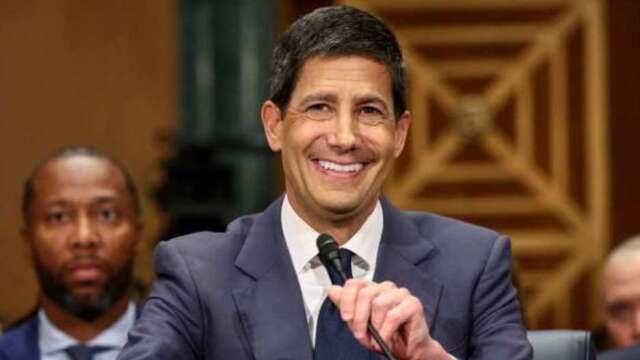
In the second policy statement since Kevin Warsh took over as chair, the Fed offered little guidance on its future path, reiterating only its commitment to price stability.
The Federal Open Market Committee (FOMC) voted 9 to 3 to maintain the federal funds rate target range at 3.5% to 3.75%. Dallas Fed President Lorie Logan, Cleveland Fed President Beth Hammack, and Minneapolis Fed President Neel Kashkari cast dissenting votes, advocating for a 25-basis-point rate hike.
Nick Timiraos, a Wall Street Journal reporter known as the "Fed whisperer," noted this was the first time since 2016 that the Fed saw three officials casting dissenting votes in the same direction during a single meeting.
"The market's immediate reaction was a sigh of relief that the Fed didn't hike," said Jack McIntyre, portfolio manager at Brandywine Global Investment Management. He added that the dissenting votes signal the FOMC remains hawkish overall: "Unless inflation and employment data clearly weaken before the September meeting, a rate hike in September remains possible."
Before the Fed's decision, markets had priced in about a 40% chance of a hike at the July meeting. The outcome now provides some clearer signals. Nonetheless, Warsh is clearly pushing reforms to break market reliance on forward guidance, leaving traders facing higher uncertainty than in the past.
At the post-meeting press conference, Warsh stated: "Market participants are learning to watch the 'ball,' not the 'referee.' Market prices will move in the direction and magnitude they deem appropriate. I believe this is a better change, and we're just getting started."
The $31 trillion U.S. Treasury market has suffered significant setbacks over the past month. Following U.S. President Trump's military action against Iran, which pushed up oil prices, Treasury yields rose more than 50 basis points in July. The 30-year bond yield is now within 10 basis points of a near 19-year high, reflecting investors' demand for higher compensation for holding long-dated bonds amid high inflation and massive Treasury issuance.
Real yields on inflation-adjusted Treasuries have also risen sharply, suggesting the market believes the Fed's neutral rate—the policy rate that neither stimulates nor restrains the economy—may now be higher than previously estimated.
McIntyre believes current yield levels imply that the 75 basis points of rate cuts the Fed delivered last year may need to be fully reversed. He forecasts the Fed will raise rates three times consecutively by 25 basis points each.
Ed Hutchings, Head of Rates at Aviva Investors, said: "Clearly, inflation, especially core inflation, remains at levels the Fed cannot accept. The longer rates stay unchanged, the more the Fed may ultimately have to act—possibly reversing all of the 2025 rate cuts, or even hiking further."
Wall Street's major banks remain deeply divided on the Fed's outlook. Before the July decision, Bank of America (BofA) predicted the Fed would hike three times starting in September, while Citigroup forecast three consecutive rate cuts beginning in October. JPMorgan Chase, Deutsche Bank, and BNP Paribas believe the next move will be a hike, while Goldman Sachs, Morgan Stanley, and TD Bank expect rate cuts.
FACT BOX
- Source: PR Times
- Category: News
- Organizations: Bank of America / Citigroup / JPMorgan Chase