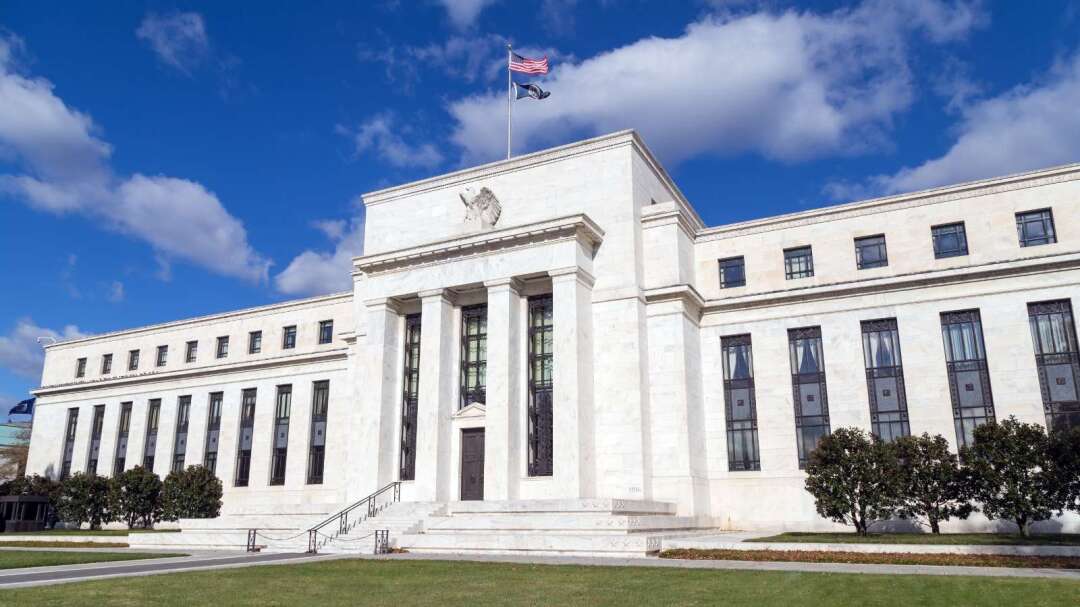
The U.S. Federal Reserve (Fed), after concluding its two-day policy meeting, announced its interest rate decision at 2:00 a.m. Taiwan time on Thursday (30th), maintaining the federal funds rate target range at 3.50–3.75%. Below is a comparison of the wording differences between the Fed’s July meeting statement and the previous June meeting statement.
Full Text of the July Policy Decision Statement
The Federal Open Market Committee (FOMC) approved the following statement by a vote of 9 to 3:
"The June statement was approved 12 to 0 to hold rates steady; in July, three dissenting votes were newly added."
The Committee decided to maintain the target range for the federal funds rate at 3.50% to 3.75%, in support of the Fed’s dual mandate. The Committee continues its policy of maintaining ample reserves in the banking system.
"The June statement read: ... The Committee reiterates its policy of maintaining ample reserves in the banking system."
Despite elevated uncertainty, partly stemming from Middle East conflicts, economic activity has expanded at a solid pace. Productivity growth and capital investment have both been strong. Employment growth has kept pace with labor force growth, and the unemployment rate has changed little.
Inflation remains elevated relative to the Committee’s 2% target, partly reflecting supply shocks pushing up prices in specific sectors such as energy. The Committee is committed to restoring price stability.
Dissenting members opposing the monetary policy action were Beth M. Hammack, Neel Kashkari, and Lorie Logan, who preferred raising the federal funds rate target range by 25 basis points (1 quarter-point) at this meeting.
"This final paragraph was absent in the June statement."
This policy statement marks the second interest rate decision statement issued since Kevin Warsh assumed the role of Fed Chair. Warsh previously pledged to significantly reform how the Fed communicates monetary policy expectations to markets.
The Fed’s June policy statement already showcased the communication style under Warsh’s leadership for the first time.
According to CNBC’s analysis, the June statement was approximately 130 words—far shorter than the typical 300+ words in previous meetings—and provided no forward guidance. It also omitted the voting results of FOMC members, both of which were standard elements in statements during former Chair Jerome Powell’s tenure.
With the addition of the final paragraph, the July statement increased to about 170 words, still maintaining a concise and straightforward style.
During his first press conference as Fed Chair in June, Warsh acknowledged the statement was "different," stating that forward guidance "is not suitable for the current policy environment."
Warsh said at the time: "The statement is shorter, simpler, and removes some phrasing used in the past. It simply aims to present the facts as we see them as directly as possible."
Previously, investors meticulously compared wording changes in Fed statements to detect subtle shifts in policymakers’ stances. However, since the June statement, markets have speculated whether the Fed will adopt a fixed, streamlined format or vary the statement structure at each meeting.
Some Wall Street institutions have even begun using artificial intelligence (AI) tools to analyze the content of Fed policy communications under Warsh’s leadership.
In June, Warsh announced the formation of multiple working groups to review key aspects of the Fed’s operations. Earlier this month, he stated that Peter Fisher, a professor at Washington University, and Mervyn King, former Governor of the Bank of England (BOE), are members of the working group tasked with reviewing the Fed’s communication mechanisms.
FACT BOX
- Source: PR Times
- Category: News
- Organizations: CNBC