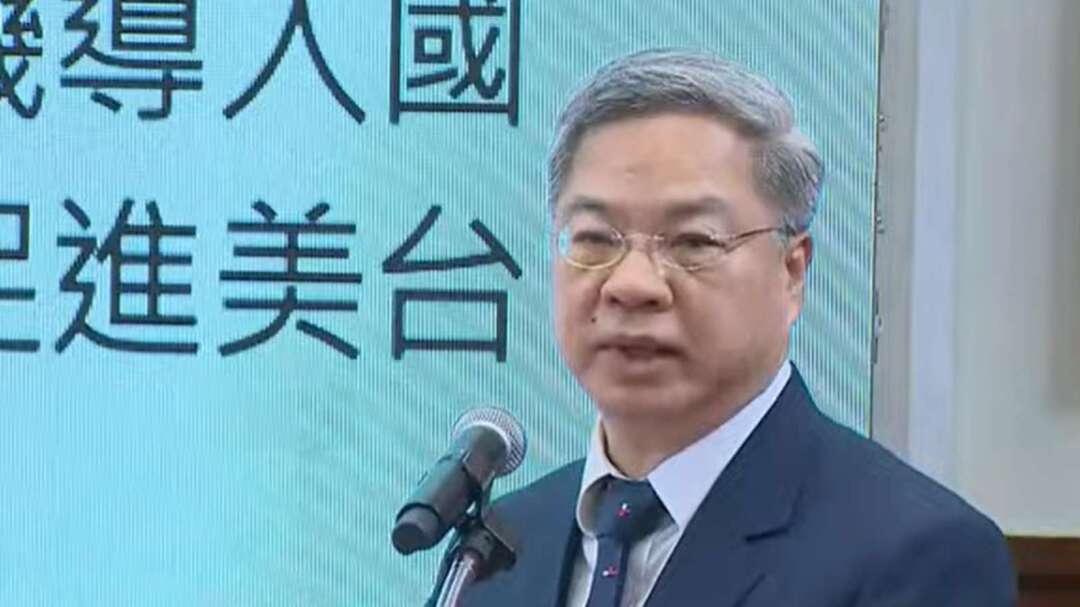
Economic Minister Kung Ming-hsin stated today (30th) that to strengthen national industrial resilience and align with international standards, the ministry is fully advancing cross-departmental resource integration. He clarified that the 5-year integrated plan does not involve additional wasteful budgeting, but rather systematically consolidates existing fragmented programs across departments. The plan centers on four main pillars—field development, procurement, technical support, and regulatory frameworks—and aims to use budget allocations to fill technological gaps in localization, ultimately achieving full domestic production. Regarding Papua New Guinea (PNG) natural gas supply, CPC will assess energy needs, respect existing long-term contracts, and flexibly utilize spot markets in coordination with the Ministry of Foreign Affairs to stabilize supply, which accounted for approximately 8% last year.
Kung spoke during a press briefing before the ministry's meeting, addressing issues including the forced labor goods import review mechanism, PNG natural gas response measures, automotive tax rates, drone-related integrated plan budgets, and the resumption of operations at Taiwanese factories affected by the Kumamoto earthquake.
On industrial policy, Kung emphasized that the 'integrated plan' does not entail additional wasteful spending, but rather a systematic consolidation of existing inter-departmental programs. The plan includes not only the construction of Phases I and II of the Asia Innovation Center, but also budgetary support for domestic firms to bridge localization technology gaps, aiming for full domestic capability in drones and projecting industrial value over the next 5 to 10 years.
On internationally watched human rights and labor issues, Kung explained that the Ministry of Economic Affairs has established a 'Forced Labor Goods Import Review Mechanism' with the Ministry of Labor. Under this mechanism, MOEA collects relevant cases or international intelligence, which is then reviewed by a committee led by the Ministry of Labor. If goods are determined to be produced by forced labor, customs will prohibit their import, thereby fulfilling Taiwan’s responsibility as a member of the global community. Regarding the recent case involving Giant, Kung noted that the company has actively communicated with U.S. CBP and complied with compensation requests, expressing optimism about the outcome, with the government committed to providing necessary assistance.
On stability in livelihood and traditional industries, Kung demonstrated a rigorous stance. Regarding PNG natural gas supply, he emphasized that CPC, after reviewing energy security, will respect existing long-term contracts while flexibly using the spot market in alignment with the Ministry of Foreign Affairs’ strategy to stabilize supply, which accounted for about 8% last year.
On the controversy surrounding automotive tariffs, Kung pointed out that the automotive supply chain is extremely long, and eliminating tariffs could halt assembly plants, significantly impacting domestic parts manufacturers. The number of affected workers could rise from 11,000 directly employed to as many as 82,000, which is precisely why international negotiations on automotive tariffs are so sensitive.
Finally, regarding the impact of the Kumamoto earthquake on Taiwanese manufacturers, Kung cited frontline reports indicating that TSMC’s JASM Plant 2, still under construction, was unaffected, while the mass production line at Plant 1 has paused inspections to facilitate recovery. The Economic Division in Kyushu has immediately assessed the status of personnel and production lines at local Taiwanese factories, with current reports being favorable. The government will provide necessary support as needed.
FACT BOX
- Source: PR Times
- Category: News