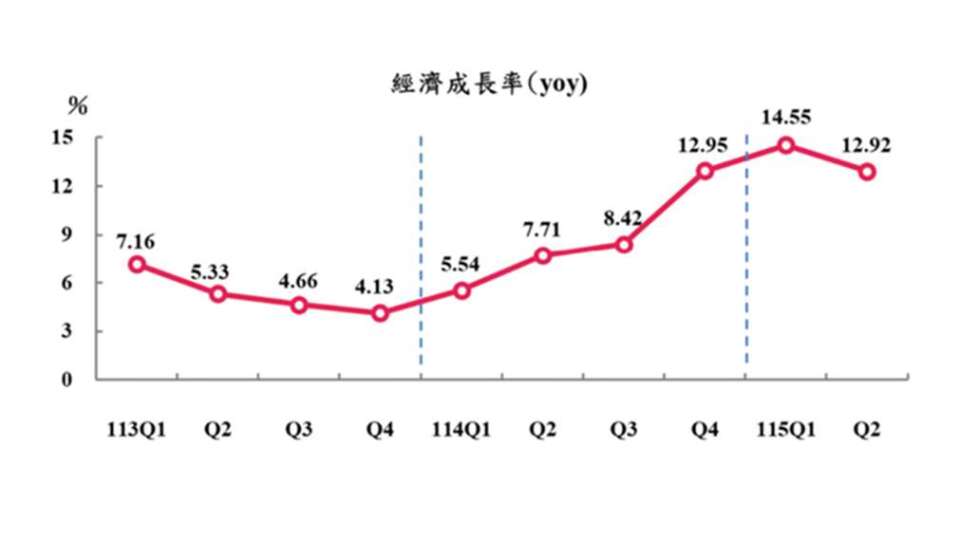
The Directorate-General of Budget, Accounting and Statistics (DGBAS) announced on June 31 that Taiwan's second-quarter real GDP growth rate was revised up to 12.92%, an increase of 2.09 percentage points from the May forecast. This marks the third consecutive quarter with growth exceeding 10%, primarily due to capital formation (including fixed investment and inventory changes), private consumption, and export growth outperforming expectations.
The DGBAS explained that the continuous expansion of application demands for artificial intelligence (AI), high-performance computing, and cloud services has boosted the shipment momentum of related electronic information products. Additionally, the price increase effect led to a 21.64% real growth in goods and services exports for the second quarter, up 0.69 percentage points from the forecast of 20.95%.
From the import perspective, the strong international division of labor, export, and investment-driven demand in the AI industry chain have prompted manufacturers to actively stock up on materials and purchase capital equipment. Coupled with a significant rise in international commodity prices, the second quarter saw a 18.27% real growth in goods and services imports, up 2.12 percentage points from the forecast of 16.15%.
After netting out exports and imports, net foreign demand contributed 5.93 percentage points to economic growth, down 0.72 percentage points.
On the domestic demand side, the DGBAS noted that the stock market's high performance has driven the wealth effect. Combined with the diminishing impact of automobile import tariffs and increased promotional efforts by businesses, car market sentiment has rebounded. Private consumption for the second quarter is estimated to have grown by 5.88% in real terms, up 1.90 percentage points from the forecast of 3.98%.
Of this, domestic consumption by Taiwanese grew by 5.52% in real terms, while overseas consumption by Taiwanese grew by 11.71%. Travel spending (classified as service imports) also increased simultaneously but did not affect overall GDP.
In terms of capital formation, sustained strong demand for emerging technology applications has continued to drive corporate investment. Second-quarter capital equipment imports in New Taiwan dollars increased by 52.65% year-on-year (with semiconductor equipment up 40.38% year-on-year), while domestic investment goods production increased by 40.19%. Investments in machinery, intellectual property, and construction projects also grew. However, transportation equipment investment decreased due to slower purchases of business-use compact cars and delayed aircraft deliveries. After accounting for inventory changes and excluding price factors, capital formation (including government, public, and private fixed investment and inventory changes) is estimated to have grown by 15.14% in real terms, a significant increase of 7.23 percentage points from the forecast of 7.91%, contributing 4.03 percentage points to economic growth.
The DGBAS pointed out that overall domestic demand growth in the second quarter reached 8.47%, contributing 7.00 percentage points to economic growth, an increase of 2.81 percentage points from the forecast.
FACT BOX
- Source: PR Times
- Category: Survey