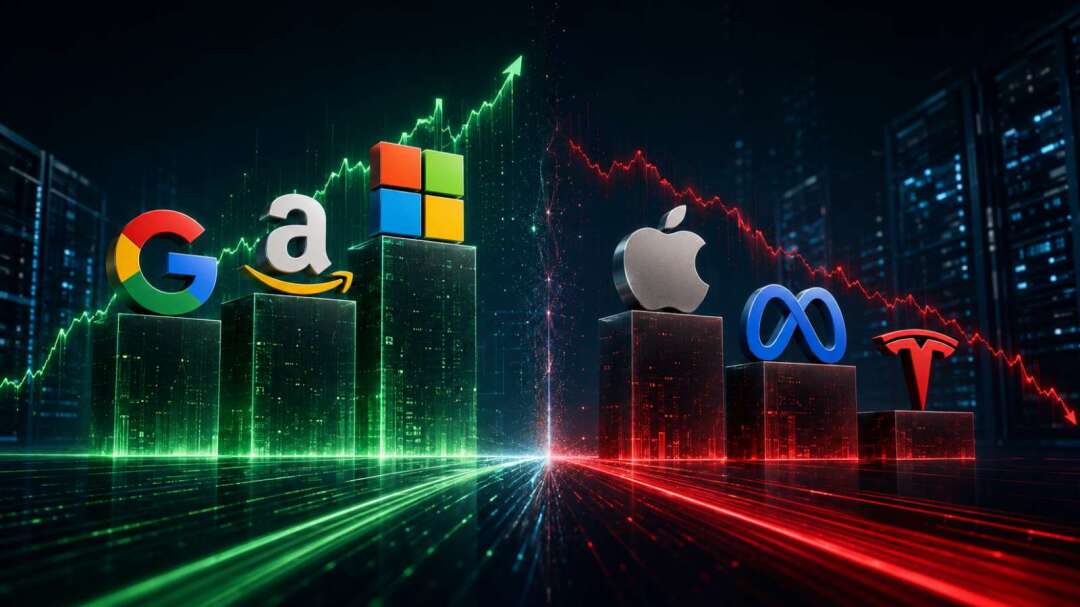
U.S. large-cap technology stocks showed a clear divergence in performance this week following earnings releases. Alphabet (GOOGL-US), Amazon (AMZN-US), and Microsoft (MSFT-US) collectively added nearly $1.5 trillion in market capitalization over the week; Apple (AAPL-US), Meta (META-US), and Tesla (TSLA-US) faced selling pressure. Investors are beginning to reassess each company's ability to generate returns from their artificial intelligence (AI) investments.
According to CNBC, by Friday, the market capitalizations of six tech giants that have reported earnings experienced significant volatility: three companies collectively gained nearly $1.5 trillion, while the other three lost approximately $442 billion, with the total net fluctuation approaching $2 trillion.
Market reactions indicate that investors are not uniformly bullish or bearish on AI spending, but are now selecting potential early winners based on cloud growth, monetization progress, and capital efficiency.
Microsoft's market cap increased by over $600 billion this week, while Amazon and Alphabet, Google's parent company, each added more than $400 billion. All three major cloud service providers delivered strong growth, leading the market to believe that the massive investments made in AI infrastructure over the past several years are gradually translating into real demand and revenue.
In contrast, Meta's stock plunged after its earnings report, with its market cap shrinking by approximately $85 billion this week. Investors remain uncertain when the company's AI infrastructure will generate clear external revenue streams.
Apple's market cap declined by over $350 billion due to memory shortages and weaker-than-expected guidance; Tesla's market cap shrank by about $7 billion as free cash flow turned negative and the company forecast increased spending.
Jason Greenberg, co-head of Jefferies' Global Technology, Media & Telecom Investment Banking, said tech giants' AI spending over the next 12 months is heading toward nearly $800 billion. The market is no longer questioning whether AI is being used or whether there is real demand for chips and computing power, but is now asking the critical question: "Will long-term profits be large enough to justify such massive investments?"
Amazon's earnings report became a key pillar of market confidence.
Amazon's second-quarter cloud division, Amazon Web Services (AWS), saw revenue grow 37% year-over-year, the fastest pace since 2021. Since AWS is Amazon's core platform handling most of its AI-related business, its growth rate is seen as a key indicator of demand for AI infrastructure.
Amazon also raised its 2026 capital expenditure forecast from $200 billion to $220 billion, signaling the company will continue expanding its AI infrastructure. Despite the further increase in spending, strong AWS growth alleviated market concerns about overinvestment ahead of demand, driving Amazon's stock to close up over 15% on Friday.
Forrester analyst Tracy Woo noted that AWS's high-speed growth shows Amazon's infrastructure investments are responding to market demand, not running far ahead of it. However, Amazon's stock performance this year has lagged relatively, rising only about 4% year-to-date.
Apple's situation is markedly different. Although the company's latest quarter revenue, profits, and iPhone sales all exceeded market expectations, it projected quarterly revenue growth of 9% to 11%, below analysts' expected 12%. Apple attributed its weaker guidance to supply constraints, particularly severe shortages of memory chips required for devices and rising competition for semiconductor manufacturing capacity.
Supply pressures have already prompted Apple to raise prices for Macs and iPads, and analysts also expect iPhones to follow with price hikes this year. Apple's stock closed down over 7% on Friday, but is still up about 23% year-to-date. Since Apple has not significantly expanded capital expenditures like other tech giants, it was previously seen by the market as an alternative investment avoiding the AI arms race.
The contrasting stock movements of Microsoft and Meta further highlight the changing market evaluation criteria. Microsoft surged 15% on Thursday, while Meta dropped 8%. Both companies are continuing to expand AI investments, but Microsoft has already demonstrated demand and monetization capabilities through its Azure cloud service, whereas Meta's current AI infrastructure primarily serves internal operations, and its external business model remains unclear.
Hendi Susanto, portfolio manager at Gabelli, said investor patience with Meta is wearing thin. Although CEO Zuckerberg stated the company is considering generating more external revenue from its AI infrastructure, the earnings call provided no clear progress, deepening market concerns.
In summary, this earnings season reflects that Wall Street's focus on AI has shifted from "whether it's worth investing" to "who can turn investments into profits fastest." Microsoft, Amazon, and Alphabet, with high-growth cloud businesses, are attracting capital; Meta and Apple are under pressure due to monetization visibility and supply constraints, and valuation gaps among tech giants are widening accordingly.
FACT BOX
- Source: PR Times
- Category: News
- Organizations: Alphabet / Amazon / Microsoft
- Products / services: Amazon Web Services (AWS) / Azure