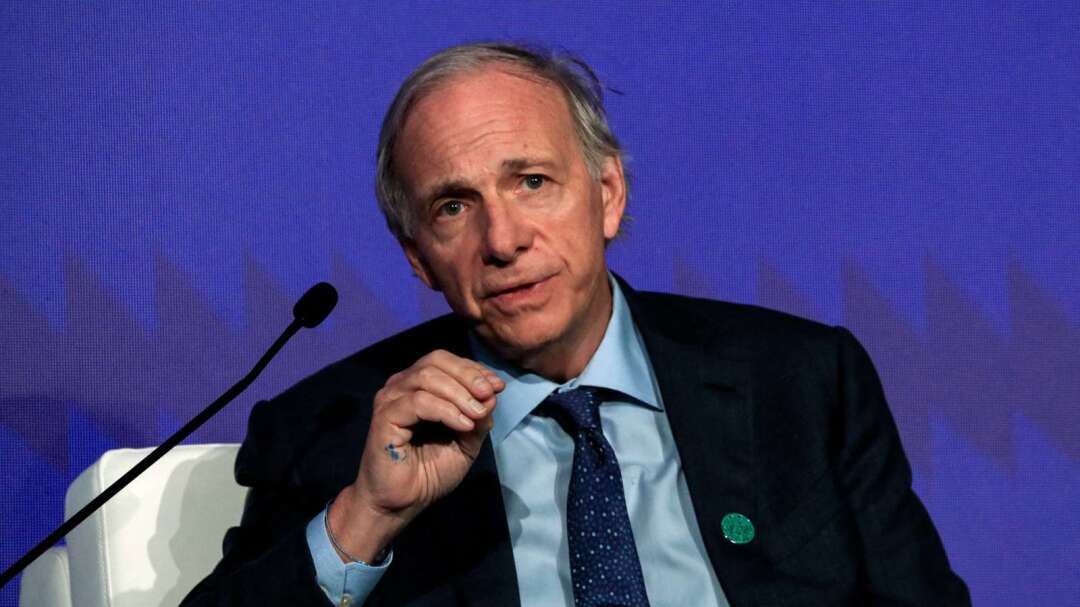
Ray Dalio, founder of Bridgewater Associates, recently issued a strong warning on the current market during a prominent business interview program, 'The Diary Of A CEO.' He stated bluntly that the artificial intelligence (AI) sector is exhibiting typical characteristics of an asset bubble, and this frenzy is occurring simultaneously with global debt imbalances, widening social wealth gaps, and geopolitical order instability—suggesting humanity may be entering the final stage of an 80-year 'Great Cycle.'
The macro investing legend, known for accurately predicting the 2008 financial crisis and delivering positive returns during the downturn, laid out a comprehensive analytical framework during a 90-minute interview with host Steven Bartlett, addressing topics such as the AI boom, asset allocation strategies, geopolitical risks, and intergenerational wealth disparities.
At the start of the program, the host referenced Jeremy Grantham, a legendary Wall Street investor, who claimed that 'we are currently experiencing the largest investment bubble in U.S. history.' Dalio immediately agreed, asserting that the market is indeed showing classic bubble signals.
He further explained the mechanism behind such bubbles: startups raising only tens of millions of dollars can be valued on paper at billions, instantly turning founders into 'paper billionaires,' while the actual capital deployed remains far below the stated valuation.
Dalio emphasized that this wealth is essentially 'unrealized'—it only becomes spendable cash upon sale. If rising interest rates or tax pressures force investors to seek liquidity, a wave of selling could trigger a sharp decline in asset prices, forcing companies to cut spending and ushering in a recession.
He also cautioned that AI-related companies have recently been aggressively raising capital through high-valuation share issuances, significantly increasing the number of shares in circulation. If leveraged positions face margin calls, it could become the final straw that collapses the market.
Dalio's 'Great Cycle' is a framework he developed through decades of studying historical economic rises and declines, with a cycle length roughly equivalent to a human lifespan—about 80 years. The previous cycle began in 1945, at the end of World War II.
He believes Western economies, including the U.S. and the U.K., are now in the decline phase of this cycle.
He attributes this downturn to three interrelated structural pressures:
First, government fiscal strain, where massive budget deficits make it difficult for policymakers to fulfill political promises. He cited the U.K., which has changed prime ministers seven times in the past seven years, as an example of how fiscal distress directly impacts political stability.
Second, the widening wealth gap behind capitalist prosperity, which intensifies polarization between left and right during economic downturns.
Third, the relative decline of U.S. global influence. The handling of the Red Sea crisis and Middle East conflicts, in his view, exemplifies how America's former ability to command global compliance with a single order has significantly weakened.
Avoid Cash: Dalio Favors Gold Over Bitcoin
Faced with the inevitability of cyclical volatility, Dalio's asset allocation advice is clear: diversify and move away from cash.
He noted that while most people keep money in banks for security, real returns are often dismal over the long term due to inflation. Even if nominal interest rates match inflation, after taxes, the net return is rarely favorable.
He recommends that typical investment portfolios include a mix of stocks, bonds, real estate, cash, gold, and Bitcoin, and within the 'hard currency' category, he clearly favors gold over Bitcoin.
Dalio revealed he holds only about 1% of his portfolio in Bitcoin, acknowledging its qualities—'cannot be infinitely printed and is difficult to hack technologically'—but stressed that within a 5% to 15% hedge allocation, he still prefers physical gold bars.
He explained that gold tends to perform well when stocks and bonds falter, making it a relatively reliable safe-haven asset. Although gold lost its monetary status after 1971, it remains the second-largest central bank reserve asset globally.
In contrast, Bitcoin faces risks from government regulation and technological threats like quantum computing. If governments decide to crack down, holders would have little recourse. He cited the example of Russia's assets being frozen under international sanctions, while its gold reserves remained untouched, illustrating the relative safety of physical precious metals during geopolitical conflicts.
Winners and Losers in the AI Era: Adaptability Is the True Edge
On AI's impact on the job market, Dalio likened it to the continuation of human technological evolution—just as tractors replaced manual labor, AI is now replacing human cognitive and judgment-based work.
He observed that the share of corporate revenue allocated to labor continues to decline, while capital owners capture an increasing portion, potentially worsening wealth inequality.
For younger generations' career choices, he advised against fixating on whether specific skills or majors will become obsolete. Instead, only a small minority—about 10% of the population—who can stand at the forefront of AI application and master these tools will maintain an advantage. Workers whose livelihoods depend purely on thinking and judgment face replacement risks.
He concluded that history shows the ones who ultimately succeed are not necessarily the smartest or hardest-working, but those with the 'greatest adaptability.' Learning how to continuously enhance one's value with tools like AI is the fundamental way to navigate change.
FACT BOX
- Source: PR Times
- Category: News