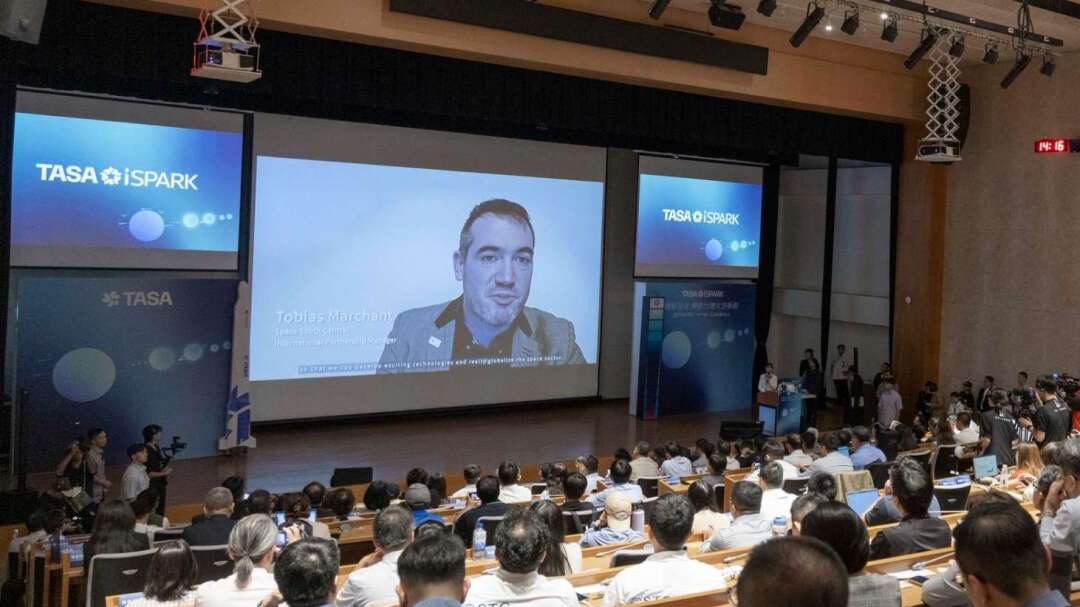
Premier Cho Jung-tai attended the opening ceremony of the TASA iSPARK Star Creation Base at National Yang Ming Chiao Tung University's Hsinchu campus on the 31st, stating that this marks Taiwan's first national-level space startup accelerator. The government has invested NT$71 billion (approximately USD 2.2 billion) into the third phase of the Long-Term Space Science and Technology Development Program, aiming to successfully nurture space industry unicorns, narrow the technological gap with advanced nations, and gradually realize the vision of 'competing in space,' showcasing Taiwan's robust capabilities in the global space sector.
Cho emphasized that the launch of TASA iSPARK represents a significant milestone in Taiwan's space industry development. President Lai Qing-te has proposed a national vision of exploring space and oceans, with next-generation communications as a key national strategy and a core component of the AI-driven New Ten Major Construction Projects and 13 Strategic Industries. The government is comprehensively supporting the emerging space industry through legal frameworks, organizational reforms, policy initiatives, and budgetary allocations. Taiwan's first Formosat-8 (Chilin) satellite was successfully launched, and the image quality transmitted far exceeded initial targets. More ambitious goals will be set moving forward.
Although Taiwan still lags behind leading countries in space technology, Cho expressed full confidence and determination. He cited Taiwan's national baseball team, which, despite starting later than teams from the U.S. and Japan, won a world championship—proving that with talent and hard work, success is achievable. Applying the same spirit, Taiwan can compete in space. Located within NYCU's campus, the iSPARK base will deepen industry-academia collaboration, and with policy and budget support, aims to incubate space unicorns.
Cho stressed that Taiwan already possesses strong technological capabilities and a solid economic foundation. The government will continue cultivating high-end tech talent and accelerate partnerships with the private sector to establish the space industry as a new pillar of Taiwan's technological advancement.
During his trip north that day, Cho also called the Ministry of Transportation to inquire about the progress of the expansion project for National Highway No. 1 between Yangmei and Toufen. With a budget exceeding NT$130 billion and an eight-year construction timeline, the project is now entering its final bidding stage. Once completed, it will more closely connect the Hsinchu Science Park, Zhunan Science Park, and Tongluo Science Park.
FACT BOX
- Source: PR Times
- Category: Event
- Products / services: TASA iSPARK