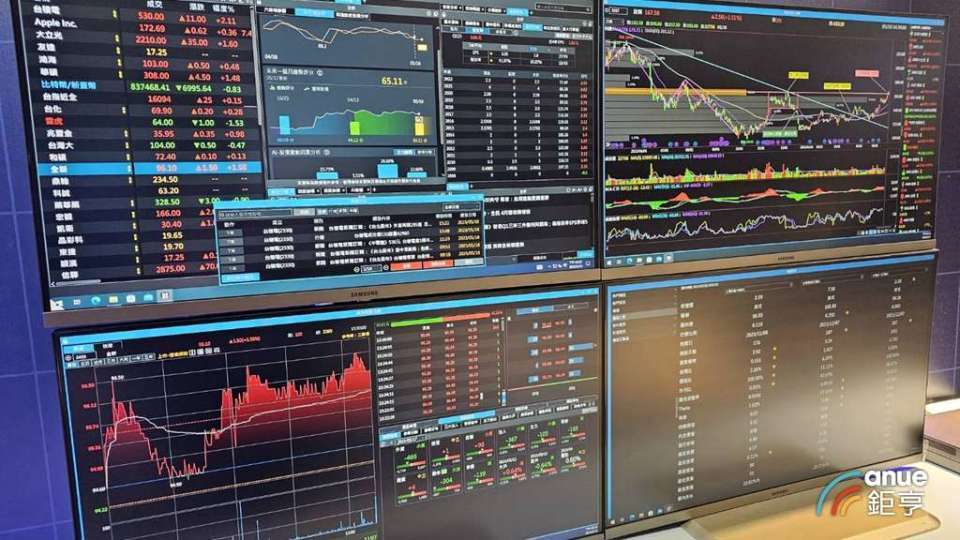
Taiwan's stock market delivered an epic rebound last Friday, soaring 3,186 points in a single session, which rapidly narrowed the week's decline to 535 points. The weekly candlestick formed a long lower shadow, providing technical support. Investors are now asking whether the low point of the correction has passed. Market traders believe this sell-off significantly reduced margin debt losses, helping to stabilize market positioning, although the overall market still faces resistance from both the monthly and quarterly moving averages—two critical levels for the bulls to overcome.
From a technical perspective, the single-day surge reversed two consecutive days of downward bending in the quarterly moving average and prevented the monthly line from crossing below the quarterly line, temporarily halting Taiwan's descent into a short-to-medium-term bearish phase. However, after Taiwan Index Futures dropped 1,077 points in overnight trading on Friday (July 31), closing at 42,650 and falling below the 43,000 mark, technical correction risks have re-emerged.
Foreign investors sold a net NT$82.5 billion last week, marking their sixth consecutive week of net selling. Conversely, domestic institutional investors continued their bullish stance, recording net buying for the 15th consecutive week, acting as the main driver of market support. Meanwhile, local dealers sold a net NT$8.97 billion during the correction, marking their fourth consecutive week of net selling, adding another layer of downward pressure.
Foreign investors' major net sell positions included Yuanta Taiwan Top 50 (0050-TW) at 234,000 contracts, Pegasus Taiwan Upgrade 50 (00403A-TW) at 211,000 contracts, Macronix (2337-TW) at 37,000 contracts, Quanta Computer (2382-TW) and Formosa Plastics (1301-TW) at 31,000 contracts each, Powerchip Technology (6770-TW) at 30,000 contracts, China Petroleum Chemical Development (1314-TW) at 23,000 contracts, and King Yuan Electronics (2449-TW) at 19,000 contracts.
Domestic institutions focused their buying on financial stocks, reflecting risk-averse sentiment. Key purchases included Pegasus Nuveen Taiwan Select (00980A-TW) at 27,000 contracts, Hua Nan Financial (2880-TW) at 19,000 contracts, Yuanta Taiwan Top 50 at 18,000 contracts, Yuanta Financial (2885-TW) and Mega Financial (2886-TW) each exceeding 16,000 contracts, China Trust Financial (2891-TW) at nearly 15,000 contracts, and Wistron (3231-TW) and Cathay Financial (2882-TW) each over 12,000 contracts.
Yuanta Securities Investment Trust stated that while the weekly-level correction has not yet ended from a medium-term perspective, rebounds often occur after 4–6 weeks of correction, suggesting the market may be approaching a short-term bottom.
SinoPac Investment Trust analyzed that July's pullback was essentially a convergence of positive price deviation. The larger the positive deviation, the more unstable the profitable positions become, and any significant trigger can lead to concentrated selling. As August is typically a month with fewer market catalysts, price movements are likely to be dominated by investor positioning.
The most significant event in August will be NVIDIA's earnings report on August 26. Whether cloud providers continue to raise capital expenditure plans and whether market profit forecasts for 2027–2028 can be revised upward will determine if the broader AI sector can reignite.
From a positioning perspective, the scale of foreign selling has been substantial. For the market to bottom and regain strength, foreign investors' sentiment will be crucial. Additionally, SinoPac highlighted ongoing oil price uncertainty due to unresolved Middle East tensions. Although former U.S. President Trump announced on August 1 the cancellation of planned attacks on Iran—contingent on a swift agreement—energy prices may ease. However, cost pass-through effects are spreading across industries, making inflation stickier than expected, posing a significant variable for global financial markets.
FACT BOX
- Source: PR Times
- Category: News
- Organizations: NVIDIA