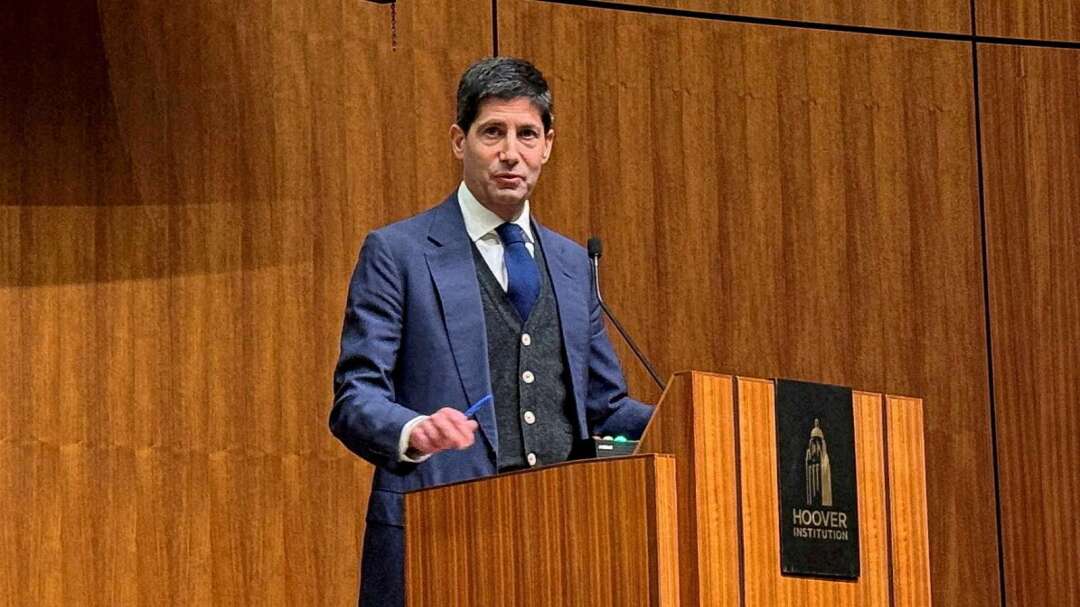
Bank of America's latest report indicates that Federal Reserve (Fed) Chair Kevin Warsh's first rate decision press conference failed to stabilize market expectations, triggering rising inflation expectations, a steepening Treasury yield curve, and a weaker dollar. If upcoming inflation data does not show a clear cooldown and the labor market remains resilient, a September rate hike could shift from a policy option to a necessary step to restore the Fed's credibility.
Following his first post-rate-decision press conference as Chair, market doubts about the Fed's resolve to combat inflation have not diminished but intensified.
In its latest research report, Bank of America Securities invoked Jared Diamond's 'Anna Karenina Principle,' arguing that successful monetary policy requires multiple conditions to align simultaneously, and the failure of just one element can derail the goal of price stability.
The Fed recently voted 9 to 3 to hold interest rates steady. However, Warsh, in his post-meeting press conference, failed to provide the clear guidance the market expected. Instead, he emphasized that tightening financial conditions in financial markets themselves have already substituted for the effects of a rate hike.
This statement immediately prompted market repricing: the Treasury yield curve steepened, long-term yields rose, breakeven inflation rates—reflecting inflation expectations—increased, and the dollar weakened.
Analysts point out that this is a classic market reaction when a central bank's credibility is questioned.
Bank of America stated bluntly in its report that if the inflation data released over the coming weeks fail to deliver sufficiently dovish signals, a September rate hike by the Fed may no longer be just a policy option, but a necessary step to restore market trust and repair policy credibility.
'Maradona Rate' Falters? Warsh's Communication Logic Sparks Debate
The core of market skepticism lies in whether Warsh is actively steering inflation or passively following market sentiment.
Warsh's signals during the press conference were contradictory: on one hand, he argued that financial markets have already tightened funding conditions spontaneously, making further rate hikes redundant; on the other, he hinted that the Fed might consider broader inflation indicators in the future and even use policy tools beyond rate hikes to address price pressures.
Bank of America analysts noted that the crux of the issue is that Warsh's policy logic significantly diverges from traditional central bank communication models.
Former Bank of England Governor Mervyn King's 'Maradona Theory of Interest' posits that central banks should guide markets to tighten financial conditions preemptively by setting clear policy expectations, thereby reducing the need for direct rate hikes.
However, Warsh's approach appears closer to an alternative model: allowing markets to adjust interest rates independently while the Fed merely observes and follows passively.
Bank of America warns this approach carries risks, as rising long-term yields do not necessarily indicate genuinely tighter financial conditions. They may instead reflect market reassessments of widening fiscal deficits, accelerating economic growth, rising risk premiums, or higher inflation expectations.
The post-meeting rise in real interest rates, widening breakeven inflation rates, and a persistently steepening yield curve indicate that investors are beginning to doubt the Fed's ability to uphold its long-term commitment to anchoring inflation.
Labor Market Resilience Intact, Strengthening Case for September Hike
Bank of America forecasts that U.S. nonfarm payrolls for July will increase by 80,000, slightly below market consensus. However, private-sector employment is projected to rise by 95,000, outpacing June's 49,000.
The report argues that the labor market shows no clear signs of deterioration, with initial jobless claims remaining at moderate levels and employment momentum continuing. Despite seasonal summer disruptions, weak ADP employment data, and slowing government hiring posing potential risks, the overall picture still supports an optimistic soft-landing scenario.
The unemployment rate is forecast to rise slightly from June's 4.2% to 4.3%, primarily due to a rebound in labor force participation. On wages, average hourly earnings are expected to rise 0.3% month-over-month in July, with the year-over-year rate holding around 3.5%, showing no significant signs of inflationary pressure.
Bank of America notes that if these employment figures are confirmed, nonfarm payrolls will have grown for five consecutive months, with private-sector monthly job gains averaging about 89,000 since 2026, further reducing downside risks to the labor market.
Against the backdrop of resilient employment and sticky inflation, Bank of America argues that the justification for the rate-cutting cycle initiated last year is gradually weakening, while the conditions for a September rate hike are increasingly favorable.
Credibility Defense: September Meeting as a Key Turning Point
Bank of America cites the 'Anna Karenina Principle' to illustrate the Fed's current predicament: success requires multiple necessary conditions to be met simultaneously, while failure can result from the absence of just one critical element.
In the context of monetary policy, achieving price stability depends not only on interest rate tools but also on central bank credibility, anchored inflation expectations, fiscal policy coordination, and overall financial system stability—any missing piece can undermine the entire framework.
Bank of America emphasizes that monetary policy is less a mathematical equation and more an art form reliant on precise communication. The core value of the Fed's press conference is to ensure the market correctly understands the central bank's policy reaction logic. Once this communication fails, uncertainty is transferred to the market, potentially leading to unanchored inflation expectations.
The analysis identifies the key flaw in Warsh's press conference as his failure to clearly articulate how the Fed will balance economic growth, employment performance, and inflation pressures going forward.
Bank of America believes the Fed still has an opportunity to regain control of the market narrative, and the upcoming September meeting will be a critical juncture.
If data at that time still fails to demonstrate a rapid decline in inflation toward target, a rate hike may no longer be just one option, but a necessary step for the Fed to rebuild credibility and reinforce its policy anchoring role.
FACT BOX
- Source: PR Times
- Category: Survey