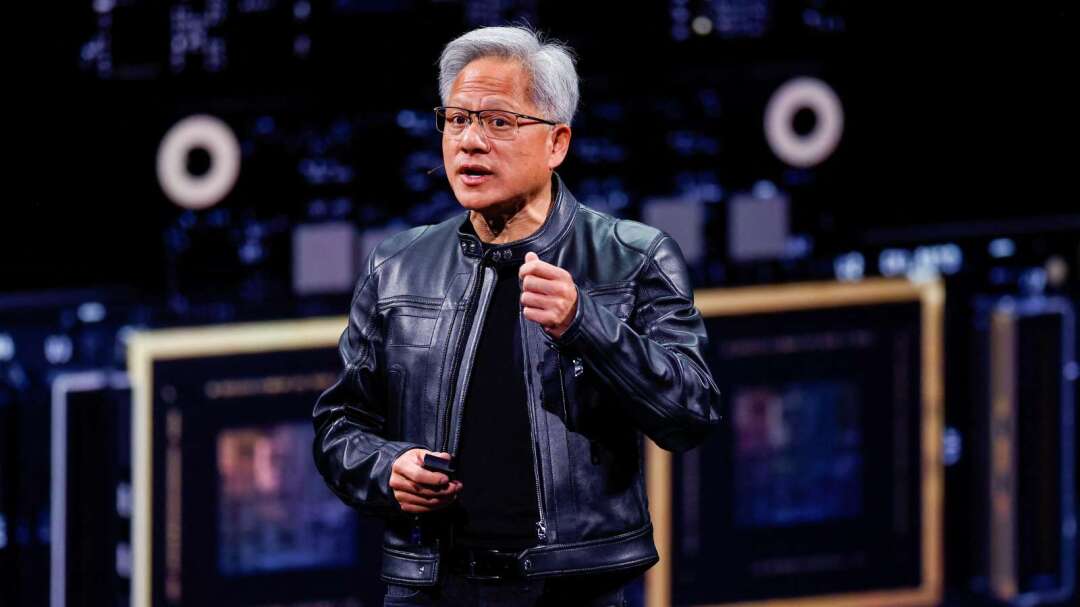
Another technology revolution led by chip giant Nvidia (NVDA-US) is accelerating and could become a major growth engine supporting the company's long-term stock performance. This revolution spans the autonomous driving and robotics markets, which Nvidia CEO Jensen Huang refers to as 'Physical AI'.
According to The Motley Fool, before ChatGPT sparked the generative AI wave, Nvidia's market capitalization was only about $386 billion. Today, benefiting from the AI boom, the company's market cap has surged more than tenfold, nearing the $5 trillion mark.
Now, 'Physical AI'—including autonomous vehicles and robotics technology—is seen as another crucial growth driver for the company.
Nvidia is best known for its GPUs and hardware supporting AI computing in data centers, but it has also established a significant competitive advantage in core components for the Physical AI domain.
Take the Jetson Thor supercomputer, for example, widely regarded as a leading product in AI inference and robotics simulation. Nvidia provides Jetson Thor to numerous robotics companies, including Boston Dynamics, Amazon (AMZN-US) Robotics, Caterpillar (CAT-US), and Deere (DE-US).
These companies use Jetson Thor to run applications like computer vision, helping robots and various equipment operate—such as supporting automated operations in Amazon warehouses or enabling Deere to operate smart agricultural machinery in farming environments.
Beyond robotics firms, Jetson Thor has also been adopted by tech companies like Meta (META-US) and OpenAI, as well as medical technology company Medtronic (MDT-US).
While the robotics market is growing rapidly, Nvidia's larger business opportunity appears to lie in the autonomous vehicle market. Foreign media suggest this industry may be approaching a critical turning point.
For instance, Waymo, under Alphabet (GOOGL-US), now provides over 500,000 paid autonomous ride-hailing trips weekly—more than double from a year ago—across 10 metropolitan areas. Tesla's (TSLA-US) Robotaxi service has also expanded to seven cities, with other autonomous driving companies accelerating their deployments.
Although Waymo and Tesla are not direct partners of Nvidia in autonomous driving, the company has partnered with several key players, including Uber (UBER-US), Toyota, Stellantis (FCAU-US), Mercedes-Benz, and China's two major EV manufacturers, BYD (002594-CN) and Geely Automobile (00175-HK).
Among these, Uber is Nvidia's most important partner in the automotive sector. The ride-hailing platform is collaborating with Nvidia and OEMs like Stellantis to deploy at least 5,000 Level 4 autonomous vehicles to build a Robotaxi fleet.
Nvidia's DRIVE AGX Hyperion autonomous driving platform will serve as the computing core for these vehicles and will also provide autonomous computing capabilities to the aforementioned partners.
The report notes that Nvidia's automotive business is still relatively small, generating $2.3 billion in revenue for the fiscal year 2026, a 39% increase from the previous year.
However, starting in fiscal year 2027, Nvidia will adjust its financial reporting structure, consolidating its three non-data center business units—gaming and AI PCs, professional visualization, and automotive and robotics—into a new Edge Computing business group.
As a result, investors will no longer be able to clearly track the standalone financial performance of the automotive business as before, though Nvidia will continue to update progress on related initiatives.
Analysts point out that while the current scale is small, the Physical AI business could generate substantial returns over the long term.
CEO Jensen Huang recently stated that the business is already running at an annualized revenue rate of $10 billion and is projected to grow to $100 billion within the next decade.
Why could this push Nvidia's market cap to $10 trillion?
Nvidia's market cap has already reached $5 trillion, yet its estimated P/E ratio is only 22x—lower than the average level of the S&P 500 index—despite Wall Street analysts forecasting an 82% revenue growth for the company this year.
This disconnect between valuation and growth reflects market concerns about semiconductor industry cyclicality and the risk of an AI bubble, as investors bet that Nvidia's record profits will eventually decline, or at least slow significantly.
The good news is that the Physical AI business offers Nvidia a crucial support pillar.
The report notes that since this is a business line independent of data centers and generative AI, and because transportation is a long-term, persistent demand, its cyclical volatility is expected to be lower.
Moreover, some of Nvidia's products in the autonomous driving segment, including the Drive AV software platform, adopt a Software-as-a-Service (SaaS) subscription model.
Since software companies typically command higher valuations than hardware firms, foreign media believe the valuation multiple for Nvidia's Physical AI business could significantly exceed that of its hardware operations.
If the Physical AI business achieves its $100 billion revenue target in the future, based on its growth rate and profitability, the business alone could be worth $2 trillion or more in market cap.
More importantly, the Physical AI business helps reduce Nvidia's reliance on the generative AI market cycle, enhancing the company's overall resilience to economic fluctuations and further boosting its overall valuation.
In other words, combined with the continued expansion of its core data center business, Nvidia reaching a $10 trillion market cap in the coming years is not unimaginable.
FACT BOX
- Source: PR Times
- Category: News
- Organizations: Meta / OpenAI / Waymo
- Products / services: Jetson Thor / DRIVE AGX Hyperion