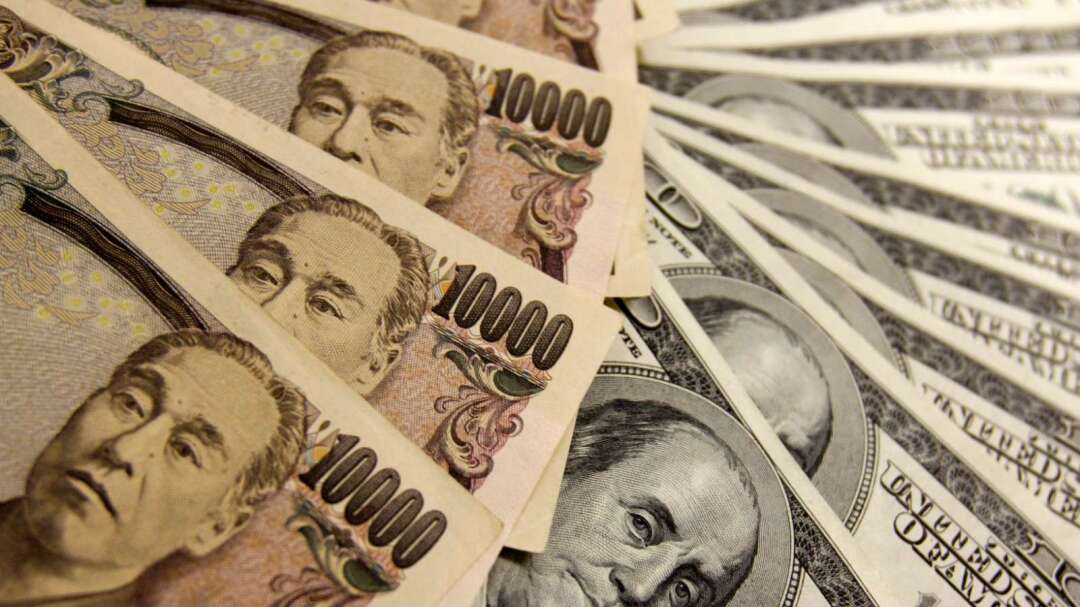
The United States and Japan recently launched a joint intervention in the foreign exchange market, driving the yen to rebound sharply from a 40-year low. The currency appreciated nearly 5% within a single week. However, the market generally believes that, given the still-significant interest rate divergence between the U.S. and Japan and the Bank of Japan’s lack of further tightening policies, this historically large-scale intervention may only temporarily stabilize the market and cannot fundamentally alter the yen’s prolonged weakness.
According to earlier reports, President Trump confirmed during a cabinet meeting that the U.S. participated in this joint intervention, describing it as a 'signal of friendship.'
Subsequently, Japan’s Ministry of Finance officially confirmed its joint market intervention with the U.S. Department of the Treasury. As a result, the yen recovered from its recent 40-year low of 164 yen per dollar to 156.8 yen, marking a weekly gain of nearly 5%. Market estimates suggest the intervention exceeded $50 billion.
Nonetheless, market reaction has been relatively muted. Although the yen surged in the short term, the exchange rate merely returned to levels seen around May this year, leaving its year-to-date gains against the dollar nearly flat. In contrast, when the Bank of Japan intervened alone in 2024, it successfully pushed the yen from 161 to 141, achieving a cumulative appreciation of about 12%. The rebound this time is clearly weaker.
Multiple foreign exchange strategists and economists point out that as long as the U.S.-Japan interest rate differential remains elevated, any official intervention can only delay depreciation, not change the fundamental weakness of the yen.
This joint intervention is also considered one of the largest coordinated actions ever between the U.S. and Japan. Media footage captured U.S. Treasury Secretary Scott Bessent’s desk, where a to-do list included 'Buy JPY 5–10 billion USD.' Additionally, the Financial Times, citing sources, reported that the Federal Reserve Bank of New York participated in the operation by selling euros and buying yen.
Notably, Japan has historically funded its interventions by selling its holdings of U.S. Treasuries, valued at approximately $1.1 trillion. However, with 30-year U.S. Treasury yields nearing 20-year highs, large-scale sales could further push up yields, thereby constraining Japan’s operational flexibility.
The intervention also triggered another market effect: the U.S. Dollar Index fell below 100 for the first time since June. Prior to formal intervention, both Secretary Bessent and Japanese Finance Minister Shunichi Suzuki attempted to strengthen the yen through public statements, but these efforts proved ineffective, ultimately prompting actual market action.
Market participants widely believe that the real driver of the yen’s trajectory remains the interest rate differential, not temporary official buying.
Robin Brooks stated that the yen’s weakness does not stem from speculative short-selling but from Japanese bond yields being far below fair value. He noted that capital naturally flows to higher-yielding markets, which is the fundamental reason behind the yen’s persistent pressure.
Currently, Japan’s policy rate stands at just 1%, while the U.S. Federal Reserve’s federal funds rate target range remains at 3.50%–3.75%, maintaining a clear interest rate gap.
After its policy meeting last week, the Bank of Japan decided to hold rates steady, further reinforcing market expectations that the interest rate gap will not narrow in the short term.
Chris Turner, economist at ING, pointed out that the Bank of Japan could still raise rates by 25 basis points at its September 18 policy meeting if it signals a clearer tightening stance. However, he emphasized that Japan’s consumer price index (CPI) is now approaching 2%, while the policy rate is only about 1%, below inflation, indicating that monetary policy remains relatively accommodative.
Louis Gave, CEO of Gavekal, shares a similar view. He stated that unless the Fed begins cutting rates or the Bank of Japan initiates a hiking cycle, the yen is unlikely to achieve a sustained appreciation. He also believes that the yen, like other Northeast Asian currencies, is currently 'severely undervalued'—a view echoed in Deutsche Bank’s (DB-US) July 'World Map' research report and The Economist’s latest Big Mac Index analysis.
From a fundamental perspective, Japan holds the largest current account surplus among G7 nations, theoretically supportive of its currency. However, over the past 15 years, the widespread yen carry trade—where investors borrow low-interest yen to invest in high-yield assets—has continuously weakened yen demand, preventing fundamental strengths from reflecting in exchange rate performance.
Analysts believe that unless the Bank of Japan takes more proactive monetary action, the effects of this U.S.-Japan joint intervention will gradually fade over time. With interest rate differentials and carry trades persisting, the yen’s structural weakness is unlikely to undergo a fundamental shift in the near term.
FACT BOX
- Source: PR Times
- Category: News
- Organizations: Gavekal