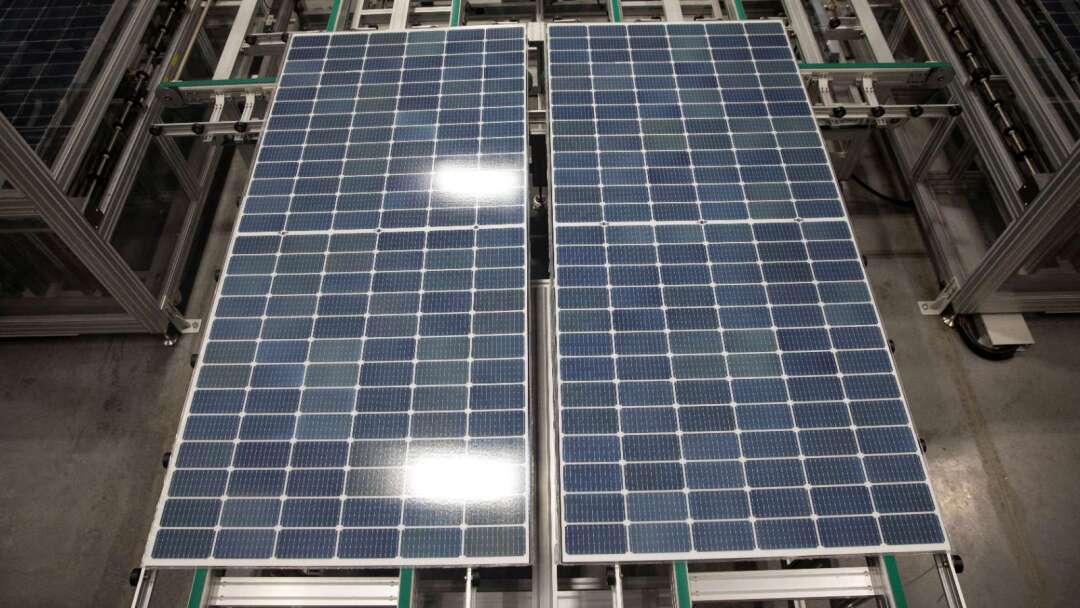
The Trump administration is preparing to set minimum prices and impose additional tariffs on imported polysilicon and related products. This move positions polysilicon—a critical raw material for both solar panels and semiconductors—as a strategic lever in the U.S. effort to counter China’s growing influence in artificial intelligence (AI) and energy sectors. The decision is expected to be announced later this month.
Reuters reported on Tuesday (April 4), citing four知情人士, that the Trump administration is considering a hybrid system combining minimum import prices with tariffs. The goal is to protect polysilicon plants in the U.S., such as Hemlock Semiconductor and Wacker Chemie’s U.S. operations, while curbing China’s expanding influence in the semiconductor supply chain.
Two of the sources said the plan may allow importers that invest in U.S. silicon wafer and solar cell production capacity to offset some of the cost increases caused by trade protection measures. China currently accounts for about 80% of global solar manufacturing capacity, and the U.S. hopes to use these policies to bring more segments of the supply chain back domestically.
Polysilicon impacts both the solar and semiconductor industries.
Polysilicon is a highly purified form of silicon and sits at the very top of the manufacturing supply chain for both semiconductors and solar power. Manufacturers first process polysilicon into silicon wafers, which are then turned into solar cells and assembled into solar panels. Semiconductor manufacturing also requires high-purity polysilicon.
According to data from the Semiconductor Industry Association (SIA), the chip industry accounts for only about 2.4% of global polysilicon demand. However, the massive consumption by the solar industry helps polysilicon producers maintain scale and capacity, indirectly supporting the supply of materials needed for chips.
Rhone Resch, Chief Strategy Officer at Japanese firm Toyo, which operates a solar panel factory near Houston, said the Trump administration is beginning to realize that developing domestic semiconductor manufacturing in the U.S. 'actually really needs solar.' Toyo also plans to invest $357 million to build a solar cell factory nearby.
The U.S. Department of Commerce has conducted a year-long investigation into whether polysilicon imports threaten national security. Trump is expected to act under Section 232 of the Trade Expansion Act, which authorizes the president to restrict imports deemed a threat to national security. Trump has previously used this authority to impose tariffs on steel, automobiles, and semiconductors.
The Chinese Embassy in the U.S. criticized the investigation, urging the U.S. to promptly end Section 232 tariffs and address concerns through equal dialogue. The White House said it would not comment before Trump’s decision, and the Commerce Department did not respond to inquiries.
Protecting domestic production could drive up energy and technology costs.
Since Congress introduced tax incentives in 2022, the U.S. solar manufacturing industry has expanded rapidly. However, most investments have focused on the final stage of panel assembly, while silicon wafers and solar cells remain heavily reliant on imports due to the longer investment and construction timelines required for upstream facilities.
Companies including Toyo, Qcells, Corning (GLW-US), Canadian Solar (CSIQ-US), and T1 Energy (TE-US) have announced or begun investing in upstream supply chain capacity to meet federal clean energy subsidy requirements for domestic manufacturing.
Still, the Solar Energy Manufacturing Coalition and bipartisan lawmakers warn that until U.S. capacity for polysilicon, silicon wafers, and solar cells can meet market demand, non-Chinese suppliers such as South Korea’s OCI Holdings and Wacker Chemie, which operates plants in Malaysia and Germany, will remain essential.
Hemlock operates a plant in Michigan and is a joint venture between Corning and Japan’s Shin-Etsu Semiconductor. Wacker Chemie runs a production site in Tennessee. Wacker emphasized that 'without polysilicon, it would be impossible to develop the downstream industries of silicon wafers, chips, and solar cells.'
The Trump administration must balance fostering domestic production with controlling costs. As the data center construction boom drives up demand for chips and electricity, solar developers and semiconductor buyers warn that tariffs could increase the cost of solar farms and push up prices for consumer electronics and automobiles.
Martin Pochtaruk, CEO of solar panel manufacturer Heliene, said that if costs rise too high, some energy projects may be forced to cancel. He described the solar industry as potentially becoming 'collateral damage' in this trade investigation, which is primarily focused on chip security.
FACT BOX
- Source: PR Times
- Category: News
- Organizations: Hemlock Semiconductor / Wacker Chemie / Toyo