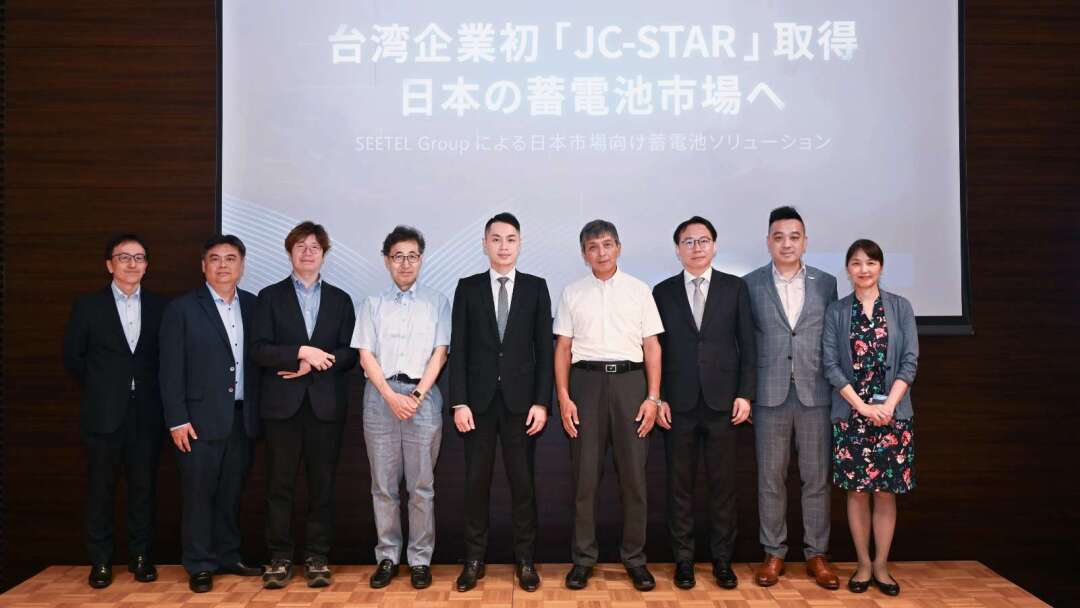
To deepen its footprint in the Japanese market and promote international energy technology collaboration, Xite Energy (7740-TW) recently held the 'Taiwan-Japan Energy Technology Exchange Forum' in Tokyo. The event brought together representatives from Japan's energy industry, academia, and multiple enterprises, underscoring the Japanese market's high regard for Taiwan's energy storage technology.
At the forum, Xite Energy shared its experience in obtaining Japan's dual JC-STAR cybersecurity certification. Leveraging its in-house R&D and local manufacturing achievements, the company emphasized its technical capabilities to drive Taiwan-Japan cooperation.
AI Data Centers Spark New Demand for Energy Storage; Cybersecurity Certification Becomes the 'Decisive Threshold'
The forum featured Mr. Hiroshi Okamoto, former Vice President of Tokyo Electric Power Company, a long-time contributor to Japan's power system planning, technological development, and smart grid construction. His participation added significant symbolic value to the Taiwan-Japan exchange.
Okamoto pointed out that with the rapid increase of AI data centers in Japan, large-scale energy storage systems can not only respond to sharp fluctuations in power load and enhance supply stability but also deeply integrate with regional renewable energy. By storing electricity during grid congestion and releasing it during peak demand, such systems help reduce the need for massive infrastructure investments in grid expansion.
As large-scale energy storage, data centers, and distributed energy accelerate integration, cybersecurity has become a core issue for smart grids. Professor Hideo Ishii of Waseda University warned that if a system is hacked and numerous devices are simultaneously controlled, it could lead to widespread blackouts. Therefore, cybersecurity and international standards are fundamental conditions for ensuring the stable operation of VPPs and maintaining grid resilience.
Japanese energy expert Kei Muratani further stated that JC-STAR certification has become a critical 'entry ticket' for Japan's energy storage market. It directly affects whether equipment can receive government subsidies, project financing, and grid connection eligibility, and is crucial for entering high-security application areas such as data centers. Muratani said, 'Companies that obtain JC-STAR certification first will undoubtedly establish an overwhelming competitive advantage.'
Integrating Hardware and Software to Meet Japan's High Standards: Xite Energy Ushers in Its 'Age of Exploration'
In response to Japan's strict requirements for cybersecurity protection and intelligent dispatch, Xite Energy's self-developed GridLink EMS (Energy Management System) successfully obtained Japan's JC-STAR certification this year, establishing a core technological foundation for entering the Japanese market. Zhang Jiecheng, Deputy General Manager of Chenxi Precision, a subsidiary of Xite Energy, shared that the company has established a complete production traceability system and, by combining its in-house BMS design capability with the logistical advantages of Taichung Port, comprehensively meets Japan's high-specification requirements.
Kanae Matsushima, General Manager of Hexi New Energy GK, Xite Energy's subsidiary responsible for Japanese market expansion, detailed the company's market entry strategy and chaired the 'Taiwan-Japan Smart Grid Future Forum—Utility 3.0,' connecting industry and academic experts from both countries to advance from technical exchange to concrete market collaboration.
The forum also invited Professor Chih-Lin Hu from the Department of Communication Engineering at National Central University to represent Taiwan's academic community and share insights on smart energy development. In a post-event interview, Professor Hu stated that Japan's mature experience in energy technology, industrial standards, and institutional development is worthy of Taiwan's reference. Taiwan, on the other hand, holds advantages in energy storage equipment manufacturing, digital technology, system integration, and flexible production. By combining Japan's local needs and market experience, Taiwanese enterprises have the potential to further penetrate Japan's energy storage and smart grid supply chains.
Xite Energy's CEO, Po-Hsun Chen, led the team to Tokyo, marking another milestone in its overseas expansion. 2024 marks Xite Energy's official entry into its 'Age of Exploration.' In the first half of the year, the company successfully entered the North American market and secured orders, becoming Taiwan's first energy storage brand to obtain Japan's dual JC-STAR certification—a key milestone.
At the opening ceremony, Chen stated that hosting the forum in Tokyo not only allows Xite Energy to share its practical experience but also aims to deeply understand local Japanese needs, integrate Taiwan's market-proven technologies and achievements with local resources, and promote more concrete Taiwan-Japan collaborations. He expressed hope for continued deepening of exchanges between Taiwan and Japan's energy industries, working together to create a new energy future.
Operationally, Xite Energy achieved another record in the first half of 2026, with consolidated revenue reaching NT$7.274 billion, a year-on-year increase of 1,508% compared to NT$452 million in the same period last year, scaling up revenue by 16 times. This reflects the strong momentum from ongoing large-scale energy storage projects and battery module shipments.
In addition to outstanding domestic performance, the company has also seen continuous success in overseas markets. Xite Energy's first demonstration project in Japan officially went online in July 2024 and is expected to contribute to overseas revenue in the second half of the year. As its international footprint in North America, Southeast Asia, and Japan matures, the proportion of overseas revenue is expected to gradually increase, providing new momentum for the next phase of operational growth.
FACT BOX
- Source: PR Times
- Category: Event
- Products / services: GridLink EMS