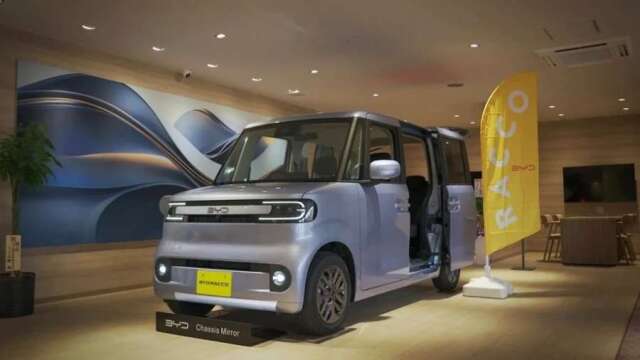
BYD (002594-CN) has created a major ripple in the Japanese market with a single compact electric vehicle, profoundly disrupting the country's deeply entrenched automotive ecosystem.
BYD's pure-electric K-Car model 'RACCO' (Haita), specially designed for the Japanese market, has been officially launched and quickly attracted significant attention from the local public. According to reports from Nikkei Chinese Edition, RACCO's order volume has already exceeded 700 units.
Data from Japan's Automobile Sales Association also shows that the vehicle reached 125 registrations within just four days of its launch. Market rumors suggest that first-week order bookings may have reached as high as 5,000 units—effectively achieving half of BYD's annual sales target in Japan.
Faced with this powerful disruption, Suzuki Motor Corporation, the dominant player in Japan's K-Car market, has publicly acknowledged BYD as a 'huge threat.' Even Alice Hirose, the Japanese national idol serving as a brand ambassador, has faced criticism for allegedly undermining the interests of domestic automakers.
K-Cars, a lifeline of Japan's automotive market, have long occupied 30% to 40% of new car sales due to their compact size, ease of parking, high traffic efficiency, and special tax incentives.
However, Japanese consumers have long lacked access to premium experiences. BYD's RACCO precisely targets this core gap, offering a price of around one million New Taiwan Dollars, yet breaking conventions by including high-end features rarely seen in its class—such as sensor-activated sliding doors, NFC smartphone keys, battery preheating, V2L vehicle-to-load external power discharge, and heated seats and steering wheel. With highly competitive value for money, it has won enthusiastic support from Japanese consumers.
This overseas success has also prompted reflection on traffic congestion and parking difficulties in China's first-tier cities. Although major Chinese cities face severe congestion and high parking costs, compact premium commuter vehicles theoretically have room to thrive. However, due to the lack of Japan's unique policy incentives and the prevailing mindset that cars must serve both long-distance travel and family-wide outings, micro-cars are unlikely to achieve widespread adoption in the short term.
Nevertheless, as urban transportation pressure intensifies, China's market may soon welcome a wave of premium micro-cars tailored to local road conditions.
The explosive popularity of BYD's RACCO in Japan is, at its core, a global validation of China's new-energy vehicle technological strength. It not only breaks the long-standing monopoly of Japanese automakers in the domestic K-Car market but also accumulates invaluable experience for Chinese automakers expanding overseas.
As the strategy of 'global validation, domestic re-import' advances, the breakout effect triggered by RACCO is becoming a shining starting point for China's automotive industry迈向 globalization.
FACT BOX
- Source: PR Times
- Category: New Product