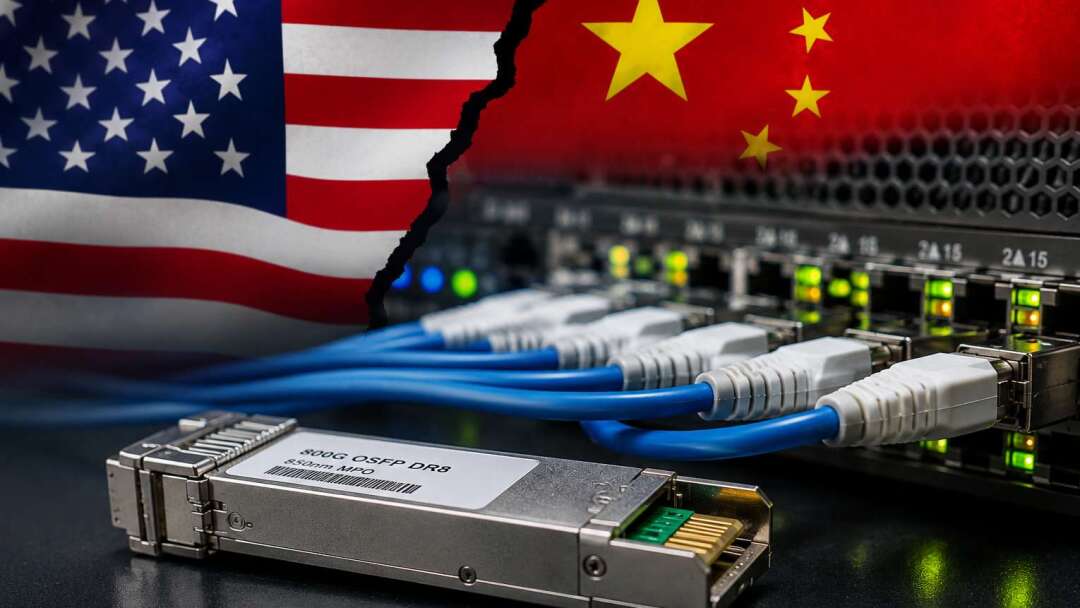
The United States is considering restrictions on imports of Chinese optical transceivers (Optical Transceiver), sparking market optimism that US suppliers could benefit. However, a new study warns that if such a ban is implemented hastily, it could instead disrupt the development of US AI infrastructure.
According to foreign media reports on Wednesday (5th), Counterpoint Research cautioned that Chinese manufacturers currently control around 60% to two-thirds of global optical transceiver supply capacity. Western manufacturers will not be able to fully close this production gap for at least the next one to two years.
Neil Shah, analyst at Counterpoint, stated that if the US rapidly implements a ban, it could lead to shortages of optical modules, further driving up deployment costs, delaying the rollout of AI data centers, and even reducing the efficiency of expensive AI accelerators—potentially impacting thousands of billions of dollars in capital expenditure plans by major tech companies.
Shah noted that hyperscale cloud providers such as AWS, Microsoft (MSFT-US), Meta (META-US), and Alphabet (GOOG-US) may all face delays in building AI clusters. He warned that sudden regulatory changes could create hardware supply bottlenecks, slowing down AI deployment across global cloud service providers.
Earlier, Reuters reported on Tuesday that the Trump administration is considering banning new Chinese data center optical transceivers from entering the US, aiming for the Federal Communications Commission (FCC) to announce related regulations by year-end. However, the measure remains under discussion and could still be modified or even canceled.
Optical transceivers are critical components in AI data centers, converting electrical signals into optical signals for high-speed data transmission over fiber optics. As demand for 400G, 800G, and 1.6T high-speed interconnects in AI superclusters grows rapidly, their importance continues to rise.
Raymond James pointed out that if the ban is formally implemented, US-listed companies Coherent (COHR-US) and Applied Optoelectronics (AAOI-US) would be the most direct beneficiaries, potentially capturing orders previously directed to Chinese suppliers.
However, Counterpoint believes US suppliers cannot quickly take over. Shah explained that Coherent and Lumentum currently lack sufficient cleanroom production capacity, automated packaging capabilities, and high-volume yield rates, making it difficult to match the massive shipment volumes of China’s Innolight and Eoptolink within the next 12 to 24 months.
Following the Reuters report, Chinese optical communication stocks fell sharply on Wednesday. New Hengsheng (Eoptolink), whose overseas revenue accounts for 96%, saw its Shenzhen share price drop as much as 10%. Innolight’s A-shares and Hong Kong shares both declined about 8%; Suzhou TFC Optical Communications dropped around 6%, and the CSI 300 Telecom Services Index fell 9% at one point.
In contrast, US optical communication stocks surged the previous trading day. Coherent rose 11%, Applied Optoelectronics jumped 18%, and Lumentum gained 7%, as markets anticipated Western suppliers gaining more orders if the ban takes effect.
Counterpoint statistics show that Innolight currently accounts for about 27% of global data center optical transceiver revenue, with 62% of its revenue in Q1 2026 coming from the US market. Overall, Chinese manufacturers hold approximately 60% of the global data center optical transceiver revenue.
Although Innolight and Eoptolink have shifted some production capacity to Thailand in recent years to mitigate risks from US-China trade policies, it remains unclear whether products made in Thailand would be exempt from future bans.
Shah emphasized that simply dividing the global optical transceiver market into 'China' and 'non-China' systems does not reflect actual industry operations. He noted that the global AI industry still heavily relies on Chinese vendors’ large-scale manufacturing capabilities.
Moreover, the supply chain itself is highly globalized. Chinese optical module makers still rely on digital signal processors (DSPs) from Broadcom (AVGO-US) and Marvell (MRVL-US), and laser components from Lumentum, Coherent, and Mitsubishi Electric. Therefore, any ban could disrupt the entire integrated global supply chain rather than cleanly splitting the market in two.
Notably, Innolight completed a roughly $6.8 billion IPO in Hong Kong on July 30, marking the largest IPO in Hong Kong this year. The company was also added to the US Department of Defense’s list of firms allegedly linked to the Chinese military in June.
Currently, Applied Optoelectronics is one of the few major suppliers with domestic US production capability and is continuously expanding capacity. Raymond James also believes that if Coherent decides to invest, it has the potential to establish optical transceiver production lines in the US.
FACT BOX
- Source: PR Times
- Category: Survey
- Organizations: Counterpoint Research / AWS / Microsoft