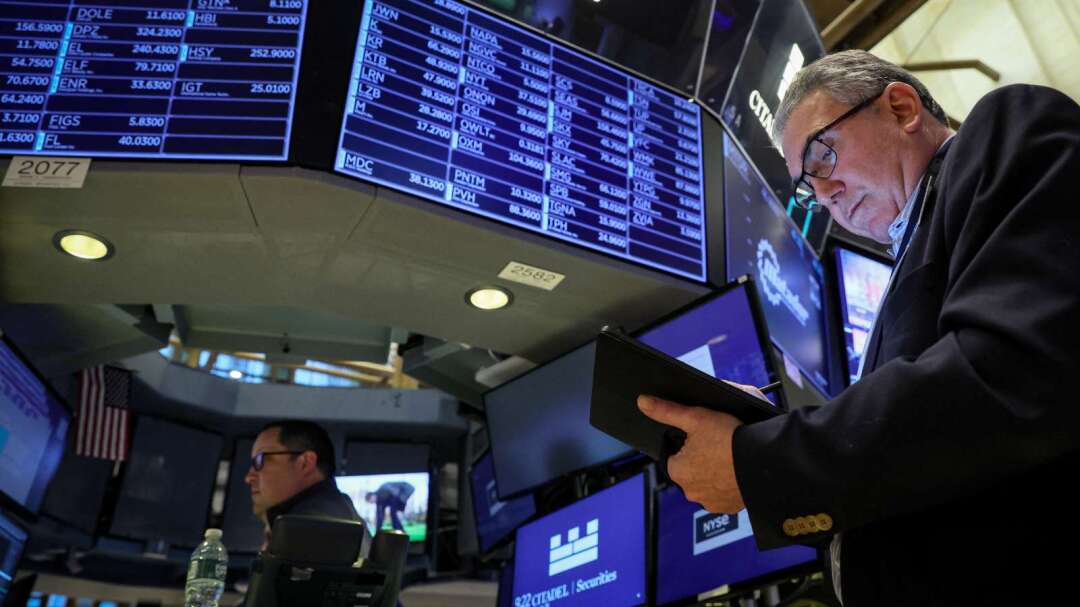
U.S. stock indices opened mixed on Thursday (6th), with tech stock selloff dragging down markets amid rising oil prices and inflation concerns pushing up Treasury yields. Investors turned cautious ahead of Friday’s (7th) crucial non-farm payrolls report. The Dow Jones Industrial Average rose at the open, the S&P 500 index traded near flat, while the Nasdaq Composite opened lower.
Western Digital (WDC-US) and SanDisk (SNDK-US) both delivered strong earnings and outlooks, yet failed to meet elevated market expectations, sending their shares sharply lower—further pressuring tech and memory stocks.
Markets are also closely monitoring Middle East developments, as Iran and Oman push for reopening shipping routes through the Strait of Hormuz. However, uncertainty remains over whether the U.S. and Iran can reach a broader, lasting peace agreement. Beyond geopolitics, Wall Street is digesting fresh corporate earnings and awaiting employment data for clues on the Federal Reserve’s future rate path.
At time of writing, the Dow Jones Industrial Average was up nearly 260 points or 0.5%, the Nasdaq Composite Index down 220 points or 0.8%, the S&P 500 Index down nearly 0.2%, and the Philadelphia Semiconductor Index down 1.4%. TSMC ADR fell nearly 0.8%.
U.S. stock index futures traded mixed on Thursday, with weakening tech stocks weighing on sentiment. Investors are watching for progress in U.S.-Iran talks while awaiting Friday’s U.S. non-farm payrolls report for clues on the Fed’s future interest rate policy.
S&P 500 futures were slightly up 0.1%, while Nasdaq 100 futures fell 0.6%. Memory giants SanDisk (SNDK-US) and Western Digital (WDC-US) plunged 9% and 15% respectively in pre-market trading after reporting earnings—despite both companies posting strong results and forecasts that still fell short of sky-high market expectations.
Alphabet (GOOGL-US), Google’s parent company, turned negative after earlier gains. The firm has begun marketing its latest tranche of U.S. investment-grade bonds, reportedly raising up to $25 billion. Alphabet recently raised its 2026 spending forecast to as much as $205 billion, sparking investor concerns about whether massive AI investments will deliver sufficient returns. This bond sale will test market appetite following July’s AI bond sell-off.
Markets are also tracking the lifting of trading restrictions on approximately $101 billion worth of SpaceX (SPCX-US) shares on Thursday. After plunging 14% following its first post-listing quarterly report, SpaceX shares recovered somewhat in pre-market trading on Thursday.
With tech stock rallies pausing, investors are reassessing valuations of AI-related stocks. Friday’s non-farm payrolls report is expected to show a strengthening U.S. labor market. Stronger-than-expected data could heighten Fed rate hike expectations; weaker data might lead traders to scale back tightening bets, easing upward pressure on Treasury yields.
Karl Steiner, Head of Analysis at SEB, said markets are currently on hold ahead of clearer positive developments in the Middle East and the release of key U.S. employment data. Bloomberg strategist Skylar Montgomery Koning noted the report could trigger polarized reactions: two consecutive weak reports would strengthen dovish arguments, while strong data might suggest June’s softness was an anomaly, prompting earlier rate hike pricing.
In commodities, Brent crude held near $80 per barrel. Iran said it reached an agreement with Oman on a proposal for Hormuz Strait shipping lanes, increasing the likelihood of restored energy transport through this critical waterway. However, no sustainable deal has been reached between the U.S. and Iran to ease inflation and Treasury yield pressures. President Trump said Wednesday he would watch how negotiations unfold.
The dollar extended Wednesday’s losses, while U.S. Treasury prices declined. The 10-year Treasury yield rose 3 basis points to 4.64%. Gold briefly surged 1.4%, temporarily breaking above $4,300 per ounce.
In European markets, the Dow Jones Europe 600 Index rose 0.4%. Deutsche Telekom jumped 6.7% after announcing an expanded share buyback program. UK drinks giant Diageo rose 7% after forecasting a return to business growth. Siemens fell 4.6% as its upgraded outlook failed to meet investor expectations.
Asian semiconductor stocks also came under heavy selling pressure. South Korea’s Kospi Index, seen as a barometer for AI trades, plunged 4.6%, led by SK Hynix and Samsung Electronics.
As of around 9 p.m. Taipei time Thursday (6th):
Dow Jones Industrial Average up 263.24 points or 0.49%, temporarily at 54,349.12
Nasdaq Composite Index down 221.55 points or 0.83%, temporarily at 26,363.44
S&P 500 Index down 12.97 points or 0.17%, temporarily at 7,723.55
Philadelphia Semiconductor Index down 170.38 points or 1.40%, temporarily at 12,008.88
TSMC ADR down 0.76% to $414.00 per share
10-year Treasury yield dipped to 4.61%
NY Light Crude down 0.03% to $75.20 per barrel
Brent Crude up 0.24% to $79.64 per barrel
Gold up 0.36% to $4,320.70 per ounce
DXY up to 99.78
Key stocks:
Peloton (PTON-US) down 12.19% early session to $5.73 per share
Peloton Interactive plunged nearly 14% pre-market. Its Q4 EPS of $0.13 met expectations, and revenue beat forecasts. However, active paying subscribers declined 8.8% year-on-year, sparking investor concerns over user attrition.
Moderna (MRNA-US) up 2.16% early session to $57.47 per share
Moderna rose 4% pre-market. The U.S. FDA approved its mRNA flu vaccine mFlusiva for adults aged 50+, marking new progress for its vaccine pipeline.
SanDisk (SNDK-US) down 10.50% early session to $1,208.63 per share
SanDisk fell 10% pre-market as its Q1 revenue outlook failed to meet heightened investor expectations. The company forecast revenue between $10.3 billion and $10.8 billion, below the $10.47 billion consensus. Despite Q4 revenue and profit beating estimates, the stock continued to fall.
Today’s key economic data:
U.S. initial jobless claims last week: 199K vs. 203K expected, prior 198K
U.S. continuing jobless claims: 1.801M vs. 1.79M expected, prior 1.777M
Wall Street analysis:
Media reports indicate Fed Chair Wachter is prepared to raise rates at the September meeting if upcoming inflation data spikes sharply and market expectations for rising Bitcoin costs increase. Sources say while Wachter has proposed shrinking the central bank’s $6.7 trillion balance sheet to tighten monetary policy, interest rates remain the primary tool and will be used at upcoming meetings if needed.
FACT BOX
- Source: PR Times
- Category: News
- Organizations: SanDisk / Alphabet / Google