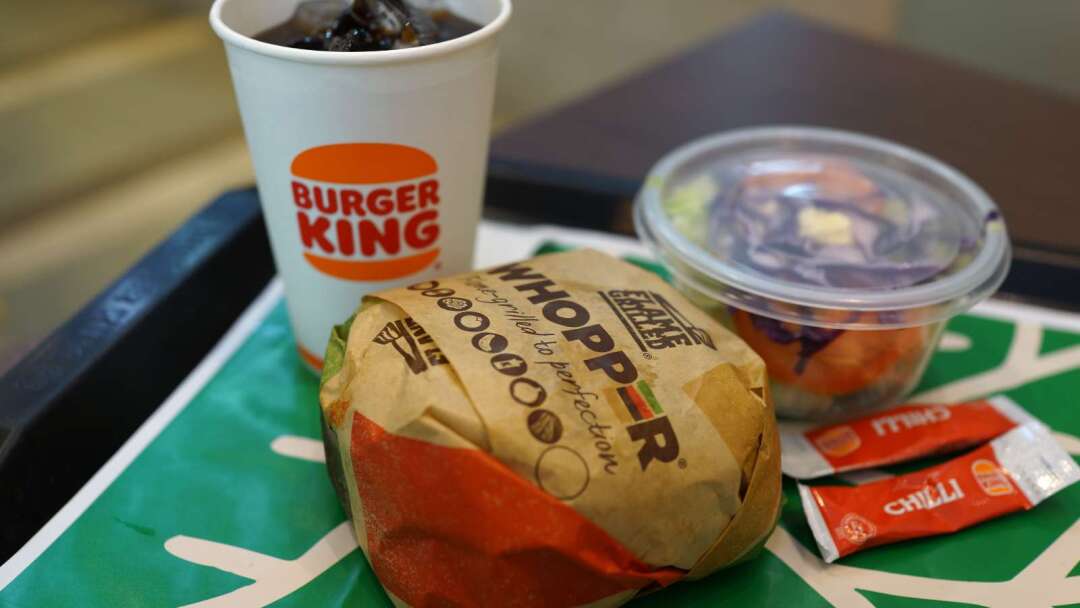
The ranking of the US fast-food burger market has shifted significantly, with Burger King surpassing Wendy's after six years to reclaim the title of the second-largest hamburger chain in the United States based on total system-wide sales. The two companies have followed divergent performance paths over the past two years: Burger King has been executing a turnaround of its US business, achieving five consecutive quarters of positive same-store sales growth. In contrast, Wendy's has now recorded six consecutive quarters of declining same-store sales in the US, with the most recent quarter seeing a sharp 7% drop.
Restaurant Brands International (QSR-US), Burger King’s parent company, announced its second-quarter results on Thursday, reporting an 8.5% increase in US same-store sales—continuing its streak of positive growth over the past five quarters. In contrast, Wendy's released its latest quarterly results on Friday, showing a 7% decline in US same-store sales, reflecting ongoing pressure on customer traffic and brand appeal.
McDonald's (MCD-US) remains the largest burger chain in the US, maintaining a substantial lead over its two closest competitors. While McDonald's only reports global system-wide sales, making direct comparisons difficult, Barclays data indicates that McDonald's held approximately 48% of the US burger market share in 2024, compared to Wendy's 11.4% and Burger King's 10%.
This means that although Burger King has reclaimed the number two spot, McDonald's continues to dominate the US burger market. Meanwhile, the competition between second and third place has been reshuffled due to the contrasting performance trajectories of the two chains in recent years.
Wendy's initially surpassed Burger King to become the second-largest burger chain in the US, partly due to the success of its nationwide breakfast menu rollout. However, maintaining that position has proven difficult, as the brand has faced weakening performance, leadership turnover, and increasing consumer sensitivity to pricing.
Both Burger King and Wendy's were impacted by the COVID-19 pandemic and subsequent supply chain disruptions. During the pandemic, the restaurant industry grappled with unstable supply chains and soaring ingredient costs. Later, consumers pushed back against menu price increases, and overall dining expenditures slowed.
During this period, the strategic approaches of the two companies began to diverge.
Restaurant Brands International announced a turnaround plan for Burger King’s US operations at the end of 2022. At the time, Burger King was experiencing a prolonged period of weak sales. The company focused its strategy on improving food quality, increasing marketing investment, and renovating store locations, aiming to restore brand appeal and boost customer traffic.
This turnaround strategy has gradually reflected in Burger King’s recent performance. US same-store sales have grown for five consecutive quarters, reaching 8.5% in the latest quarter, indicating renewed growth momentum and serving as a key factor in its ability to overtake Wendy's.
In contrast, Wendy's has struggled with frequent changes in senior leadership, occurring amid an environment where US consumers are increasingly price-sensitive and beef costs continue to rise.
Longtime CEO Todd Penegor retired from Wendy's in 2024, concluding an eight-year tenure. He was succeeded by Kirk Tanner, a senior executive from PepsiCo (PEP-US). However, Tanner served for just over a year before leaving to take a leadership role at Hershey (HSY-US).
Following Tanner’s departure, CFO Ken Cook briefly served as interim CEO until May of this year, when the company appointed Bob Wright, former CEO of Potbelly, as permanent CEO.
During Friday’s earnings call, Wright acknowledged that the challenges Wendy's has faced in recent years are now directly impacting its financial performance. He stated that the company’s quality differentiation has weakened, its value proposition has eroded, and it has failed to consistently deliver the experience customers expect from Wendy's.
Wright noted that these issues have affected customer traffic and placed pressure on the restaurant operating model—the core of the entire business.
Wendy's 7% decline in US same-store sales for the latest quarter not only signifies being overtaken by Burger King in market ranking but also highlights deeper issues related to brand positioning, customer traffic, and restaurant profitability.
Notably, Wendy's is now preparing to launch its own turnaround initiative aimed at reigniting sales and improving brand performance. This means that while Burger King has successfully reclaimed the position of the second-largest burger chain in the US, it cannot afford to be complacent.
For Burger King, the current rebound confirms that its turnaround strategy is yielding initial results. However, to maintain its second-place standing, it must continue enhancing food quality, store environments, and customer experience, while preserving perceived product value in a market where price sensitivity is rising.
For Wendy's, the new management team must rebuild brand differentiation in an environment where consumers prioritize affordability and pricing. The company previously surpassed Burger King through its national breakfast strategy; now, it must identify the next core strategy capable of driving customer traffic and sales growth.
Overall, the top three格局 of the US burger chain market is undergoing realignment. McDonald's maintains a commanding lead with about 48% market share, while the rivalry between Burger King and Wendy's enters a new phase. Burger King has regained second place through five consecutive quarters of same-store sales growth, while Wendy's begins its turnaround after six straight quarters of decline. The effectiveness of each company’s upcoming strategies will determine whether this 'No. 2 burger chain' battle is rewritten once again.
FACT BOX
- Source: PR Times
- Category: News
- Organizations: Restaurant Brands International / McDonald's / Wendy's