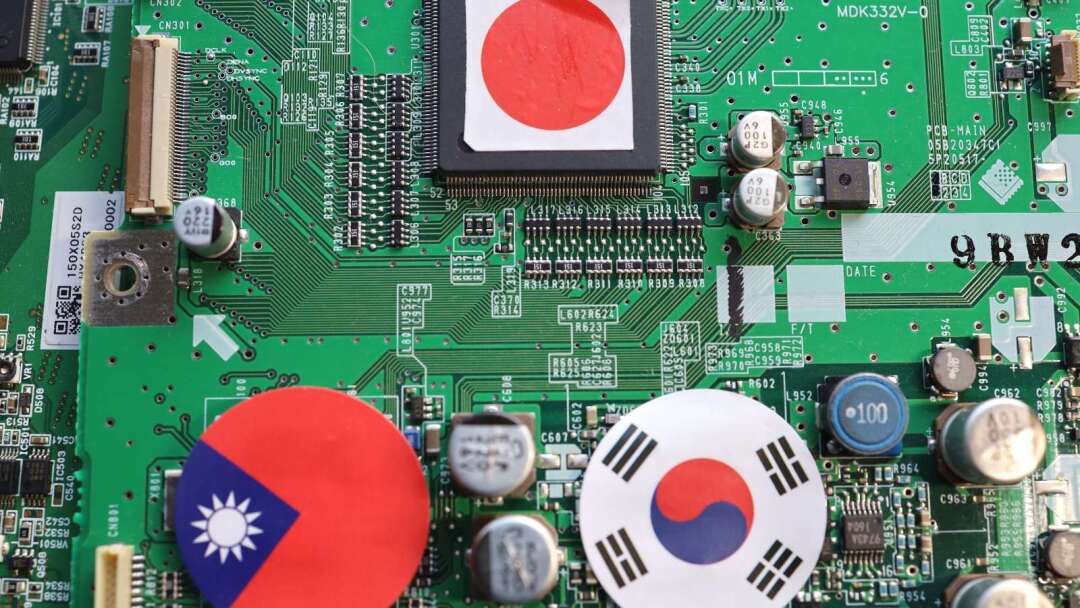
Latest data shows that in dollar terms, South Korea’s exports in the first half of 2024 reached $496.3 billion, Taiwan’s $416.6 billion, both surpassing Japan’s $384.4 billion for the first time. Japan recorded nearly 10% year-on-year growth, but Taiwan and South Korea both surged nearly 50%, marking a historic shift in East Asia’s export landscape.
According to reports from international media including CNBC and the Nikkei, the root of this gap lies in the positioning of 'end products' in the AI semiconductor sector. TSMC dominates advanced process foundry, while Samsung and SK Hynix monopolize HBM. South Korea’s semiconductor exports reached $149 billion in the first half of 2024 (about 30% of total exports), and Taiwan’s reached $133.2 billion. South Korea surpassed Japan’s full-year IC export value for 2025 in just six months, while Japan’s IC exports amounted to only $21.2 billion, just 5% of its total exports.
The reports point out that although Japan holds dominant market shares in equipment and materials through companies like Tokyo Electron, Advantest, and Lasertec, its semiconductor manufacturing equipment exports reached $15 billion in the first half—higher than Taiwan’s $3.5 billion and South Korea’s $5.2 billion—its benefits from AI-related capital expenditure remain indirect.
Kenji Maruyama, Deputy Head of Research at Mitsubishi UFJ Research & Consulting, noted that component and equipment exports cannot replicate the high growth rates seen in end-use chips.
Moreover, structural industrial weaknesses are compounded by a double blow from exchange rates and energy. The yen remains at multi-decade lows, suppressing the dollar-denominated export figures.
Japan’s June imports surged 25.4% year-on-year, the highest since November 2022. Oil import costs spiked 59.3%, driven by rising oil prices due to Middle East tensions. Japan, which relies on imports for 87% of its energy, is hit hardest. While exports remain an economic driver, the 'high exports, even higher imports' dynamic is worsening trade conditions.
Japan’s decline in rankings is no accident of the AI wave. From the 1970s to the 1990s, it consistently ranked third globally in exports. In the 21st century, it was first overtaken by mainland China, then by the Netherlands and Hong Kong, falling to sixth place globally last year.
From textiles and steel to automobiles and electronics, Japan once precisely supplied the world’s mid-tier products, but has fallen behind in 'end products' like smartphones, AI servers, and advanced chips.
At its core, Japan’s overtaking by Taiwan and South Korea exposes its industrial fault line of 'strong upstream, weak end products.' As AI infrastructure expands exponentially, the benefits flow first to economies that can package chips into computing power products—not just suppliers selling manufacturing tools.
FACT BOX
- Source: PR Times
- Category: Survey
- Organizations: Lasertec
- Products / services: HBM