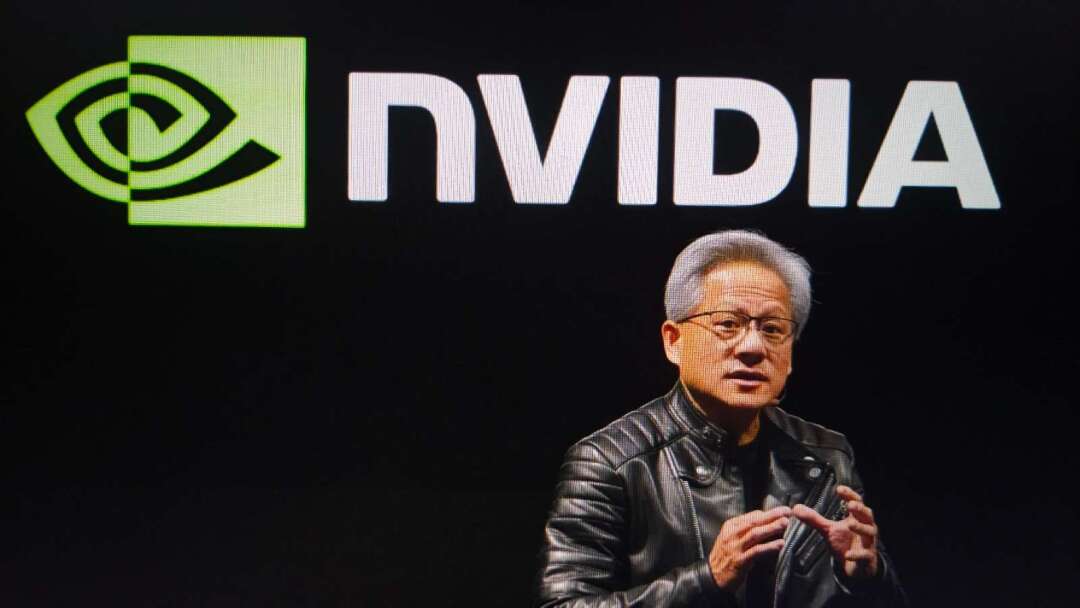
NVIDIA (NVDA-US) is partnering with major Wall Street asset management and financial institutions to transform artificial intelligence (AI) chips and data center computing power into a new, financeable and investable asset class. The company plans to raise over $500 billion in third-party capital through six major financial institutions to help hyperscale cloud providers, frontier AI labs, and enterprises build data centers and purchase NVIDIA GPUs.
On Monday (10th), NVIDIA announced it has signed memorandums of understanding with Apollo Global Management (APO-US), BlackRock (BLK-US), Blackstone Group (BX-US), Brookfield Asset Management (BAM-US), Goldman Sachs (GS-US), and KKR (KKR-US). These partnerships will establish a series of financing platforms to provide financial support for AI infrastructure customers.
The overall goal is to mobilize over $500 billion in third-party capital, reducing reliance on tech companies’ own balance sheets for AI data center and GPU procurement. Through institutional credit, insurance capital, and private equity, AI data centers and computing hardware could adopt financing models similar to commercial real estate, toll roads, and other infrastructure assets.
This strategy could transform the funding landscape for AI infrastructure. In the past, hyperscale cloud providers and AI companies had to invest heavily in capital expenditures to build data centers, purchase GPUs, and deploy power and networking equipment. If computing power itself can serve as collateral or a cash-flow-generating asset for financial institutions, companies could expand AI infrastructure investments through external capital while reducing direct strain on their balance sheets.
NVIDIA’s founder and CEO, Jensen Huang, stated that the company’s mission has evolved from merely building chips to helping create a new productive, investable infrastructure—the so-called 'AI factory.' He emphasized that in the AI industry, computing power itself is a revenue source, and NVIDIA’s computing capabilities are particularly well-suited for this role.
Huang further noted that because NVIDIA’s hardware and software platforms are widely adopted, flexible, and transferable across customers, lenders can more confidently assess these computing assets and treat them as revenue-generating, long-lived assets.
This vision also challenges traditional perceptions of GPU value. Historically, GPUs have been viewed as rapidly depreciating electronic hardware, especially as AI chip generations evolve quickly—new products often render older chips less competitive in performance and efficiency.
But NVIDIA now aims to prove that the economic value of AI chips should not be determined solely by hardware residual value, but also by the computing power they deliver, the revenue generated by data centers, and the sustained enterprise demand for AI services. If successful, GPUs and related data center infrastructure could gradually shift from mere capital expenditure items to financial assets that banks and institutional investors can evaluate, price, and finance.
However, a core challenge remains: whether AI chips can maintain long-term asset value like commercial real estate, power infrastructure, or toll roads. As NVIDIA continues to release new GPU generations, the performance and economic value of older models may decline rapidly. This means financial institutions financing GPUs must contend with risks such as depreciation, technological obsolescence, and volatility in the secondary market.
In recent years, major Wall Street alternative asset managers have actively invested in digital infrastructure, particularly data centers, AI computing, and cloud services. Financial institutions like Apollo and Blackstone have previously participated in funding AI companies such as Anthropic, indicating that private credit and alternative asset markets are becoming key channels for AI firms to access large-scale capital.
As the capital required for AI data centers continues to grow, traditional tech companies may struggle to fund all expansion plans through internal cash flow and balance sheets alone. This opens new investment opportunities for private credit, insurance capital, infrastructure funds, and large asset managers.
Wall Street leaders including BlackRock CEO Larry Fink, Blackstone President Jon Gray, and Goldman Sachs CEO David Solomon have stated that modern computing infrastructure is rapidly evolving into a critically important asset class and could become a major driver of global economic growth in the next phase.
Solomon said the industry is at a pivotal moment in a historic AI investment cycle. Goldman Sachs’ involvement in investment and capital distribution reflects its confidence in NVIDIA’s leadership and its anticipation of building a new credit market powered by NVIDIA’s computing capabilities.
If NVIDIA’s plan succeeds, the impact could extend beyond funding AI data centers—it may redefine the entire capital structure of AI infrastructure. Tech companies could begin treating GPUs, data centers, and computing power as cash-flow-generating infrastructure, using debt, private capital, and institutional funding to accelerate AI investments.
For NVIDIA, this could also create a new business advantage. Beyond selling GPUs and AI systems, the company would help customers overcome the significant financial barriers to acquiring equipment. If financial institutions accept the future revenue potential of AI computing assets as a basis for financing, it could lower the capital threshold for customers to access NVIDIA products, accelerating data center construction and GPU deployment.
This suggests the competitive focus in the AI industry is shifting from 'who can produce the fastest chip' to 'who can secure enough capital to build the largest computing capacity.' In an environment of growing AI model scale, inference demand, and data center construction, computing power itself may gradually become a fundamental production factor akin to land, electricity, and communication networks.
However, whether the $500 billion in funding will materialize depends on how financial institutions assess the long-term cash flows of AI computing, GPU depreciation rates, chip generational turnover, and the actual revenue-generating capacity of AI services. If new chips rapidly devalue older equipment, the risk of using AI computing power as collateral could rise accordingly.
Therefore, the true significance of NVIDIA’s collaboration with Wall Street may not just be a large-scale fundraising effort, but an attempt to establish a new financial framework—transforming AI computing power from expensive tech equipment into a productive asset that can be priced and financed by financial markets. If the market ultimately embraces this model, the pace of AI infrastructure expansion could accelerate further, providing a new source of capital for the wave of AI capital expenditures in the coming years.
FACT BOX
- Source: PR Times
- Category: Partnership
- Organizations: Brookfield Asset Management / KKR / Anthropic
- Products / services: GPU