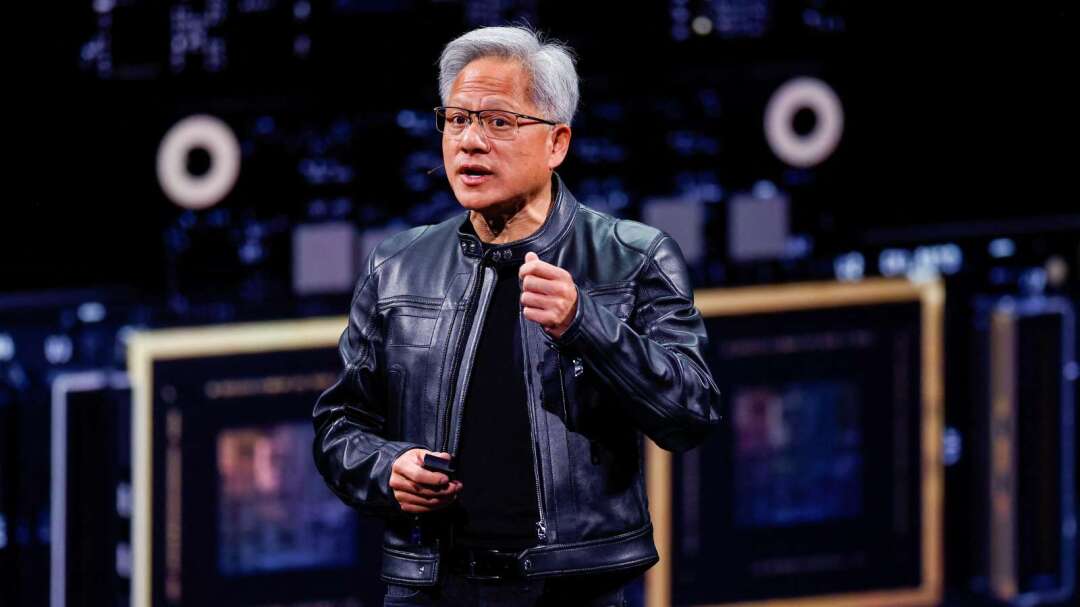
NVIDIA (NVDA-US) CEO Jensen Huang has rarely voiced support for 'open-weight' AI models, but within days, over 70 companies and AI industry figures signed a joint statement, clearly dividing the industry into open and closed model camps. This debate, seemingly about technical direction, actually reshapes chip, cloud, model, and AI application interests.
Jensen Huang, usually low-key and rarely expressing opinions on social media, made a rare personal post on X, directly endorsing an open letter titled 'Open Weights and American AI Leadership'.
The letter attracted over 70 signatories within just a few days, up from an initial 25, and accumulated over 60 million views, clearly revealing for the first time that Silicon Valley's AI industry has split into two distinct camps: 'open models' and 'closed models'.
The letter's message is straightforward: it calls for industry-wide support for the development of 'open-weight' models and opposes blanket restrictions by regulators on open-source AI models.
Analysis shows that while this appears to be a mere industry initiative, it directly addresses several key issues: preventing startups from being locked into a single model provider, expanding competition from the model layer to cloud and chip layers, advocating that technical transparency aids safety governance, and defending 'knowledge distillation' (training smaller models using outputs from larger ones) as a legitimate, long-standing research practice that should not be considered infringement or theft.
The core stance of the letter can be summarized in one sentence: regulatory bodies should not restrict the development space of open-weight technology to prevent hypothetical future risks.
Heavyweights such as Microsoft (MSFT-US) CEO Satya Nadella, Tesla (TSLA-US) CEO Elon Musk, Turing Award winner Yann LeCun, and AI scholar Andrew Ng have all signed in support, making this one of the largest collective industry statements in recent AI history.
Examining the corporate composition behind the signatories reveals this is actually a battle over profit distribution in the AI supply chain, with each party supporting open source for their own commercial reasons.
Chip and hardware makers like NVIDIA and Dell Technologies (DELL-US) are most concerned about sustained growth in computing demand. As more enterprises choose to deploy and fine-tune open-weight models in-house, demand for hardware procurement and cloud computing power will rise accordingly—this is the fundamental motivation behind NVIDIA's support for open source.
Cloud service and enterprise software providers like Microsoft and Palantir (PLTR-US) aim to enrich their cloud platforms with open-weight models, preventing enterprise customers from being locked into a single API provider and keeping them within their own cloud and subscription service ecosystems.
The open-source camp led by Meta (META-US) and infrastructure players seeks to control technical standards through open models like the Llama series; startups like Mistral and Hugging Face also use this opportunity to compete for enterprise clients previously monopolized by closed-source giants.
Venture capital firms like a16z and YC worry that if foundational models remain controlled by a few closed-source companies long-term, the profit margins for application-layer startups will be severely compressed. Hence, they support open weights to ensure startups retain bargaining power in cost and business models.
Notably, in this wave of near-universal alignment, Anthropic's absence stands out.
As a representative of the closed-source camp, Anthropic not only declined to sign but also had its employee Julian publicly express skepticism toward the open-source camp on X, prompting a direct response from Andrew Ng.
Ng stated that while any company has the right not to open its code, it has no standing to prevent others from choosing open source.
It is widely believed that Anthropic's reserved stance on open weights is closely tied to its business model.
The company's revenue and valuation heavily depend on the scarcity of its model capabilities. If viable open-source alternatives emerge in the market, the premium pricing power of its APIs and capital markets' imagination of its growth potential could be significantly impacted. Meanwhile, how regulators will respond remains an ongoing variable for the open-source camp.
As models become 'infrastructure,' the application layer becomes the new battleground
Analysts suggest that as open-source models' performance continues to approach—and in some cases surpass—closed models, the industry widely believes foundational large language models are gradually becoming 'infrastructure,' turning into low-cost, widely accessible public resources where simply stacking parameter scale can no longer sustain long-term competitive advantage.
Under this trend, industry profits may concentrate at two ends: one being hardware makers like NVIDIA that control computing infrastructure, and the other being application-layer companies that deeply integrate AI technology with enterprise data, business processes, and intelligent agents (Agents).
At the same time, enterprises' growing emphasis on data sovereignty and technical security has led some industry observers to view smaller-parameter, privately deployable, domain-specific models—along with the proliferation of edge computing devices (such as AI PCs and AI smartphones)—as the most promising commercialization direction for the next phase.
This open versus closed model debate is unlikely to reach a conclusion in the short term. However, for the entire AI industry, this public debate marks, in a way, the formal end of the industry's wild early growth phase and the beginning of a new era of rule-making and profit redistribution.
FACT BOX
- Source: PR Times
- Category: News
- Organizations: NVIDIA / Microsoft / Tesla