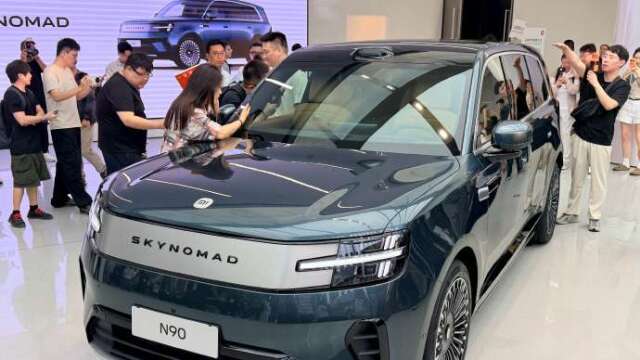
Xiaomi Auto unveiled its new 'Skynomad' series on July 30, launching two extended-range SUV models: the flagship seven-seat N90 Max priced at RMB 299,900 (all prices in CNY), and the five-seat AWD N70 Max at RMB 259,900, with official launch expected in September.
According to China's Cailian She on Wednesday (5th), across 499 Xiaomi Auto sales outlets in China, each store averages 200–300 intent deposits. In the Beijing-Tianjin region alone, cumulative pre-orders have surpassed 30,000 units. Extrapolating across all outlets, total pre-orders for the entire Skynomad lineup could exceed 100,000 units—making it the most explosive 'pre-launch' case in the new energy vehicle market in the second half of 2024.
Unlike the pure-electric SU7 and YU7, which targeted younger 'driver-focused' demographics with sleek coupe designs, the Skynomad clearly shifts toward middle-aged consumers bearing family responsibilities. It abandons sloping rooflines in favor of a boxy, upright SUV silhouette and replaces pure electric drive with Xiaomi's self-developed Kunlun extended-range system, balancing long-range capability with refueling convenience.
The Skynomad's core selling point is its intelligent variable extended-range system, which replaces pure electric drive to deliver both long-range performance and energy replenishment flexibility. Terminal feedback shows that the N90 Max at RMB 299,900 accounts for about 80% of orders. Its seven-seat layout and Lei Jun's positioning as 'one of the best SUVs under RMB 500,000' precisely target car-upgrading consumers aged 35–50.
This move reflects Xiaomi Auto overcoming a strategic bottleneck. While SU7 and YU7 achieved legendary feats—'50,000 firm orders in 27 minutes' and '289,000 orders in one hour'—the pure-electric coupe segment has limited market ceiling. Throughout 2024, Xiaomi Auto has struggled to break past the '30,000 monthly sales threshold'.
By entering the fiercely competitive 250,000–300,000 CNY extended-range family SUV segment—rivaling Li Auto's L-series, Aito's M9/M7, and Zeekr's C-series—Xiaomi leverages a 'triple punch': brand traffic, pricing 20,000–30,000 CNY below expectations, and a 499-store direct sales network. This channels Xiaomi's vast middle-aged smartphone user base directly into its automotive business.
However, the 100,000 pre-orders are based on refundable RMB 1,000 deposits, not final confirmed orders or deliveries.
Moreover, Xiaomi Auto's Beijing Phase II factory capacity, final configurations and market reception at September launch, and the risk of market saturation in the extended-range segment will determine whether 'hype-driven orders' can convert into sustained monthly sales of 40,000–50,000 units.
Lei Jun is no longer chasing youth trends—he's reaching into middle-aged wallets. This move may lack the shock value of the SU7 launch, but it could be the crucial piece enabling Xiaomi Auto to evolve from a pure-electric niche player into a full-scenario, long-term automotive contender.
FACT BOX
- Source: PR Times
- Category: New Product
- Products / services: N90 Max / N70 Max