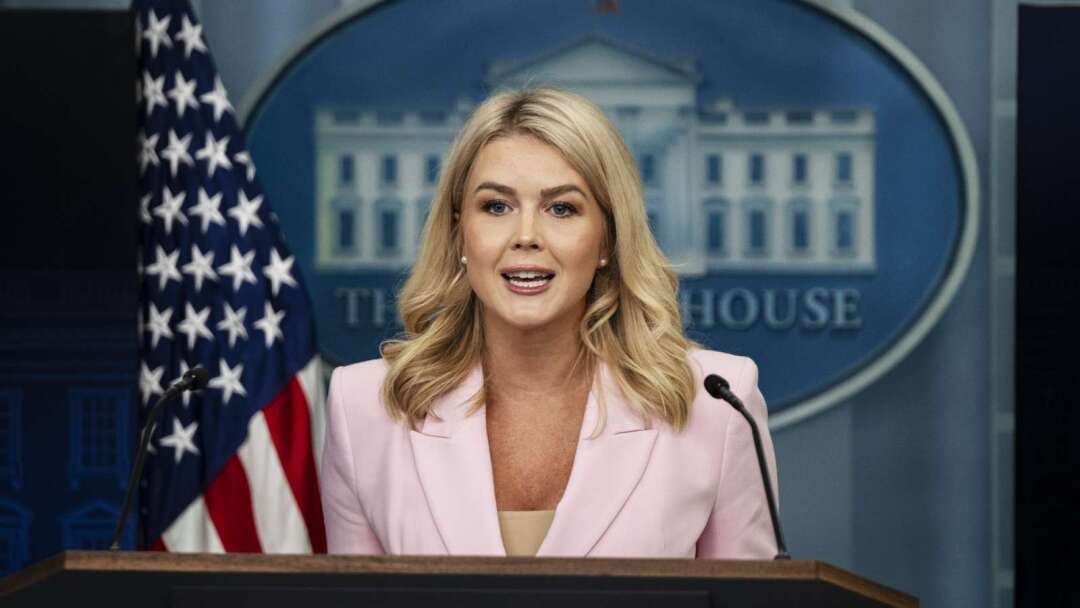
U.S. President Trump announced on Wednesday (12th) that White House Press Secretary Karoline Leavitt will leave her current role by the end of August, citing her desire to spend more time with her family. This personnel change comes approximately three months before the U.S. midterm elections on November 3, meaning that the core communications team of the Trump administration will undergo a significant adjustment just before the election campaign.
Trump announced on Truth Social that Leavitt will leave her position as White House Press Secretary at the end of this month to spend more time with her young children and family, and stated that he fully understands and respects her decision. Trump also said that Leavitt will become one of his "top external advisors" and continue to play an influential role within the Republican Party, helping the party "rewrite history" and win the midterm elections.
Leavitt herself posted on the social platform X, stating that serving as White House Press Secretary over the past year and a half has been one of the most honorable and adventurous experiences of her life. She did not disclose whether she would join a specific campaign team after leaving, but Trump has clearly stated that her departure from the White House does not mean she is exiting his political inner circle, but rather transitioning to an important political advisory role outside the White House.
This announcement also comes with a special timing context. The 2026 U.S. midterm elections will be held on November 3, and the Republican Party is currently actively integrating campaign strategies between the Trump camp, the Republican National Committee, and candidates across states. According to an Axios report in July, Trump's main political advisors both inside and outside the White House had already held meetings to review polling data, campaign messaging, and midterm election strategies. At the time, Trump's Super Political Action Committee and the Republican National Committee collectively held approximately $530 million in funds and had begun planning how, when, and in which districts to allocate resources.
Leavitt's role within Trump's political camp has already gone beyond that of a traditional White House spokesperson. She joined Trump's 2024 presidential campaign team, later served as spokesperson for the transition team, and was ultimately appointed by Trump as White House Press Secretary, becoming the youngest White House Press Secretary in U.S. history. Since the beginning of Trump's second term, she has become a key figure in communicating government policies, responding to media inquiries, and defending Trump's administration.
In recent years, Leavitt has also become a highly visible political figure in the Trump administration. According to White House official records, she continued to host regular media briefings until July this year, and on July 23, she explained government policies and answered questions from the media in the James S. Brady Press Briefing Room at the White House.
Her departure is also directly linked to family circumstances. In May this year, Leavitt announced the birth of her daughter Viviana. She and her husband Nicholas Riccio also have a young son named Niko. She had taken maternity leave before giving birth and announced her daughter's birth in May.
After Leavitt's departure, the White House will face a reorganization of its communications operations. She served as spokesperson for approximately one and a half years during Trump's second term, frequently representing the White House at media briefings and often serving as the primary defender of Trump's policies and political positions. Her departure occurs just before the final stretch of the midterm elections, so attention will focus on whom Trump appoints to succeed her in this highly political role.
Trump is currently actively involved in shaping the Republican Party's midterm election strategy. An AP analysis in May noted that Trump has tightened his grip on the Republican nomination process and is actively endorsing certain candidates, though the Republican Party still faces voter scrutiny over Trump's second-term performance and the economy in the November elections. Republican strategists believe that how Trump utilizes political resources and mobilizes his supporters will be a key variable in the midterm elections.
Trump has recently continued to urge Republican congressional leaders to accelerate his political agenda. For example, at the end of July, Trump called on Senate Majority Leader Thune to cancel the August recess and remain in Washington to push forward a bill requiring voters to provide proof of citizenship and present photo identification when voting, indicating Trump's attempt to further consolidate Republican political issues before the midterm elections.
For Trump, while Leavitt's departure from the White House will cause a personnel change in daily news operations, her transition to an external advisor means she will continue to participate in Republican political work. This may allow her to shift from a government spokesperson role to more direct campaign and political advocacy work. With less than three months remaining until the midterm elections, Trump has clearly positioned her as a key political ally in helping the Republican Party win the elections.
FACT BOX
- Source: PR Times
- Category: 人事