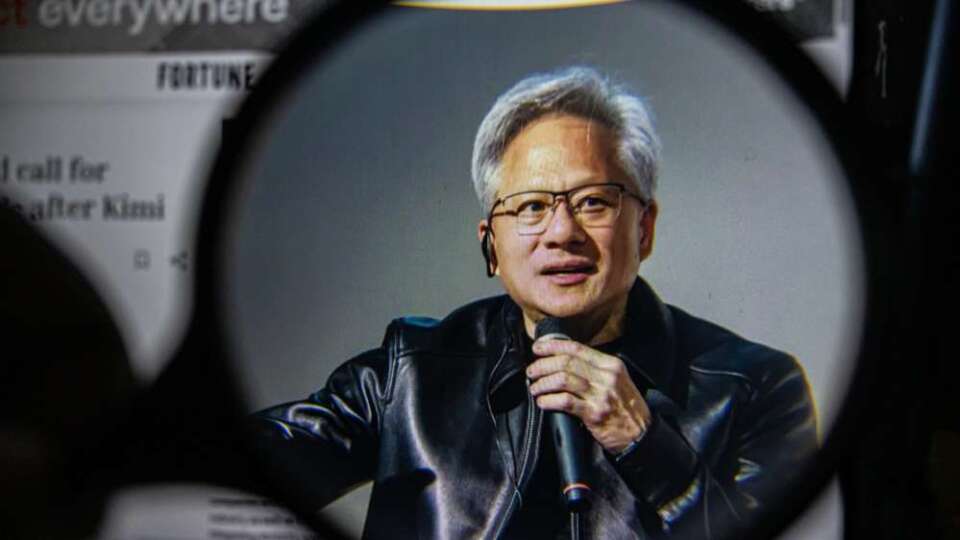
NVIDIA (NVDA-US) has partnered with six major Wall Street financial institutions to launch a $500 billion AI infrastructure financing platform, sparking divergent reactions across capital markets. Following the announcement, shares of alternative asset management giants surged, while large-cap tech stocks declined for the second consecutive trading day, underscoring a clear divide among investors: Is this AI financing model a financial innovation supporting AI infrastructure expansion, or does it signal that part of AI demand now depends on financing to sustain growth?
On Monday (10th), NVIDIA CEO Jensen Huang appeared alongside executives from Goldman Sachs (GS-US), BlackRock (BLK-US), Blackstone (BX-US), KKR (KKR-US), Apollo (APO-US), and Brookfield Asset Management (BAM-US) to announce that the six financial institutions have signed a memorandum of understanding. Each will establish an independent computing power financing platform, raising funds from third-party capital markets for AI infrastructure, with a target scale of $500 billion—potentially expandable.
Huang described the initiative as a "grand vision," centered on redefining the financial attributes of AI computing power. He emphasized that AI systems differ from PCs or smartphones, as they are revenue-generating assets with productivity, longevity, replaceability, and flexibility.
Waldemar Szlezak, KKR’s Head of Digital Infrastructure, stated that AI computing power can be viewed as a revenue stream, which can then be securitized or have its risks segmented to allow different types of investors to participate. Goldman Sachs CEO David Solomon also noted that asset-backed financing for AI infrastructure is unsurprising, as it is underpinned by tangible, valuable physical assets.
Under current plans, the six financial institutions will make independent lending decisions, while NVIDIA will act as a matchmaker between clients and financing partners and may choose to assume up to 25% exposure in loan guarantees.
Huang later clarified on social platform X that the support is based on asset residual value and is intended to supplement—not replace—standalone underwriting.
Asset Managers Celebrate as Financing Platform Becomes a New Gold Mine
The market first voted in favor of the plan through stock prices, particularly benefiting the alternative asset managers involved. On Tuesday (11th), KKR surged 6.88%, Apollo Global Management (APO-US) jumped 6.26%, Brookfield Asset Management (BAM-US) rose 4.77%, Blackstone (BX-US) gained 3.89%, and BlackRock (BLK-US) climbed 1.54%.
The market views the massive AI financing pipeline as a direct positive for private credit and alternative investment businesses, as expanded funding scale implies long-term growth potential for future management fee revenues.
AI infrastructure-related firms also benefited: Nebius (NBIS-US) rose 4.95%, Riot Platforms (RIOT-US) gained 4.33%, Hut (HUT-US) increased 3.64%, and Iris (IREN-US) climbed 2.61%.
GPU cloud computing provider CoreWeave (CRWV-US) rose 2.42% during regular trading and spiked over 16% in after-hours trading.
CoreWeave is one of the emerging cloud providers most directly positioned to benefit from this financing model. It has real computing demand but lacks the balance sheet strength of hyperscale cloud providers—exactly the type of customer targeted by the financing platforms.
Tech Stocks Decline: Two Market Interpretations
In stark contrast to the strength of asset managers and AI infrastructure stocks, large-cap tech stocks weakened for the second consecutive day.
Google (GOOGL-US) closed down 3.84% on Tuesday, its largest single-day drop in nearly six months. Amazon (AMZN-US) fell 2.09%, Apple (AAPL-US) dropped 1.09%, Broadcom (AVGO-US) declined 1.5%, and Microsoft (MSFT-US) fell 0.44%. NVIDIA (NVDA-US) itself was nearly flat, down just 0.02%. The three major U.S. indices closed lower for the second straight day, with the Nasdaq Composite down 0.6%.
This movement reflects another interpretation of the $500 billion financing plan. If AI computing demand were truly strong, hyperscale cloud providers with robust balance sheets should benefit directly.
The fact that NVIDIA must personally help clients establish financing channels instead raises concerns among some investors about whether the financial capacity of potential demand-side players is already under pressure.
Credit markets have also not fully absorbed these concerns. NVIDIA’s five-year credit default swap (CDS) has surged approximately 90% year-to-date. Although it narrowed by 5 basis points to 72.11 basis points on Tuesday following Huang’s clarification, it remains near historical highs. The controversy over "circular financing" has not subsided.
The Biggest Uncertainty in "Circular Financing": GPU Residual Value
The industrial logic behind this financing model is that the bottleneck in AI development is shifting from chips and power to capital.
Beyond hyperscale cloud providers, AI labs, emerging cloud computing companies, and sovereign AI initiatives also face massive computing demands but lack the balance sheets of tech giants like Google and Microsoft.
Building a 1-gigawatt AI data center costs about $50 billion, yet OpenAI still lacks an investment-grade credit rating.
BlackRock CEO Larry Fink compared this model to the early development of the mortgage-backed securities market, suggesting it could be the next frontier in financial engineering.
Apollo Global Management President Jim Zelter acknowledged there will be "excesses and corrections" in the process but noted that broad participation helps diversify concentration risk.
However, the market’s biggest unanswered question remains: What is the long-term residual value of GPUs used as collateral? NVIDIA’s chip refresh cycle has accelerated from every two years to annually, with each new generation delivering significant performance leaps, potentially continuously eroding the market value of previous-generation chips.
Thus, the crucial foundation of the entire financing model—GPU residual value—has yet to be tested through a full industry cycle.
Moreover, what has been announced so far is only a memorandum of understanding, non-binding. Specific borrowers, interest rates, facility locations, and launch timelines have not been disclosed.
Brookfield CEO Bruce Flatt pointed out that Huang is driving these financing structures because there are "hundreds of trillions of dollars" of capital globally.
This vast capital pool may be the strongest support for the $500 billion "grand vision," but until GPU residual values and actual financing details are verified, it remains the biggest unknown fueling market divergence.
FACT BOX
- Source: PR Times
- Category: Partnership
- Organizations: KKR / CoreWeave / Google