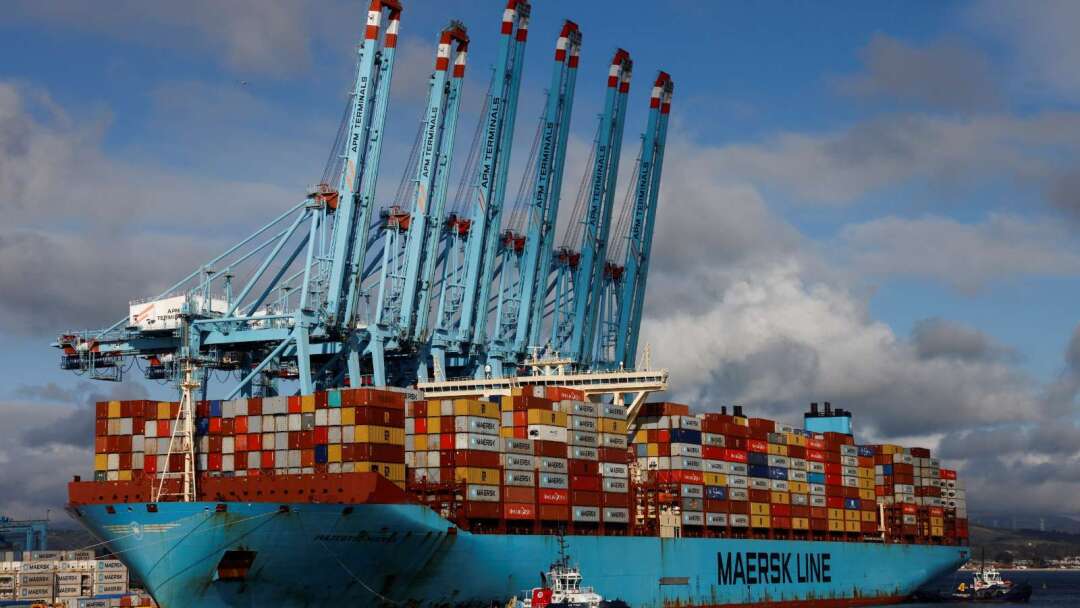
Danish shipping giant Maersk raised its full-year financial outlook again on Thursday (13th), marking the second time this year it has upgraded its profit forecast. Despite rising fuel and operating costs due to Middle East conflicts, global container shipping demand remains resilient. Port congestion and robust Chinese exports have driven freight rates higher, resulting in second-quarter profits that significantly exceeded market expectations. Maersk's Copenhagen-listed shares rose 8% following the announcement.
Maersk's second-quarter earnings before interest, taxes, depreciation, and amortization (EBITDA) reached $3 billion—surpassing both last year's $2.3 billion and the analyst consensus estimate of $2.12 billion.
Maersk CEO Vincent Clerc stated that vessels waiting to dock at the Port of Shanghai have faced delays of up to 12 days. He attributed the congestion to long-term underinvestment in land-side infrastructure across Northern Europe, South America, West Africa, and China, which now struggles to handle rapidly increasing freight demand. Clerc emphasized that the primary driver of rising freight rates is not the Middle East conflict, but port congestion and logistical network bottlenecks.
This situation resembles the period during the COVID-19 pandemic, when supply chain disruptions compressed effective shipping capacity, leading to sharp increases in freight rates and shipping company profits. This quarter, Chinese exports have become the main engine of global container trade growth, with increased demand in other regions offsetting a 40% decline in Middle East imports.
Maersk now forecasts its 2026 base EBITDA to reach $10.5–12.5 billion, up from the previous $8–10 billion range. Base operating profit is also significantly revised upward, from $2–4 billion to $4.5–6.5 billion.
The company noted that Chinese exports show no signs of slowing and strong demand may continue into the third quarter. However, given the unresolved Middle East conflict, the outlook remains cautious. German competitor Hapag-Lloyd recently raised its financial forecast as well, although it estimates the Middle East crisis will cost the company $600 million.
The Middle East situation has increased Maersk's ocean freight operating costs by 19% year-on-year, with average fuel prices surging 44%. However, the company has offset some of these impacts through improved fuel efficiency and commercial measures.
After the Red Sea was attacked by Yemen's Houthi movement, most shipping lines temporarily abandoned the Suez Canal route between Asia and Europe. Clerc said Maersk has now resumed four of its 13 related routes via the Suez Canal or Red Sea, restoring about one-third of normal volume. While conditions for full resumption by 2026 are in place, the company will return gradually to avoid exacerbating already severe port congestion.
FACT BOX
- Source: PR Times
- Category: News
- Organizations: Hapag-Lloyd