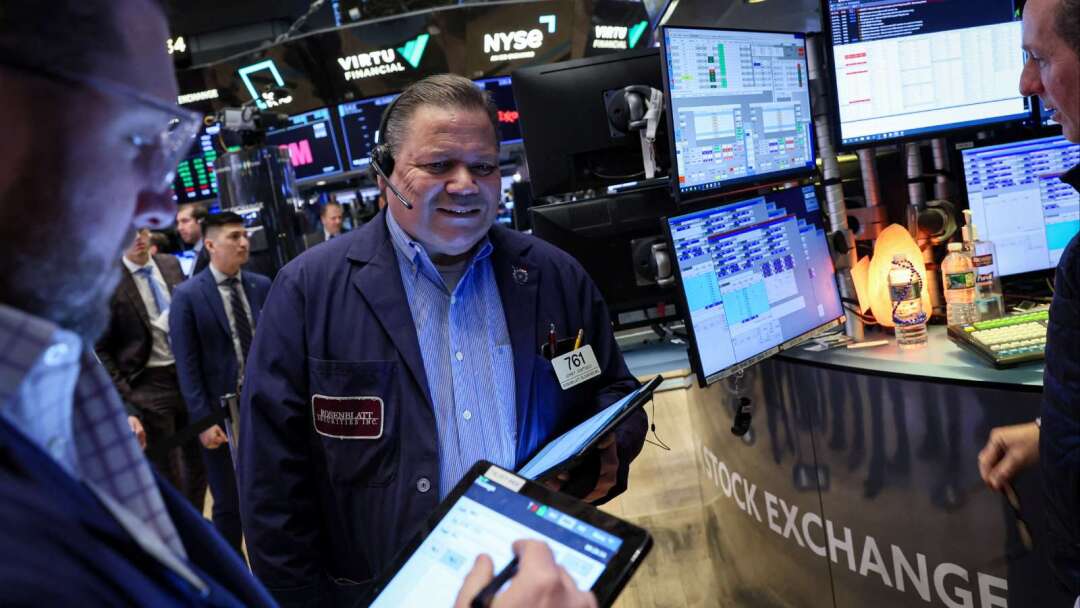
Major U.S. stock indices opened Friday (14th) with divergent movements. The S&P 500, having closed at a record high the previous session, remained largely unchanged and is on track for its third consecutive weekly gain. U.S. July retail sales unexpectedly fell, further diminishing market bets on a Federal Reserve (Fed) rate hike in September. However, investors continue closely monitoring Middle East developments and risks tied to rising energy prices.
At time of writing, the Dow Jones Industrial Average was down nearly 30 points, or 0.1%. The Nasdaq Composite Index rose about 20 points, or 0.06%, while the S&P 500 edged up 0.02%. The Philadelphia Semiconductor Index dropped nearly 0.6%. TSMC's ADR declined by nearly 0.8%.
U.S. equities held near all-time highs ahead of Friday’s open, supported by a rebound in AI trading activity and fresh economic data that pushed back market expectations for Fed rate hikes, bolstering demand for risk assets. Still, tensions involving Iran and shipping risks in the Strait of Hormuz could push energy prices higher, adding uncertainty to inflation and market outlooks.
As of press time, S&P 500 futures were up 0.1%, following Thursday’s record closing high. Nasdaq-100 futures gained 0.3%, putting the index on track for a 1.2% weekly rise. Memory maker Sandisk (SNDK-US) surged nearly 6% in pre-market trading after JPMorgan upgraded its rating, while investors also watched OpenAI’s reported plans to go public on Wall Street.
AI Capital Returns to Tech Hardware
Technology stocks have driven the S&P 500 to repeated new highs this month, as investors rotate back into previously sold-off semiconductor and other AI-related stocks. Second-quarter earnings across these companies generally exceeded already optimistic market expectations, refocusing attention on actual revenue and profit growth.
A strategist team led by Michael Hartnett at Bank of America (BofA) stated the “door has opened” for bulls to further push risk assets higher, citing soaring corporate profits, a projected $10 trillion increase in household wealth by 2026, and anticipated AI capital expenditures exceeding $1 trillion by 2027.
South Korea’s benchmark Kospi index rose over 2% Friday, gaining 11% for the week and ending a seven-week losing streak. Samsung Electronics and SK Hynix both climbed more than 15% over the past five trading sessions, reflecting renewed investor appetite for AI hardware and memory stocks.
Hitoshi Asaoka, Chief Strategist at Asset Management One, noted that massive inflows from hyperscale cloud providers are translating into robust revenue and profit growth for hardware firms. As a result, investors are refocusing on corporate fundamentals rather than just AI investment scale and valuation concerns.
Monetary policy expectations are also supporting equities. U.S. July retail sales posted their largest decline in over a year, and both consumer and producer price data released this week came in milder than expected—strengthening the case for the Fed to remain patient. The yield on the two-year Treasury note, sensitive to policy outlooks, fell 4 basis points to 4.11%, while the dollar index dropped 0.4%.
Energy Prices and Long-Term Yields Pose Risks
Despite rising risk appetite, the threat of energy-driven inflation remains. Brent crude briefly spiked nearly 2% Friday before paring gains, settling around $87 per barrel. U.S. Treasury Secretary Scott Bessent said Washington would impose an unprecedented “economic isolation” on Iran, coupled with continued blockades of Iranian ports, delivering a double blow.
Patrick Armstrong, Chief Investment Officer at Plurimi Wealth, warned that normal shipping through the Strait of Hormuz may not fully resume in the short term, and markets may be overly complacent about the risks. If oil supplies are disrupted again, rising energy prices could reignite inflation and force investors to reassess the Fed’s policy path.
The bid yield on Thursday’s 30-year U.S. Treasury auction hit a 25-year high, highlighting that investors demand higher risk premiums to finance America’s massive fiscal deficit. Persistently high long-term yields could pressure stock valuations.
Bloomberg strategist Skylar Montgomery Koning noted markets have shown remarkable resilience, potentially ending the summer season on a positive note. Yet, tail risks beneath the calm surface continue to grow, particularly around rising commodity prices, stagflation, and climbing long-dated bond yields.
As of Taipei time Friday (14th) around 9 p.m.:
Dow Jones Industrial Average: Down 68.90 points (-0.13%) at 53,771.09
Nasdaq Composite Index: Up 45.83 points (+0.17%) at 26,848.86
S&P 500 Index: Up 7.38 points (+0.09%) at 7,806.37
Philadelphia Semiconductor Index: Down 47.43 points (-0.10%) at 12,408.57
TSMC ADR: Down 0.87% to $426.78 per share
10-Year U.S. Treasury Yield: Rose to 4.65%
NY Light Crude Oil: Up 0.10% to $81.33 per barrel
Brent Crude Oil: Down 0.09% to $86.99 per barrel
Gold: Up 0.43% to $4,439.20 per ounce
Dollar Index: Fell to 99.62
Key Stocks:
Reddit (RDDT-US): Up 13.45% in early trading to $179.40 per share
Reddit surged 12% pre-market. S&P Dow Jones Indices announced Reddit will be added to the S&P 500 Index effective August 18, replacing real estate investment trust AvalonBay Communities (AVB-US).
Applied Materials (AMAT-US): Down 4.63% in early trading to $509.79 per share
Applied Materials fell over 5% pre-market after its second-quarter earnings failed to impress investors. Adjusted EPS was $3.50, revenue $9.12 billion. Core semiconductor systems revenue reached $7.04 billion, slightly above the $6.96 billion consensus estimate from FactSet analysts.
SanDisk (SNDK-US): Up 4.53% in early trading to $1,597.34 per share
SanDisk rose 5% pre-market after JPMorgan upgraded its stock rating from “Neutral” to “Overweight.” Analysts highlighted that SanDisk’s “new business model” has structurally improved margins through long-term agreements and a multi-year, high-margin, take-or-pay-like revenue structure that significantly reduces volatility from memory industry cycles.
Today’s Key Economic Data:
U.S. July Retail Sales MoM: -0.6% (Expected: +0.1%, Prior: +0.2%)
U.S. July Core Retail Sales MoM: -0.3% (Expected: +0.2%, Prior: -0.2%)
U.S. August University of Michigan Consumer Sentiment Index Final: Expected 54.4, Prior 55.2
Wall Street Analysis:
According to SEC filings, Morgan Stanley filed its Q2 holdings report. Portfolio changes revealed a strategy of “maintaining core tech exposure, reducing index-based risk, and enhancing active stock selection.” The fund’s total portfolio value reached $1.89 trillion in Q2, up 13.9% from the prior quarter. During the quarter, Morgan Stanley added 449 new positions, increased stakes in 3,850 stocks, reduced holdings in 3,280, and exited 334 positions.
FACT BOX
- Source: PR Times
- Category: News
- Organizations: Sandisk / Reddit