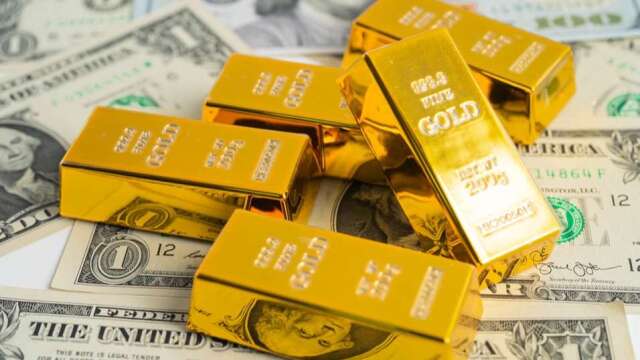
The international gold market is experiencing another bullish rally. Fueled by substantial gold purchases from the People's Bank of China, ongoing buying from global central banks, and renewed capital inflows into gold ETFs, international gold prices have not only successfully broken through the $4,300 psychological barrier but also climbed further above $4,450 this week, reaching a two-month high. According to the latest report from UBS Wealth Management’s Chief Investment Office (CIO), despite short-term volatility risks, the medium- to long-term bullish trend for gold remains intact, supported by declining real interest rates, a medium-term weakening of the US dollar, and the global de-dollarization trend. The report projects that gold prices could reach $5,000 per ounce by the first half of 2027, with a more optimistic target of $5,200 by mid-2027.
This current wave of gold price appreciation began accelerating in early August. UBS noted that gold prices broke above $4,300 for the first time since June, finally escaping a weeks-long consolidation range between $4,000 and $4,100. Last week alone, prices surged 7.4%, marking the strongest weekly performance since January this year. Key catalysts behind this move include active participation from Chinese institutional investors, renewed net inflows into gold ETFs, and easing market concerns about how long US interest rates would remain elevated.
Notably, the latest data released by the People's Bank of China shows that nearly 20 metric tons of gold were added in July—the largest single-month increase since the end of 2023—further confirming the global trend of central banks strengthening their gold reserves. Additionally, global central banks collectively purchased 289 metric tons of gold in the second quarter of this year. UBS estimates that annual central bank gold purchases could remain at a high level of 750 to 1,000 metric tons, forming a solid floor of support for gold prices.
On August 14, Asian session trading continued the recent strength. According to the foreign-currency-denominated gold deposit rates published by Taiwan Bank, the opening quote for USD-denominated gold deposits was $4,449.75, briefly peaking at $4,452.75 during the session—an all-time high. However, profit-taking sell orders emerged at higher levels, pushing prices down to a low of $4,384.50 intraday, before closing at $4,392.30.
Compared to the previous trading day’s closing price of $4,360.90, gold prices still maintained an upward trajectory, indicating strong buying interest on dips. However, the intraday swing of $68 reflects heightened sensitivity to US economic data, Federal Reserve policy expectations, and dollar movements, amplifying short-term volatility.
From a technical perspective, Taiwan Bank’s market analysis indicates that $4,300 has transitioned from a former resistance zone to a key support area. As long as prices hold above this level, bulls retain control. The next immediate target lies above $4,450, and if buying momentum continues to strengthen, a breakout toward the $4,500 psychological level cannot be ruled out.
Conversely, if global risk appetite rebounds, the US dollar recovers, or US Treasury yields rise, gold prices could retest the $4,350–$4,300 support zone, with stronger support located near $4,250.
Looking ahead, UBS emphasizes that the structural factors supporting gold remain clearly in place.
First, real interest rates are expected to decline. As a non-yielding asset, gold becomes more attractive when real interest rates fall, reducing the opportunity cost of holding it. UBS anticipates that US inflation will gradually cool, and after maintaining interest rates steady this year, the Federal Reserve could restart a loosening cycle as early as 2027, encouraging capital to flow back into gold.
Second, the US dollar is projected to weaken over the medium to long term. UBS points out that America’s massive fiscal and current account deficits remain unresolved, and global asset allocations still carry an overweight in dollar-denominated assets. Once markets begin rebalancing, this shift could benefit gold prices.
Third is the de-dollarization wave. In recent years, central banks worldwide have steadily increased their gold reserve ratios to reduce reliance on dollar assets. These official purchases are long-term and stable, serving as a crucial structural pillar supporting gold prices.
Market analysts suggest that if upcoming US economic data weakens and the US Dollar Index falls further, gold prices could officially break above $4,500 in the short term, with the next phase targeting the $4,600–$4,700 range.
In the medium term, supported by ETF inflows, central bank demand, and hedging needs, gold prices could trade within a high range of $4,300–$4,800 through this year and next.
Longer term, UBS maintains its $5,000 target for the first half of 2027, with an optimistic scenario potentially reaching $5,200. From the current level of approximately $4,400, this implies a potential upside of about 14% to 18%.
Meanwhile, Taiwan’s stock market has remained in a high-volatility range this year, driven by AI-related themes, pushing valuations significantly higher. Investors should continue to track growth sectors like AI and semiconductors while also moderately increasing allocations to hedging assets.
Financial institutions recommend conservative investors allocate 5% of their portfolio to gold; moderate-risk investors can raise this to 5%–10%. For those focused on global asset diversification, combining gold with commodities such as energy and industrial metals could justify allocations of 10%–15%.
Particularly, if gold prices retreat to the $4,000–$4,200 range due to US economic data or policy developments, it would represent a key opportunity for long-term investors to build positions incrementally. With central banks continuing to buy gold globally, de-dollarization deepening, and the Fed expected to return to an accommodative cycle, gold will remain a vital core holding in global investment portfolios over the coming years.
FACT BOX
- Source: PR Times
- Category: Survey