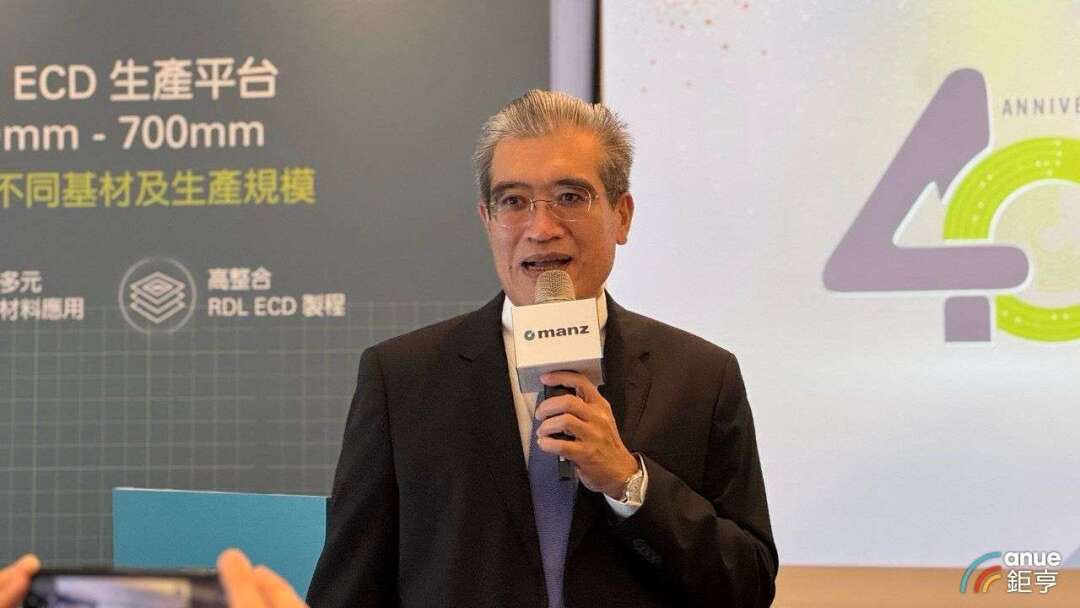
Semiconductor equipment manufacturer Yahgee Technology marks its 40th anniversary this year. Last year, through a management buyout (MBO), it became a 100% Taiwanese-owned enterprise once again and has restarted its capital market strategy. General Manager Lin Chun-Sheng stated that the company plans to list on GreTai in June 2025, targeting a TPEx listing by 2028. With rising demand for advanced packaging and panel-level packaging, next year’s operations are expected to outperform this year.
Yahgee initially started as a PCB equipment manufacturer before expanding into the display sector. About 12 years ago, it began entering the semiconductor industry. In 2008, it was acquired by Germany’s Manz, becoming a foreign-owned company, and delisted from the over-the-counter market in 2010. In 2025, amid Manz’s restructuring, the Asian management team executed an MBO to reclaim operations in Taiwan, China, and India, returning Yahgee to a fully Taiwanese corporate structure.
Lin Chun-Sheng said, “Last year marked the German parent group’s restructuring of equity and operations. This year is our first full operating year since returning to Taiwanese ownership.” The company remains profitable, with a capitalization of approximately NT$200 million. There are currently no plans for further capital increases, and the company intends to advance to GreTai under its current capital scale. Employee shareholding totals nearly 30%.
Looking ahead, Yahgee is shifting its growth focus from past PCB and display equipment to semiconductor advanced packaging, particularly emphasizing wet processes and ECD plating equipment for RDL (Redistribution Layer), targeting three major applications: FOPLP, CoPoS, and Glass Core/TGV.
Yahgee has been involved in panel-level packaging for over 10 years. To date, it has cumulatively shipped more than 50 plating units across various sizes—310mm, 510/515mm, and 700mm—with deliveries spanning Taiwan, China, the U.S., Europe, and Malaysia. End applications include PMICs, sensors, satellites, MCUs, 5G, AI, and HPC.
In terms of current shipment composition, 700×700mm equipment accounts for the largest share—over half—followed by 510mm models. The 310mm size, while recently experiencing rapid growth, still has relatively lower cumulative shipments.
Yahgee anticipates that as AI chips grow larger, the shift from traditional wafer-level to panel-level packaging will become a critical trend. Compared to circular wafers, square panels offer higher area utilization. As large AI chips continue to scale up, the waste along the edges of circular wafers becomes increasingly apparent, further driving demand for the ‘round-to-square’ transition.
The company also observes that 310mm is gradually emerging as the next-generation CoPoS format. Some new AI chip and IC manufacturers are evaluating moving their 2.5D packaging processes from wafers to 310mm panels. More high-end applications are expected to follow in the coming years.
FACT BOX
- Source: PR Times
- Category: News
- Organizations: Manz