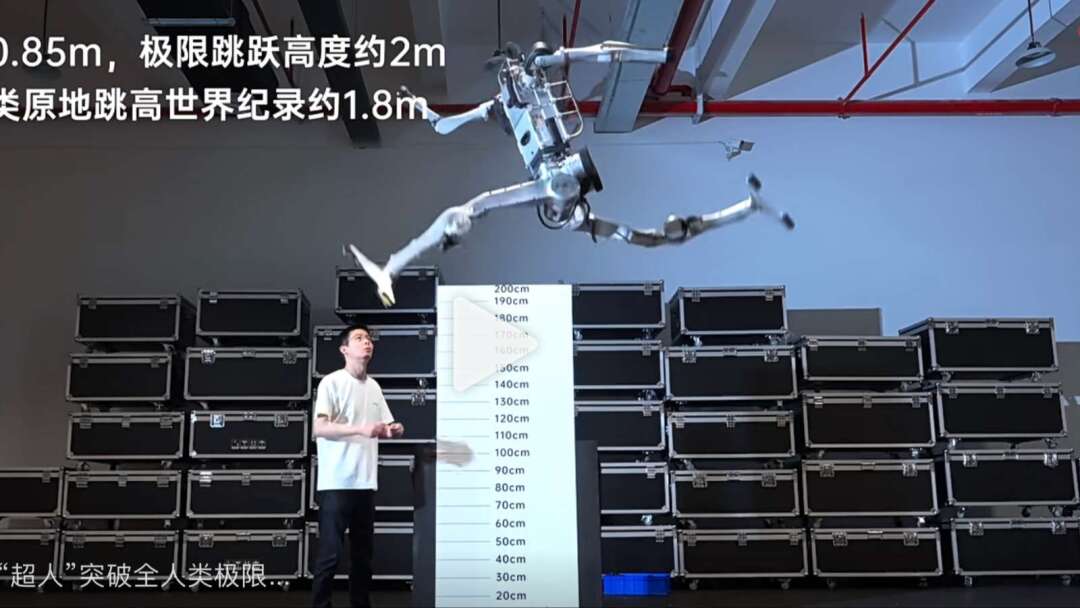
A new video released by China's Unitree Technology on the 17th (Monday) has once again gone viral online. The footage shows the company's humanoid robot 'Superman,' with leg length of 0.85 meters, achieving a vertical jump of 2 meters from a stationary position. It also reaches a top speed of 12.66 m/s.
Unitree claims that 'Superman' surpasses all human records for both vertical jumping and sprinting speed. The entire robot system was developed in just over three months, with significant improvements expected in the coming months.
The timing of this video release coincides with the company's pre-IPO phase. Unitree is also set to participate in the 2nd World Humanoid Robot Games, to be held in Beijing from August 22 to 26, further heightening public anticipation.
According to a report by 'First Financial,' an industry expert noted that the robot's ability to jump 2 meters and land stably relies heavily on algorithmic balance control. 'The motor's burst power is equally critical, and battery overheating must be prevented,' the expert stated.
Zhou Di, a senior engineer and expert in China's Ministry of Science and Technology National Expert Database, also commented that Unitree's self-developed high-torque-density motors provide ample power for high-speed running. 'Continuous iteration of millisecond-level dynamic balance control algorithms, combined with real-time posture feedback from multiple sensors, allows the robot to remain stable and avoid falling even during high-speed motion. Lightweight body structure optimization further reduces energy consumption and improves motion efficiency,' he explained.
In Zhou Di's view, researching humanoid robot running speed is not about speed for its own sake, but rather about refining dynamic balance, adaptability to complex terrains, and instantaneous response accuracy through extreme motion testing. These core technologies are key to enabling humanoid robots to operate in unstructured environments.
He added that capabilities such as obstacle crossing in factories, stair navigation between buildings, and traversing complex terrains in emergency scenarios all depend on control technologies accumulated through high-speed motion research.
FACT BOX
- Source: PR Times
- Category: New Product