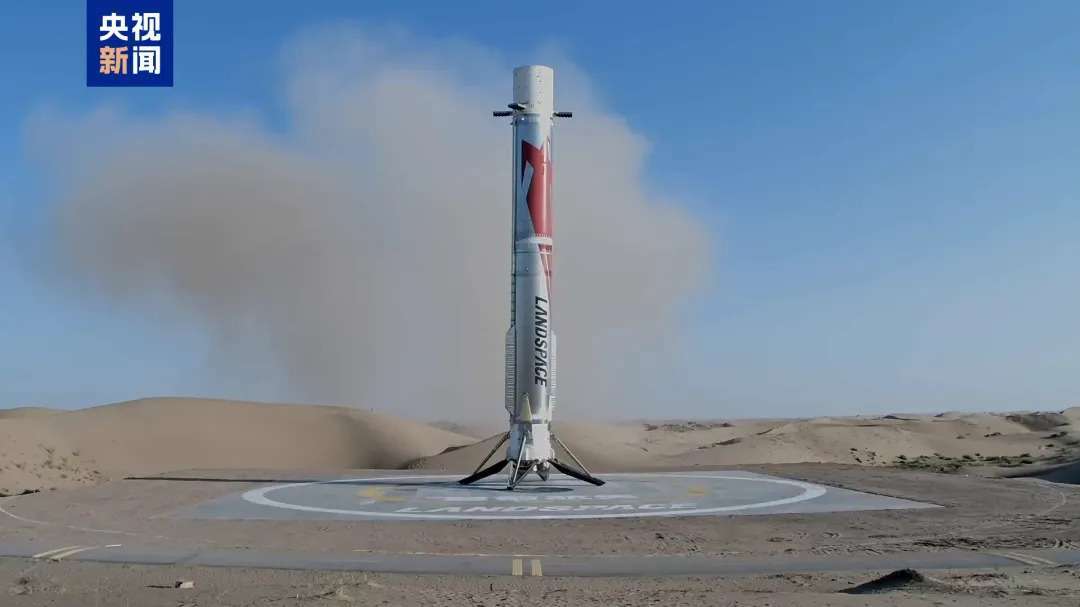
LandSpace, a Beijing-based commercial aerospace company, launched its self-developed Zhuque-3 Y2 launch vehicle on Wednesday, June 19, from the Dongfeng Commercial Aerospace Innovation Test Zone. The rocket's first stage successfully landed as planned at the Zhuque-3 landing pad in Minqin County, Gansu Province.
This marks another major breakthrough in China's key technologies for reusable rockets. The Zhuque-3 has become China's first launch vehicle to successfully reach orbit and achieve land-based recovery.
According to the Beijing Daily, the Long March 10B launch vehicle achieved China's first controlled recovery of a launch vehicle's first stage on July 10, and globally achieved the first maritime net recovery of a launch vehicle.
This 'landing' of Zhuque-3 represents another significant advancement in China's first-stage recovery technology for orbital-class launch vehicles, completing both leg-based vertical recovery and land recovery.
In launch services, the first stage accounts for approximately 70% of the total rocket cost, and manufacturing a new first stage requires several months of production lead time. Compared to 'expendable' rockets, reusable rockets offer significant advantages in reducing launch costs and increasing launch frequency.
Faced with the urgent demand for large-scale satellite constellation deployment requiring high-capacity, low-cost, and high-frequency space transportation, this technological pathway has become an essential challenge for commercial aerospace development both domestically and internationally.
'This flight test mission combines both reusable rocket technology verification and commercial launch attributes, representing a critical step forward for China's reusable liquid methane launch rockets toward engineering application,' said Dai Zheng, overall commander of Zhuque-3 at LandSpace.
Dai Zheng stated that the successful recovery of Zhuque-3 symbolizes the completion of the core technology chain encompassing rocket design, manufacturing, launch, and recovery, laying the foundation for future large-scale, high-frequency, and routine engineering applications of reusable technology.
During this mission, the rocket carried one 'passenger'—the Honghu-03 satellite. It is one of the 'vanguards' for Hongque Technology's 'Honghu-3' constellation construction. In the future, this constellation plans to deploy over 10,000 satellites across 160 orbital planes, becoming another massive low-Earth orbit network satellite constellation in China.
FACT BOX
- Source: PR Times
- Category: News