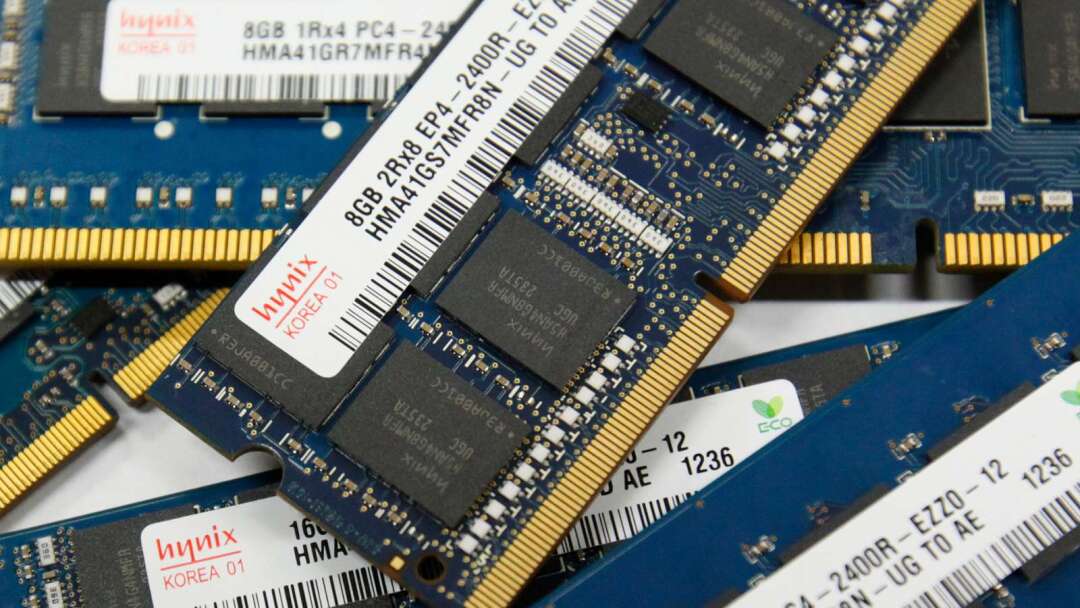
According to South Korean media outlet ChosunBiz, the price of domestically produced DRAM has risen dramatically, with the export price per kilogram now equivalent to 620 grams of gold—12.5 times higher than its low point over three years ago.
Data released on Wednesday (26th) by the Korea International Trade Association (TRASS) shows that between August 1st and 20th, the export price of South Korean DRAM (excluding DRAM modules) reached $92,183 per kilogram (approximately 127.4 million KRW), a 401% increase from the same period last year. Export value during this period surged 504.8% to $98.0662 billion (about 13.56 trillion KRW).
Investment research firm Citrini Research, analyzing South Korea's DRAM export statistics, found that the current export price is approximately 12.5 times higher than the low of around $7,400 recorded in January 2023.
While gold prices have also risen compared to over three years ago, the increase pales in comparison to DRAM. The current export price of DRAM per kilogram is 1.53 times that of platinum by weight and a staggering 41.7 times that of silver.
Despite DRAM prices reaching unprecedented levels, some industry observers believe memory shortages could worsen next year.
Goldman Sachs estimates that the DRAM supply shortage rate will expand from 5% this year to 5.9% next year. Compared to its previous forecast, Goldman Sachs revised this year’s shortage estimate up by 0.1 percentage points and next year’s by a significant 3.4 percentage points, citing that high-bandwidth memory (HBM) for AI servers and high-capacity server DRAM are consuming limited production capacity, tightening supply for standard DRAM.
Even with doubled production capacity, prices continue to surge
Unlike raw materials such as gold or silver, DRAM cannot be valued solely by weight, as prices vary significantly based on product generation, data transfer speed, storage capacity, and other performance specifications. Thanks to process miniaturization and higher integration, more data can now be packed into chips of the same size.
Compared to early 2023, when prices hit a low, today’s mainstream products offer greater storage capacity. At that time, market research firm TrendForce tracked DDR4 8Gb as the dominant spot market product. Today, TrendForce uses DDR5 16Gb (2G×8) 4800 and 5600 as the benchmark for measuring 'mainstream DRAM spot prices,' with representative product capacity doubling from 8Gb (1GB) to 16Gb (2GB).
However, industry insiders argue that the recent surge in DRAM export prices cannot be fully explained by product upgrades alone.
A semiconductor industry source said: 'As process nodes shrink and integration increases, more data can be packed into the same-sized chip, so product upgrades inherently increase the value per unit weight.' However, he added, 'It's difficult to precisely compare the storage capacity per unit weight from three to four years ago with today, but even factoring this in, the recent surge in memory prices remains astonishing.'
According to the Bank of Korea, South Korea’s DRAM export prices rose 270.3% year-on-year in July. U.S. chipmaker Micron (MU-US) also reported that its average selling price (ASP) for DRAM in the third quarter of fiscal 2026 increased by over 60% compared to the previous quarter.
SK hynix President Kwak Noh-jung stated last month that, from a supply perspective, 2027 could become the most severe shortage year in memory industry history.
A semiconductor industry source noted: 'As memory shortages worsen, NVIDIA (NVDA-US) and some cloud service providers (CSPs) have begun evaluating adjustments to HBM configurations or the number of HBM units installed in next-generation AI accelerators.'
He further pointed out: 'How long the shortage will last depends on how much HBM capacity expansion crowds out general DRAM supply, when new production capacity actually translates into shipments, and whether high prices will suppress demand.'
FACT BOX
- Source: PR Times
- Category: Survey
- Organizations: SK hynix
- Products / services: DRAM / HBM(High Bandwidth Memory)