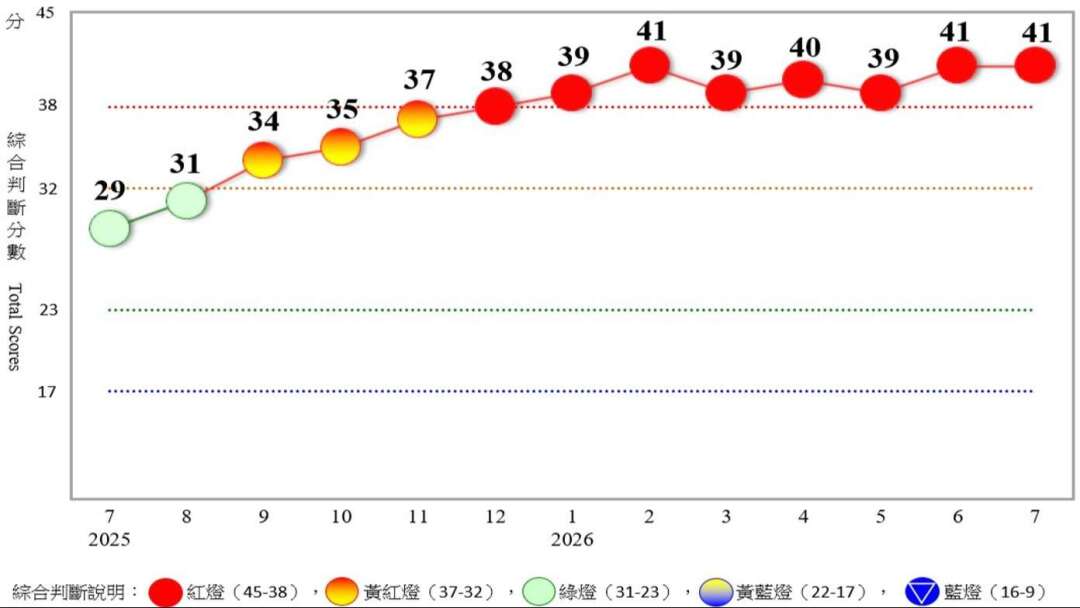
The National Development Council (NDC) today (27th) released the economic indicator signal for July 2023, with a composite score of 41 points, unchanged from the previous month, continuing to show a red light for the eighth consecutive month. The manufacturing business climate index improved from a green to a yellow-red light, driven by sustained strong AI demand. Meanwhile, the M1B monetary aggregate growth rate declined from 9.4% to 7.3% due to net foreign capital outflows, causing its signal to shift from yellow-red to green. The leading and coincident indicators continued to rise, indicating robust domestic economic growth momentum. However, attention is still needed regarding uncertainties such as developments in the Middle East, changes in U.S. tariff policies, major countries' monetary policy directions, and fiscal uncertainties.
Among the nine components, the manufacturing business climate index rose from 98.61 points last month to 101.09 points, gaining one point and shifting from green to yellow-red. The M1B monetary aggregate growth rate decreased from 9.4% to 7.3%, losing one point, with its signal changing from yellow-red to green. The remaining seven components maintained their previous signals: six items—stock price index, industrial production index, customs export value, machinery and electrical equipment import value, manufacturing sales volume index, and wholesale, retail, and food & beverage sales—continued to show red lights. The change in average overtime hours for industrial and service sectors remained at yellow-red.
On indicators, the July leading index (excluding trend) stood at 104.63, rising 0.72% week-on-week, with five out of seven components increasing: export order trend index, stock price index, real semiconductor equipment import value, manufacturing business climate index, and real M1B monetary aggregate. The coincident index (excluding trend) reached 106.80, up 0.36% week-on-week, with four components rising: wholesale, retail, and food & beverage sales; industrial production index; manufacturing sales volume index; and total electricity consumption.
Looking ahead, the NDC noted that as AI applications deepen and boost computing demand, major global cloud service providers are accelerating AI infrastructure investments. Combined with consumer electronics entering the pre-production phase for new products, exports are expected to maintain growth momentum. On investment, domestic semiconductor and AI supply chains are actively expanding capacity, international giants are increasing investments and procurement in Taiwan, and government initiatives to upgrade SMEs and traditional industries are supporting private investment growth.
On consumption, strong earnings among listed companies are boosting willingness to raise salaries and distribute dividends. Combined with a stable labor market and recovering auto demand, consumer activity is expected to remain vibrant. However, international trade and economic conditions remain subject to uncertainties including Middle East developments, U.S. tariff policy changes, major nations' monetary policy shifts, and fiscal instability, requiring close monitoring.
FACT BOX
- Source: PR Times
- Category: Survey