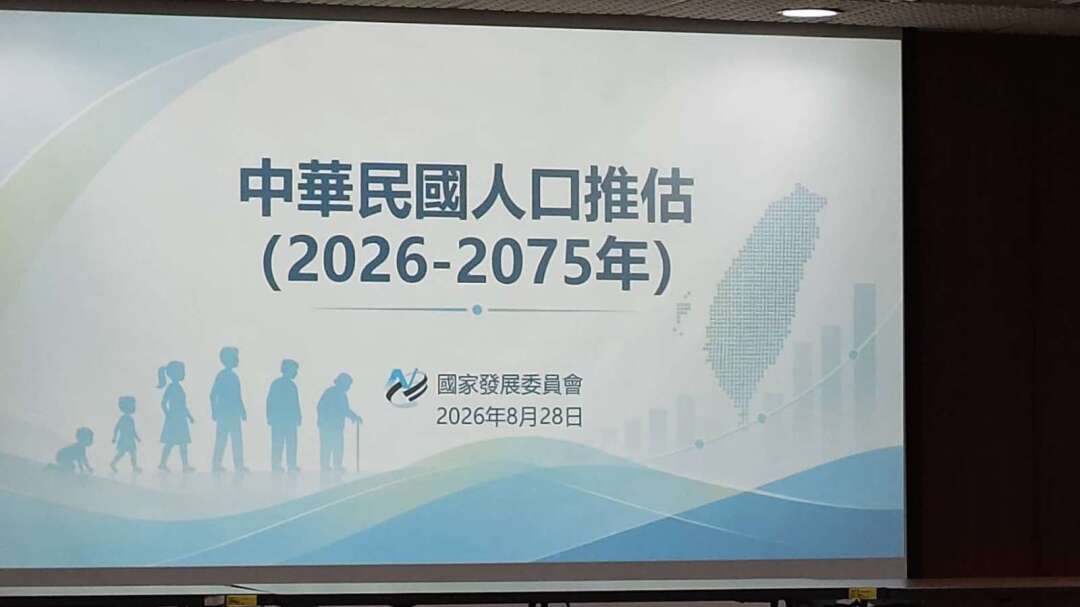
The National Development Council (NDC) held a press conference today (28th) to release the latest 'ROC Population Projections (2026–2075).' The results show that, amid accelerating low birthrates and aging, Taiwan's population structure is formally ending its labor-abundant era. The latest report delays the end of Taiwan's 'demographic dividend' from the previously projected 2028 to 2030. NDC's Director of Human Resources Development, Hsieh Chia-i, clarified that this 'delay' is not due to improved labor conditions, but a 'proportional change' resulting from a slower pace of structural shifts. Projections indicate that in 50 years, Taiwan's population will halve, with elderly (aged 65+) making up 52.9% of the total, and the median age soaring to 67.1 years—meaning 'one in two people will be a senior citizen'—an ultra-aging society. To address low fertility, aging, and labor shortages, the NDC will propose three strategic pillars—'Silver Generation,' 'Lifelong Talent Development,' and 'Global Talent Acquisition'—to the Executive Yuan in the second half of the year.
Hsieh explained that the 'demographic dividend' is defined as the working-age population (15–64) exceeding two-thirds (66.7%) of the total population. Due to Taiwan's rapidly declining birthrate, the total population (denominator) is shrinking faster than the working-age population (numerator). This slower rate of age-structure change has delayed, proportionally, the point at which the working-age share falls below two-thirds, pushing it back by two years to 2030. This is purely a 'ratio issue'—not an actual increase in the workforce. The trends of low fertility and aging remain unchanged.
According to NDC's aging data, by 2035 (10 years from now), Taiwan's total population will drop to 21.97 million, with elderly占比 reaching 28.7% and the median age rising to 52.1 years. By 2075 (50 years from now), the total population will halve to 12.15 million, with elderly占比 soaring to 52.9%. The median age will reach 67.1 years, resulting in an 'ultra-aged society' where 'one in two people is 65 or older.' This will cause the potential support ratio to plummet from 3.2 in 2026 to 0.8 in 2075—meaning every 100 working-age adults will support 136.6 dependents (children and elderly), creating an extremely heavy dependency burden.
To address the severe labor shortage and ultra-aging crisis, Hsieh noted that in addition to the Executive Yuan's existing 'Family Support' initiative, three additional strategic pillars will be planned by relevant ministries and the NDC and reported to the Executive Yuan in the second half:
'Silver Generation': Supervised by Minister without Portfolio Chen, this includes Long-term Care 3.0 and strategies for a super-aged society, aiming to ensure seniors live with dignity and fully utilize their potential for second careers.
'Lifelong Talent Development': Focuses on enhancing the 'value and quantity' of domestic labor, including boosting labor participation among middle-aged, older adults, and women; promoting cross-domain talent cultivation; and introducing AI and digital transformation to increase productivity and reduce reliance on traditional labor.
'Global Talent Acquisition': Actively 'recruiting and retaining' international talent, focusing on attracting foreign professionals, technical workers, and international students, while creating a welcoming, internationalized environment.
Hsieh emphasized that by promoting AI technology and transformation policies, the government aims to boost domestic labor productivity and, combined with overseas talent recruitment, ensure Taiwan's economy and demographic dividend can sustainably thrive in the new normal of a super-aged society.
FACT BOX
- Source: PR Times
- Category: Survey