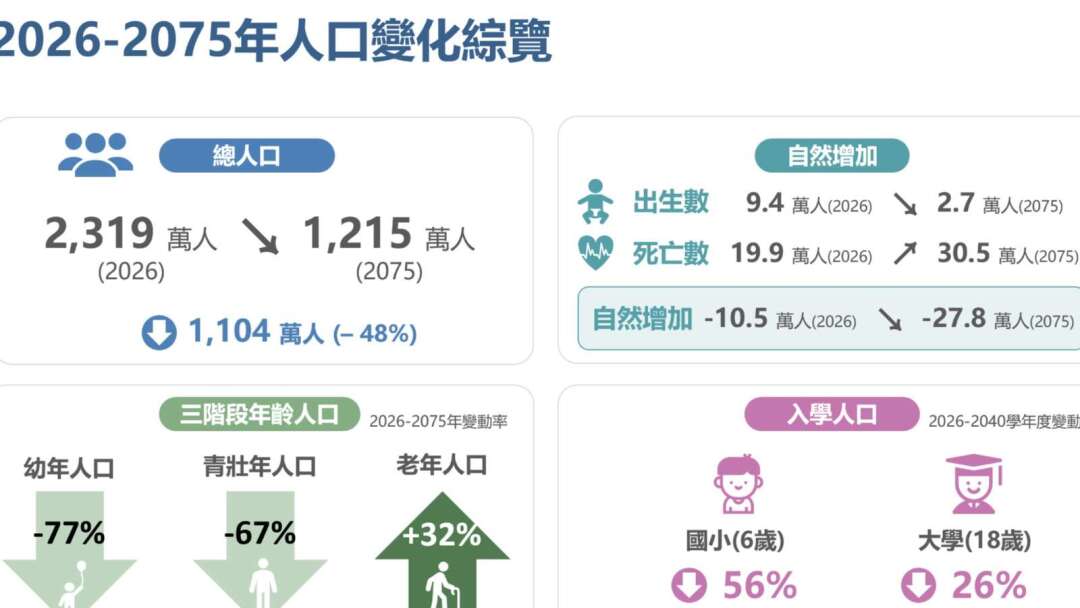
The National Development Council (NDC) has released its latest population projection, revealing that Taiwan faces a severe demographic crisis. Due to the dual pressures of low fertility and rapid aging, the total population could plummet to 12.15 million by 2075—nearly half of current levels—while the elderly population (aged 65 and over) will surpass 50% of the total.
With declining numbers of women of childbearing age and falling marriage rates, Taiwan has officially entered a post-labor-abundance era. The potential dependency burden on the working-age population is expected to increase dramatically. In response, the Executive Yuan has launched a new population strategy focusing on four pillars: family support, aging society adaptation, lifelong talent development, and global talent acquisition.
The NDC held a press conference today, chaired by Hsieh Chia-i, Director of the Human Resource Development Division, to release its biennial population projection report (2026–2075). Hsieh noted that Taiwan’s total fertility rate dropped to 0.695 last year—lower than expected—and continues to decline. This is compounded by a shrinking base of women aged 20 to 49 and decreasing marriage rates.
For the first time, this year’s projection incorporates short-term indicators such as prenatal examination records and marriage registrations, leading to a downward revision of the long-term fertility rate assumption for 2075 to between 0.6 and 1.1 children per woman.
The latest projections show that Taiwan’s population decline and aging are accelerating faster than anticipated. The total population is expected to fall from 23.191 million in 2026 to 21.972 million in 2035, 19.976 million in 2045, and just 12.15 million by 2075—nearly halving in size.
During this period, the working-age population (aged 15–64) will plummet from 67.9% to 42.3%, while the elderly population will surge to 52.9%. The median age is projected to reach 67.1 years.
This demographic shift will drastically increase societal dependency burdens. The potential support ratio—the number of working-age individuals per elderly person—will drop from 3.2 in 2026 to just 0.8 by 2075. The total dependency ratio will rise from 47.2 to 136.6, meaning that every 100 working-age individuals will need to support 136.6 dependents (children and elderly).
In response to this critical challenge, the government has established an executive task force for population strategy and introduced 18 measures, including family support and housing cost relief. These will be expanded to include policies targeting the silver economy, talent cultivation, and international talent recruitment to sustain national development.
FACT BOX
- Source: PR Times
- Category: Survey