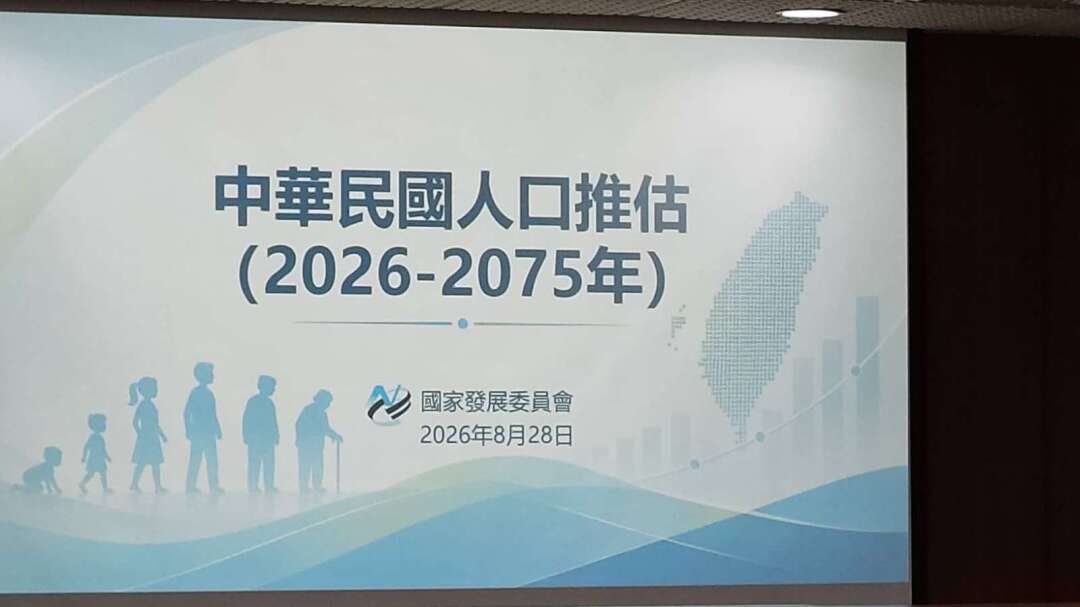
The National Development Council (NDC) held a press conference today (28th) to release the latest 'Republic of China Population Projections (2026–2075)', revealing that Taiwan faces an extremely severe challenge from low fertility. Taiwan's total fertility rate in 2025 has fallen to a critically low level of 0.695, a decline far exceeding expectations. In response, the NDC not only announced a downward revision of long-term fertility rate assumptions but also addressed the key question raised by media: 'Why can South Korea, but not Taiwan?' NDC's Director of Human Resource Development, Hsieh Chia-i, offered two explanations.
The NDC explained that, to enhance the timeliness and reference value of this projection, it has, for the first time, collaborated with the Ministry of Health and Welfare to incorporate short-term indicators such as 'number of prenatal checkups' and 'number of marriages.' As Taiwan is a country where most births occur within marriage, marriage and fertility behaviors are highly positively correlated. However, statistics show that the population of women aged 20–49 in Taiwan peaked in 2005 and has been continuously declining since, while the marriage rate has also been falling year by year, leading to a shrinking 'technical base' of people eligible for childbearing.
Therefore, the NDC has revised downward its long-term total fertility rate projections for 2075 across high, medium, and low scenarios—from the previous 1.3, 1.0, and 0.8 children per woman—to 1.1, 0.8, and 0.6, respectively.
In response to media inquiries about South Korea's recent fertility rebound and whether Taiwan faces policy limitations in catching up, Hsieh Chia-i explained that the 'child-rearing conditions' in the two countries are fundamentally different. South Korea's recent rise in birth rates is due to two main factors: first, a strong 'marriage boom' following the pandemic; second, and more crucially, South Korea has a 'rebound generation' (post-war baby boom cohort) born between 1991 and 1996. This large cohort is now entering their prime childbearing age of around 30, causing the number of women of childbearing age in South Korea to increase rather than decrease during this period.
In contrast, Taiwan lacks this structural advantage. The size of Taiwan's childbearing-age women is continuously shrinking. Without a population base to buffer the decline, it is extremely challenging for Taiwan to replicate South Korea's short-term rebound.
Facing this new reality, the NDC emphasized that the government's population strategy is not about imposing the 'duty' of childbearing on citizens, but rather about removing barriers. The Executive Yuan has established a cross-ministerial 'Population Strategy Task Force,' which launched the 'Family Support Package' in May this year. This package integrates 18 measures covering support for safe childbirth and parenting, enhanced childcare services, and housing cost relief. The government aims to create a supportive and inclusive social environment to lower the barriers for younger generations entering marriage and parenthood, striving to improve future fertility rates toward the 'high projection' scenario of 1.1 children per woman.
FACT BOX
- Source: PR Times
- Category: Survey