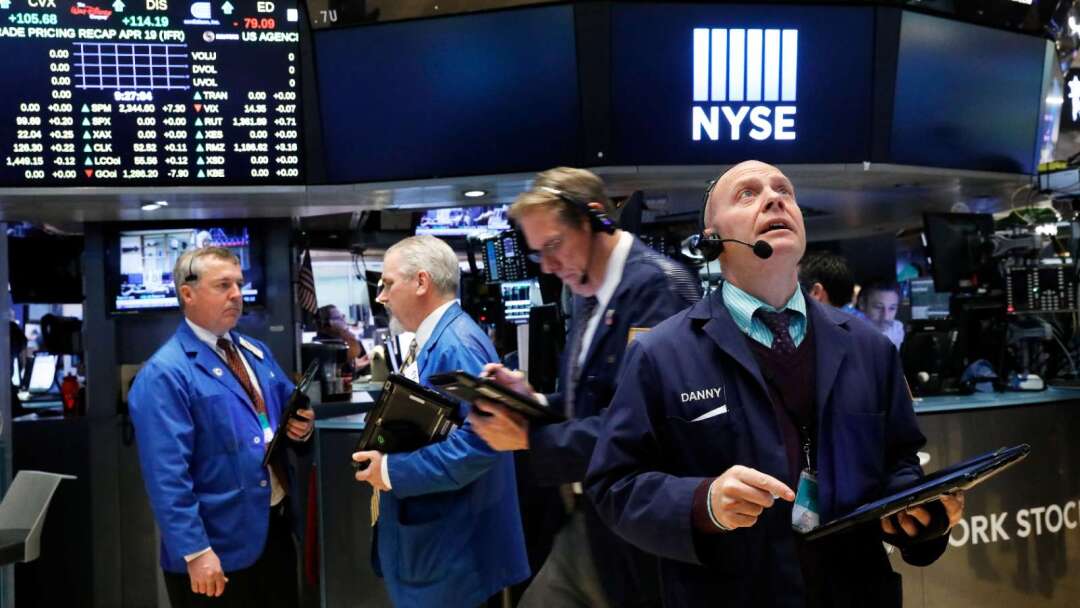
U.S. stocks opened lower on Monday (14th) as leaders in the artificial intelligence (AI) industry issued successive warnings about safety risks and called for a slowdown in AI development, triggering market concerns that the AI investment boom could cool down. Chip stocks such as NVIDIA (NVDA-US) came under pressure, sending both the Nasdaq Composite Index and the S&P 500 lower.
Meanwhile, renewed disruptions to oil supply in the Middle East pushed up international oil prices, further dampening market risk appetite.
At press time:
The Dow Jones Industrial Average was down nearly 150 points, or about 0.3%; the Nasdaq Composite Index fell nearly 320 points, or around 1.2%; the S&P 500 dropped approximately 0.8%; and the Philadelphia Semiconductor Index declined nearly 5.9%. TSMC's ADR fell more than 2.0%.
U.S. stocks were already trading lower in pre-market activity, as an unusual appeal from AI industry leaders to slow down the development of advanced models combined with renewed Middle East tensions disrupting oil supplies and pushing oil prices sharply higher—creating a double negative impact on market sentiment. Nasdaq 100 futures plunged 1.6%, S&P 500 futures dropped 0.7%, and an ETF tracking major chipmakers fell 5.4% before the opening bell.
AI-related stocks were hit hardest. Dario Amodei, CEO of Anthropic, said on Saturday that his company would introduce new safety measures and urged the industry to slow the development of its most advanced AI models. Sam Altman, CEO of OpenAI, voiced support, while Elon Musk, CEO of xAI, stated bluntly, "Dario is right."
These comments sparked market worries that if the pace of AI development is restricted, it could undermine the AI investment frenzy that has driven hundreds of billions of dollars in capital expenditures in recent years. SoftBank Group, a key investor in OpenAI, saw its shares post their largest drop in nearly three months, while South Korea’s Kospi index plunged 3.3%.
However, some market participants question whether AI giants will truly hit the brakes, especially given intense competition from China. Former U.S. President Donald Trump downplayed these concerns, while China criticized such statements as "spreading fear." Mohit Kumar, strategist at Jefferies, believes safety safeguards can help guide AI development but won’t actually slow technological progress, noting that the long-term trend of AI advancement will continue.
At the same time, renewed interference in Middle Eastern oil supplies added further downward pressure on markets. Saudi Arabia shut down its East-West Pipeline as a precautionary measure after coming under attack, causing Brent crude to surge 3.9%, breaking above $108 per barrel. The U.S. dollar index rose 0.4%, the 10-year U.S. Treasury yield approached 5%, and money markets now price in nearly a 90% chance of a Fed rate hike on Wednesday.
Tim Waterer, Chief Market Analyst at KCM Trade, noted that the combination of warnings over slowing AI development and rising oil prices creates a particularly unfavorable environment for risk assets.
European markets also faced pressure. The Stoxx 600 index fell 0.4%, with rising energy prices fueling inflation concerns. The yield on two-year UK government bonds rose 10 basis points to 4.91%, while the euro fell to a one-month low against the U.S. dollar.
This week, global central bank decisions are in focus. The Federal Reserve (Fed) and the Bank of Japan (BOJ) will announce interest rate decisions on Wednesday and Friday respectively. With inflation pressures mounting, both face upward pressure to raise rates. Although the Bank of England (BOE) is expected to hold steady on Thursday, markets haven't ruled out a rate hike in November. ECB Governing Council member Kazimir also stated that the ECB will raise rates further without hesitation if evidence warrants it.
As of around 9:00 PM Taipei time on Monday (14th):
Dow Jones Industrial Average: Down 164.41 points (-0.31%) at 52,408.88
Nasdaq Composite Index: Down 310.08 points (-1.18%) at 26,022.96
S&P 500 Index: Down 55.53 points (-0.73%) at 7,601.45
Philadelphia Semiconductor Index: Down 646.17 points (-5.47%) at 11,177.83
TSMC ADR: Down 3.26% to $419.07 per share
10-Year U.S. Treasury Yield: Up to 4.98%
NY Light Crude Oil: Up 3.69% to $103.74 per barrel
Brent Crude Oil: Up 3.97% to $108.76 per barrel
Gold: Down 2.17% to $4,313.40 per ounce
U.S. Dollar Index: Up to 99.63
Key individual stocks:
Intel (INTC-US): Pre-market share price down 8.01% to $94.69 per share
Warnings from AI industry leaders urging a slowdown in AI capability development triggered broad declines among major chip stocks ahead of Monday’s open. Intel (INTC-US) plunged nearly 6%, Marvell Technology (MRVL-US) fell over 7.4%, and AMD (AMD-US) also dropped over 5%. Dario Amodei and others warned that AI technology is advancing too quickly and should be slowed with enhanced safety assessments.
Hewlett Packard Enterprise (HPE-US): Pre-market share price down 9.89% to $55.95 per share
Warnings from Elon Musk, Anthropic’s Amodei, and OpenAI’s Altman regarding AI development speed and safety risks dragged down AI infrastructure stocks in pre-market trading. HPE fell over 7%, while IT solutions provider Super Micro Computer (SMCI-US) also declined over 5%.
Palo Alto Networks (PANW-US): Pre-market share price up 4.73% to $346.31 per share
Growing concerns over AI safety boosted cybersecurity stocks in pre-market trading. As Musk, Amodei, and Altman warned of overly rapid AI development, markets anticipate increased cybersecurity investment from enterprises and governments. Palo Alto Networks rose over 4% pre-market, while CrowdStrike (CRWD-US) surged 5.4%.
Today’s key economic data:
None
Wall Street analysis:
Three pressures are converging on markets. Michael Hartnett, Chief Investment Strategist at Bank of America, warned that record-high diesel prices, 30-year U.S. Treasury yields soaring to their highest since 2007, and underlying productivity concerns masked by the AI boom are collectively building the risk of stagflation this autumn.
FACT BOX
- Source: PR Times
- Category: News
- Organizations: NVIDIA / Intel / Marvell Technology