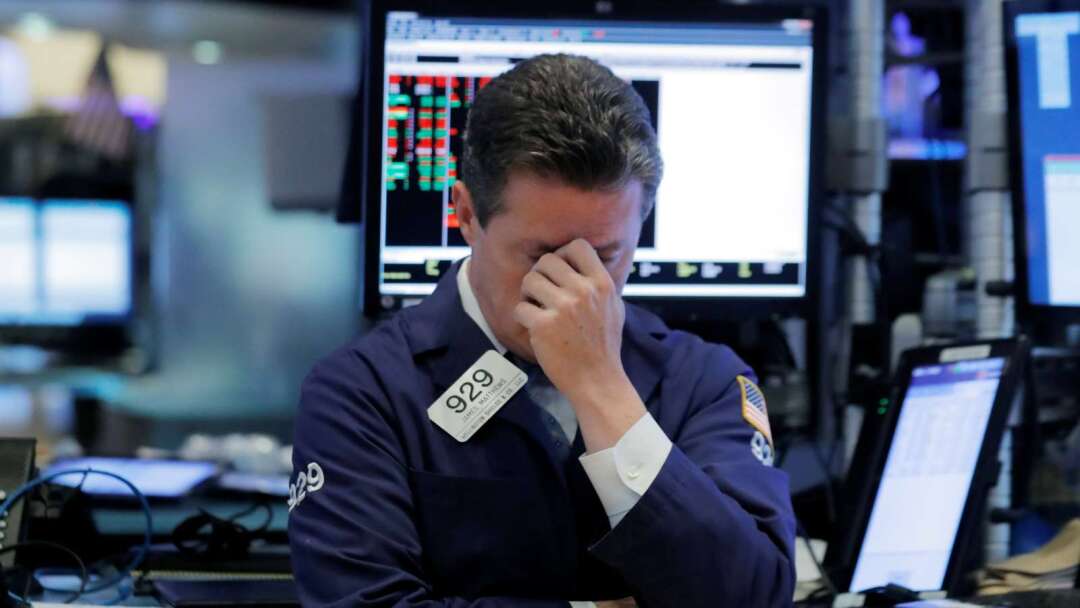
According to CNBC, rising oil prices and inflation fears triggered by the Iran conflict, combined with strong market expectations of a 25-basis-point rate hike by the Federal Reserve (Fed) on Wednesday, have pushed yields across all maturities of U.S. Treasuries higher. On Tuesday, October 15, the yield on the 10-year U.S. Treasury note surged past 5%, reaching its highest level since 2007.
While bond prices continue to face downward pressure, some fixed-income strategists argue that with yields at multi-year highs, the interest income provided by bonds is now sufficient to absorb part of the price decline. As a result, the risk-reward balance of intermediate-term bonds has improved, and investors may reconsider their asset allocation.
### Oil Prices and Rate Hike Expectations Push Yields Higher
The 10-year Treasury yield briefly touched 5.041% during trading, the highest since July 2007, closing around 5.00%, up more than 3 basis points from the previous session.
The 30-year Treasury yield, more sensitive to geopolitical risks, rose to 5.401%, the highest since June 2007. The 2-year yield reached 4.688%, marking a new high since July 2024.
Markets currently expect the Fed to raise rates by 25 basis points following its two-day policy meeting ending Wednesday. According to the CME FedWatch tool, traders assign over a 94% probability to a 25-basis-point hike.
Jonathan Liang, Head of Fixed Income and Foreign Exchange Investment at Standard Chartered Bank, stated that the 10-year U.S. Treasury yield is highly sensitive to inflation expectations. With inflation indicators still above the Fed’s 2% target, this tight correlation is expected to persist for some time.
### Correlation Between Oil Prices and Treasury Yields Rises to 0.96
International oil prices are another key factor driving yields higher. Ongoing conflict with Iran and the de facto blockage of the Strait of Hormuz have pushed West Texas Intermediate (WTI) crude oil back above $105 per barrel on Tuesday.
Oil prices spiked earlier this year after the U.S. and Iran clashed, then fell below $70 per barrel in July as both sides signed a memorandum and hopes grew for de-escalation. Recently, renewed attacks and declining crude inventories have driven energy prices higher again.
Diesel prices have also recently surpassed $6 per gallon, further fueling inflation concerns.
Data from BMO Capital Markets shows that the one-month rolling correlation coefficient between front-month WTI futures and the 10-year Treasury yield has risen to 0.96.
Sosnick, Chief Strategist at Interactive Brokers, noted that while rising oil prices typically boost inflation expectations, the current geopolitical impact on oil prices and global inflation is particularly pronounced, making the relationship tighter than before. As long as oil prices remain elevated or continue to rise, interest rates will continue to face upward pressure.
However, Kevin Hassett, Director of the White House National Economic Council, believes recent data already shows inflation is slowing, which could become a reason for Fed officials to oppose a rate hike. Still, the White House will respect the Fed’s final decision.
### Higher Yields Mean Greater 'Price Buffer' for Bonds
Although yields breaking 5% unsettles markets, they also increase bond coupon income, enhancing investors’ ability to withstand price declines compared to the low-rate environment of 2020.
Lucas, Head of Fixed-Income Research at Morningstar, stated that as yields rise, bonds now possess a far greater price buffer than in 2020. An investor who buys $1 million worth of 10-year Treasuries yielding 5% would earn approximately $50,000 annually—$500,000 over ten years—making such bonds more attractive to high-net-worth investors seeking low-risk income.
Roche, founder of Discipline Funds, described the break-even point where bond income offsets price losses as 'escape velocity.' When a bond's yield and modified duration are close, one year of interest income could potentially offset the price drop caused by a 1-percentage-point rise in yields.
Roche pointed out that at current interest levels, bonds with maturities under five years already have sufficient buffers; the longer the maturity, the weaker the ability to withstand further yield increases.
Michael Reynolds, Deputy Chief Investment Strategist at Glenmede, illustrated that if a bond yields 4.90% with a duration of 5.8 years, yields could rise by about 0.84 percentage points before price losses outweigh a full year’s interest income. The higher the base yield, the lower the relative cost of an incorrect investment judgment.
### Risk-Reward Profile Improves for 7- to 10-Year Treasuries
Strategists generally recommend that investors sensitive to price volatility prioritize short- to intermediate-term bonds to mitigate the impact of further yield increases.
For those able to tolerate higher volatility, 5- to 10-year bonds may be considered. Reynolds believes the 7- to 10-year range currently offers a better risk-reward profile.
Scott Helfstein, Head of Investment Strategy at Global X, suggested investors adopt a 'bond ladder' strategy, spreading investments across 5- to 10-year U.S. Treasuries to reduce exposure to interest rate fluctuations and single-entry timing risks.
Ultra-short-term bonds remain the most popular strategy through 2026. iShares 0-3 Month Treasury ETF (SGOV-US) saw net inflows of $41 billion this year. However, Helfstein noted that slightly extending maturities allows investors to access the most attractive yields in nearly two decades.
Investors can also participate via iShares 1-3 Year Treasury ETF (SHY-US), iShares 3-7 Year Treasury ETF (IEI-US), or broader-market funds like Vanguard Total Bond Market ETF (BND-US) and iShares Core U.S. Aggregate Bond ETF (AGG-US).
### 5% Risk-Free Yield Enhances Bond Appeal
Link, Chief Investment Strategist at Hightower Advisors, still favors the growth potential of equities but acknowledged that the 10-year Treasury yield rising to 5% has clearly enhanced bond attractiveness.
She said that if the 5% yield holds for three to six months, it will attract more investor attention. Portfolios that became overweight in stocks due to equity gains could consider taking partial profits and reallocating to bonds.
Link noted that as long as inflation doesn’t spiral out of control, investors holding to maturity can lock in a 5% low-risk return. If inflation remains at 2% to 3% over the next decade, this allocation becomes even more appealing.
FACT BOX
- Source: PR Times
- Category: News
- Organizations: CNBC / CME / BMO Capital Markets
- Products / services: ETF(SGOV-US, SHY-US, IEI-US, BND-US, AGG-US)