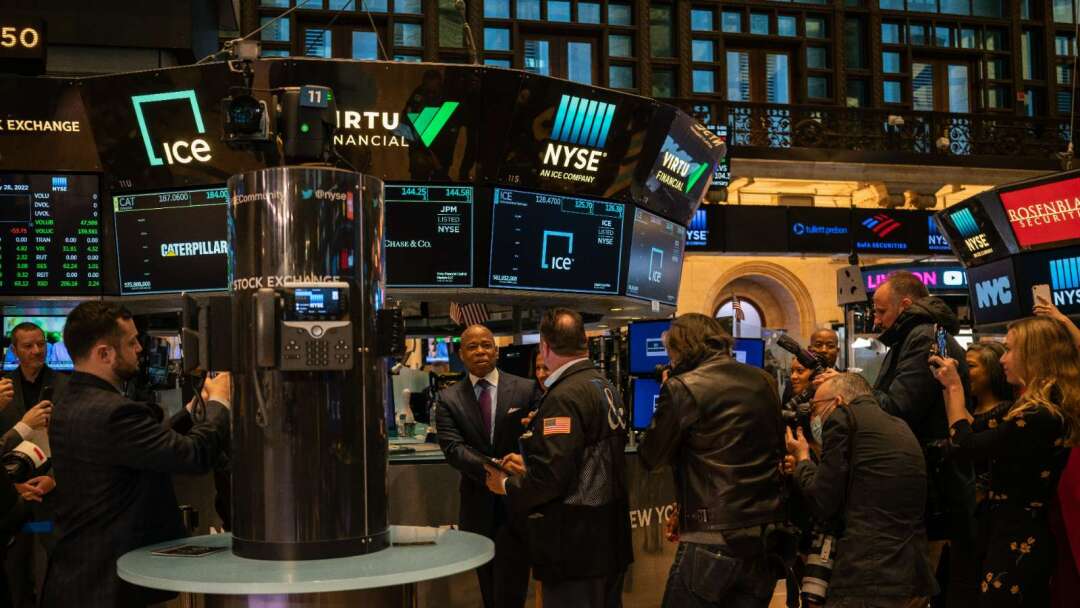
The three major US stock indices all fell on Tuesday (15th) as investors reduced risk exposure ahead of the Federal Reserve's interest rate decision. International oil prices surged again, and the yield on US 10-year Treasury bonds broke through 5%. AI-related stocks rebounded after pressure on Monday, with the PHLX Semiconductor Index rising 0.40% against the trend.
The market is almost certain that the Fed will raise rates by 1 percentage point on Wednesday. With core inflation exceeding expectations and energy prices continuing to rise, investors' focus has shifted from "whether to raise rates" to whether this marks the beginning of a new rate hike cycle.
The bond market continued to see selling pressure on Tuesday, with the yield on US 10-year Treasury bonds rising to 5.041%, the highest since July 2007. The yield on 30-year bonds also reached 5.401%. Demand for a $200 billion auction of 20-year Treasury bonds was weak, further exacerbating the decline in long-term bonds. US fiscal deficits, AI infrastructure spending, and inflation pressures are all causing investors to demand higher term premiums.
International oil prices resumed a sharp rise on Tuesday, with Brent crude oil rising about 2.9% to $108.75 per barrel, and West Texas Intermediate crude oil surging about 4.4% to $105.83 per barrel.
Libya's National Oil Corporation announced that the security guards responsible for oil facilities closed the main pipeline valve connecting Hamada and Zawiya, causing three oil fields and pumping stations to shut down. They threatened to halt all production if their demands were not met, and officials may be forced to declare force majeure.
Additionally, Saudi Arabia's East-West oil pipeline was closed after being attacked by Yemen's Houthi militants, and oil loading operations at the Red Sea port of Yanbu were reported to have been suspended, deepening market concerns about supply disruptions.
The performance of major US stock indices on Tuesday (15th) was as follows: - Dow Jones Industrial Average: Down 328.09 points (0.63%) to 52,093.11 points - Nasdaq Composite: Down 204.84 points (0.78%) to 25,981.57 points - S&P 500: Down 34.25 points (0.45%) to 7,585.73 points - PHLX Semiconductor Index: Up 44.27 points (0.40%) to 11,175.55 points - NYSE FANG+ Index: Down 163.83 points (0.88%) to 18,505.38 points
Among the focus stocks, most of the tech giants in the NYSE FANG+ Index fell. Meta (META-US) rose 0.70%; Apple (AAPL-US) fell 0.52%; Alphabet (GOOGL-US) fell 1.26%; Microsoft (MSFT-US) fell 1.64%; Amazon (AMZN-US) fell 2.02%. The PHLX Semiconductor group saw mixed performance. AMD (AMD-US) rose 2.19%; Broadcom (AVGO-US) fell 1.58%; NVIDIA (NVDA-US) rose 0.57%; Applied Materials (AMAT-US) fell 0.72%; Qualcomm (QCOM-US) surged 4.25%. Memory-related stocks generally fell. Micron (MU-US) rose 0.39%; Western Digital (WDC-US) fell 3.51%; SanDisk (SNDK-US) fell 1.36%; Seagate (STX-US) plummeted 4.19%; SK Hynix ADR (SKHY-US) fell 0.46%. Taiwan ADRs saw mixed performance. TSMC ADR (TSM-US) fell 1.02%; ASE ADR (ASX-US) rose 0.11%; UMC ADR (UMC-US) fell 1.32%; Chunghwa Telecom ADR (CHT-US) rose 0.27%.
In corporate news, NVIDIA (NVDA-US) rose about 0.6% to $212.17 per share. CEO Jensen Huang and former US President Trump both refuted the "AI doomsday" theory. The two spoke during the All-In Summit in Los Angeles, with Trump dismissing claims to limit AI development as a "scam," while Huang said that in the US AI race, "everyone will be a winner."
Meta (META-US) rose 0.70% to $670.24 per share, as Meta plans to start deploying its next-generation in-house AI chips in data centers in the first half of next year to reduce dependence on external chip suppliers.
Software stocks were under pressure as investors took profits after gains in the previous trading day. Palantir (PLTR-US) fell 0.43%, Workday (WDAY-US) fell 1.82%, and CrowdStrike (CRWD-US) rose 3.02%.
Due to the failure of the cryptocurrency regulatory bill, the Clarity Act, to advance in the Senate on Tuesday, market expectations for the bill's passage this year have cooled. Cryptocurrency-related stocks plummeted. Cryptocurrency exchange Coinbase (COIN-US) crashed more than 10%. Robinhood (HOOD-US) plummeted 3.4%.
Tesla (TSLA-US) fluctuated and closed lower on Tuesday, falling about 0.7% to $356.58 per share. CEO Elon Musk recently hinted in an episode of the All-In Podcast, featuring SpaceX President Gwynne Shotwell, that Tesla and SpaceX might merge.
Musk also promoted Tesla's second-generation electric sports car, the Roadster, which is scheduled to be officially unveiled on October 1.
Wall Street analysts: BMO Wealth Management market strategist Carol Schleif said that with inflation data being hot, strong corporate earnings, and a resilient labor market, the Fed has little room not to raise rates. She believes that if the Fed unexpectedly holds rates steady, the stock market might be disappointed, as the bond market has been signaling for weeks that rates should be higher.
Principal Asset Management global chief strategist Seema Shah noted that market discussions have shifted from "whether the Fed will raise rates" to how much policy tightening is needed to restore price stability. The likelihood of the Fed raising rates only once and then stopping is low, meaning investors still need to assess the magnitude and duration of future rate hikes.
Jones Trading market strategist Michael O'Rourke said that the 10-year yield breaking 5%, combined with West Texas Intermediate crude oil futures hitting a new high, is putting double pressure on the stock market from rising yields and energy prices.
Wolfe Research strategist Chris Senyek said that if the Fed raises rates as expected by the market, US stocks may face short-term downward pressure, but historical experience shows that 6 to 12 months after the first rate hike, US stocks typically rebound and turn upward.
Senyek believes that this rate hike does not necessarily mean that US stocks have already peaked, and tech stocks can still benefit from the long-term AI trend, strong corporate earnings, and the resilience of the US economy.
Edward Jones strategist Brock Weimer also said that limited additional rate hikes are unlikely to derail overall economic expansion or end the US stock bull market.
FACT BOX
- Source: PR Times
- Category: News
- Organizations: Meta / Apple / Alphabet