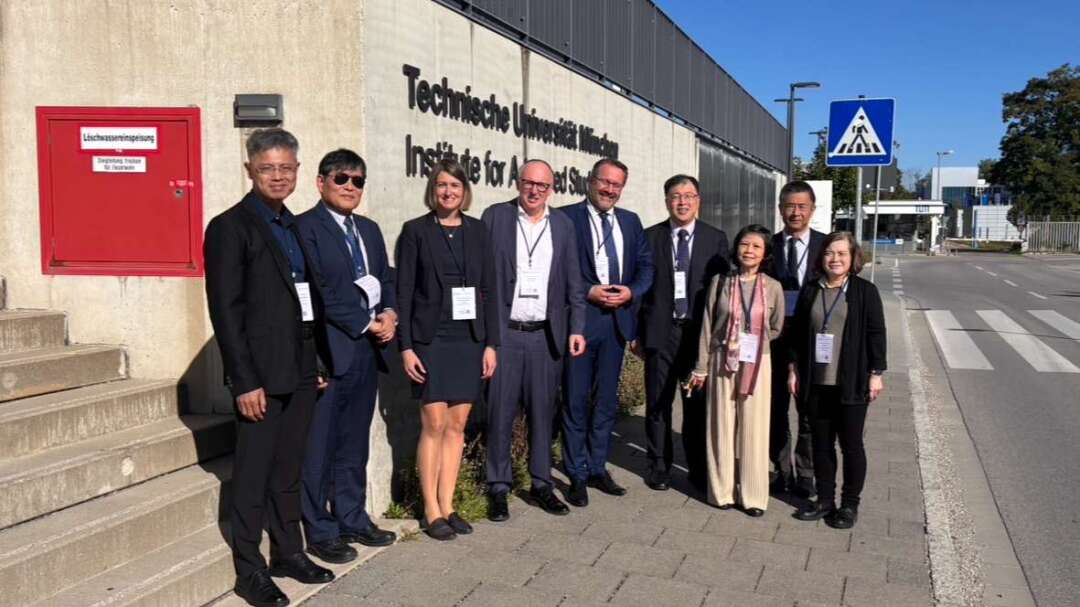
The National Science and Technology Council (NSTC) and Germany's Federal Ministry for Research, Technology and Space (BMFTR) jointly hosted the '2026 Taiwan-Germany Semiconductor Collaboration Outcomes Symposium' in Munich, Germany, from September 15 to 17, Taiwan time, further deepening the strategic partnership between Taiwan and Germany in semiconductor chips and industrial innovation. The NSTC stated that this symposium integrates complementary R&D capabilities from both sides to explore key technologies in advanced chips, heterogeneous integration, and emerging systems, while encouraging research teams to conduct overseas research exchanges to enhance the international visibility and impact of collaborative outcomes.
NSTC Engineering Division Director Hung Lo-wen stated that since 2017, the NSTC and Germany's BMFTR have jointly funded bilateral research teams, initially focusing on battery-related research projects. The collaboration has been close and highly successful, leading to the signing of the Taiwan-Germany Science and Technology Cooperation Agreement (STA) in 2023. Under this framework, bilateral international research programs in the semiconductor field were launched in 2024, with 23 research projects currently receiving funding.
Dr. Fabian Kohler, representative of Germany's BMFTR, emphasized that in the current geopolitical climate, Taiwan-Germany semiconductor cooperation is crucial for building a robust talent pool in chip design and enhancing global market resilience. He noted that both sides exchange cutting-edge technologies, transform research outcomes into local value, and strengthen innovation capacity to address technological and societal challenges. The BMFTR expressed its desire for long-term collaboration with Taiwan, aiming to continuously strengthen the scientific cooperation framework and provide resources to advance the microelectronics R&D partnership to the next stage.
The forum brought together core research team members from the Taiwan-Germany semiconductor cooperation projects spanning 2024 to 2026. Research topics focused on edge computing AI chips, wireless communications, design automation, advanced packaging, and quantum computing. BMFTR also arranged visits and exchanges with academic and industrial institutions, including Infineon (DE-IFX), BMW's chip design division, TSMC's (2330-TW) European Design Center, Siemens AG, Friedrich-Alexander University Erlangen-Nürnberg (FAU), and the Fraunhofer Institute for Integrated Circuits (Fraunhofer IIS).
On September 16, the delegation visited the Bavarian State Ministry of Economic Affairs. Taiwan's Representative to Germany, Ambassador Ku Jui-sheng, pointed out that Taiwan possesses the world's most complete semiconductor and technology ecosystem, producing over 99% of the world's advanced semiconductor chips and high-end AI server equipment. He stated, 'Without Taiwan, there is no AI.'
The NSTC emphasized that through the continuous advancement of the Taiwan-Germany semiconductor cooperation program, an interdisciplinary and intergenerational platform is being established to foster international perspectives and collaboration opportunities for emerging talent. This initiative further drives industrial innovation through semiconductor chips, serving as a critical foundation for the next phase of large-scale and high-impact international cooperation, while continuously enhancing Taiwan's pivotal role in the global scientific research network.
FACT BOX
- Source: PR Times
- Category: Event
- Organizations: Infineon (DE-IFX) / BMW / TSMC (2330-TW)