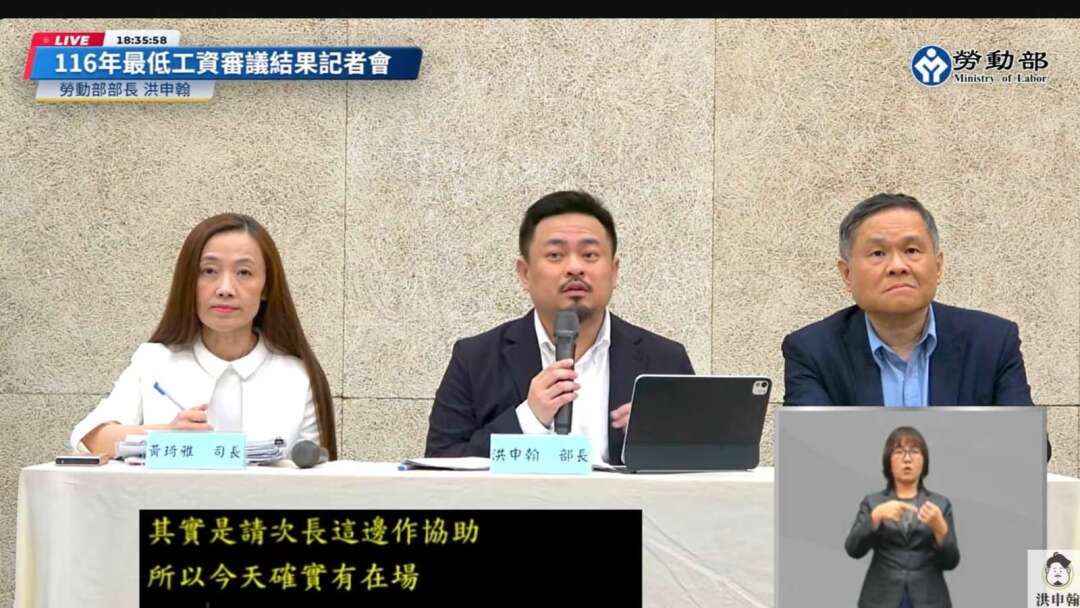
Taiwan's economic growth rate is projected to soar to 11.05% this year, yet the minimum wage will rise by less than 5%. The disconnect between robust GDP growth and stagnant wages has become the central debate in this year's minimum wage deliberations. After approximately 7.5 hours of negotiations, the Minimum Wage Committee decided today (24th) that starting in 2027, the monthly minimum wage will increase from NT$29,500 to NT$30,900—an addition of NT$1,400, or a 4.745% raise. The hourly rate will also rise from NT$196 to NT$205, marking the first time the monthly minimum exceeds NT$30,000.
Why does GDP growth at 11.05% result in only a 4.745% wage increase? Following the meeting, Labor Minister Hung Sheng-han pointed to "industrial disparities" as the key factor. This year’s rapid economic expansion has been primarily driven by AI, high-tech, and semiconductor industries, while traditional sectors, service industries, and small and micro enterprises have not enjoyed the same level of growth benefits. Directly linking minimum wage adjustments to GDP growth could impose excessive personnel cost burdens on certain businesses.
This led to intense negotiations during this year’s review. Labor representatives argued that economic gains should be shared by both employers and employees, proposing a pre-meeting increase of 7.77%. Business representatives countered that economic conditions vary significantly across industries, emphasizing that traditional sectors and SMEs are under financial strain and that minimum wage decisions cannot rely solely on favorable macroeconomic figures. In the final stage, labor demanded NT$31,100 while business held firm at NT$30,700. The two sides remained deadlocked over the NT$400 difference for about 40 minutes before converging on NT$30,900.
Another major consideration was inflation. Minister Hung noted that fully reflecting changes in the Consumer Price Index (CPI) was nearly a consensus among committee members. However, how to share the benefits of GDP growth became the most prolonged discussion point due to uneven industry performance—some sectors thriving while others struggle.
Although the 4.745% increase falls far below the 11.05% GDP growth rate, the NT$1,400 nominal raise marks the largest single increase in history. Minister Hung explained that because the current minimum wage base is higher than in previous years, even a percentage increase below 5% translates into a greater actual salary boost than in past adjustments. This revision is expected to benefit 2.6116 million workers, including 2.1972 million domestic workers and approximately 414,400 foreign laborers.
Notably, the minimum wage hike will also increase cost pressures on SMEs, traditional industries, and the service sector. Economic Minister Kung Ming-hsin previously stated that his ministry would collaborate with the Ministry of Labor to develop industry-specific support measures, potentially expanding subsidy programs—modeled after those used during pandemic-hit sectors—from manufacturing to services.
If approved by the Executive Yuan, Taiwan will see its eleventh consecutive annual minimum wage increase. However, as AI and semiconductors push GDP growth into double digits while minimum wages rise by only 4.745%, this highlights the K-shaped industrial divergence underlying Taiwan’s current economic boom. Whether GDP growth can truly translate into broad-based wage gains for all citizens will remain a core challenge for future labor policy.
FACT BOX
- Source: PR Times
- Category: News