When Can You Move Into a Used Home? Survey on Move-in Speed for Used Homes
When buying a home, it's not just price and location that matter.
The speed of moving in—"when can I start my new life?"—is also a crucial factor that shouldn't be overlooked.
In this regard, used homes have a clear advantage: since the building already exists, there's no need to wait for construction to finish.
So, how soon can you actually move into a used home?
To explore this, NEXER Group conducted a joint survey with Sumakana, targeting 83 men and women nationwide who previously answered "yes" to having purchased a used home, asking about the "move-in speed for used homes."
※When quoting this press release, please follow these guidelines:
・Indicate the source as "Survey by NEXER Group and Sumakana"
・Include a link to Sumakana (https://www.sumakana.net/)
Survey Overview: "Move-in Speed for Used Homes"
Method: Online questionnaire
Period: June 11–18, 2026
Respondents: Men and women nationwide who previously answered "yes" to having purchased a used home
Valid responses: 83 samples
Survey questions:
Q1: When purchasing a used home, how much did you prioritize "move-in speed"?
Q2: Please explain your reason.
Q3: At the time of contract, what was your ideal "time between contract and move-in"?
Q4: Why did you prefer that timeframe?
Q5: In reality, how long did it take from contract to move-in?
Q6: How did the actual move-in timing compare to your original ideal?
Q7: Please select any "time-related benefits" you felt from choosing a used home. (Multiple answers allowed)
Q8: If there were specific situations or episodes where the "fast move-in" unique to used homes was beneficial, please share.
※Percentages are rounded to the nearest hundredth, so totals may not sum to 100%.
55.4% said they prioritized "move-in speed" when purchasing a used home
First, we asked how much respondents prioritized move-in speed when buying a used home.
"Very prioritized": 19.3%, "Somewhat prioritized": 36.1%.
Combined, 55.4% of respondents prioritized move-in speed.
On the other hand, "Not much prioritized": 28.9%, "Not at all prioritized": 15.7%.
We also collected reasons—here are some examples:
Respondents who said they prioritized speed:
・I was in late pregnancy and wanted to move before the baby was born. (Female, 40s)
・I had a deadline to vacate company housing. (Female, 50s)
・I wanted to make it in time for my child's new school year. (Male, 70s)
Respondents who said they did not prioritize speed:
・I took my time selecting. (Female, 30s)
・I moved in after a full renovation. (Female, 40s)
・A house is a lifelong asset, so rushing isn't wise. (Male, 50s)
Among those who prioritized speed, many cited life events such as "making it for the new school year" or "moving before childbirth." It appears that upcoming life milestones often drive the desire for faster move-in.
Meanwhile, those who didn't prioritize speed mentioned reasons like "I'm renovating, so no rush" or "a house is for life, so no need to rush." The differing priorities reflect diverse lifestyle needs—some value speed, others prefer a careful approach.
79.5% said their ideal "time from contract to move-in" was "within 3 months"
Next, we asked about the ideal timeframe respondents had in mind at the time of contract.
"Within 3 months" was the most common answer at 47.0%.
Followed by "within 1 month" at 32.5%, "within 6 months" at 16.9%, and "more than 6 months" at 3.6%.
We also asked why they preferred that timeframe—here are some responses:
Respondents who chose "within 1 month":
・I wanted to move in as soon as possible. (Male, 30s)
・I chose the fastest option within my constraints. (Male, 50s)
・I wanted to finalize the contract before the seller changed their mind. (Male, 80s)
Respondents who chose "within 3 months":
・I factored in time for procedures and moving preparations. (Male, 30s)
・I wanted to settle in quickly. (Male, 40s)
・It depended on the lease terms of my previous home. (Female, 50s)
Respondents who chose "within 6 months":
・Timing of lease renewal. (Male, 40s)
・Constraints from commuting and lifestyle. (Male, 50s)
・I needed renovations to make it livable. (Male, 80s)
Those who preferred early move-in (within 1 or 3 months) often cited unique relocation challenges like lease renewals or previous housing contracts. Some even made practical calculations, allowing 3 months for moving prep.
Others mentioned wanting to act before "the seller changed their mind," showing awareness of the interpersonal nature of real estate transactions. Perhaps many people seek a certain pace because home buying isn't solely about personal convenience.
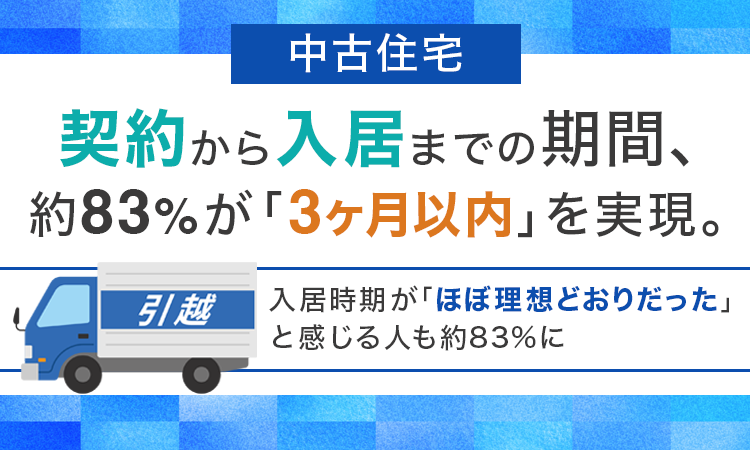
83.1% said the actual move-in period was "within 3 months"
Next, we asked how long it actually took to move in.
The results: "within 3 months" at 48.2%, followed by "within 1 month" at 34.9%, totaling 83.1% who moved in within 3 months of contract. "Within 6 months" was 13.3%, and "over 6 months" was only 3.6%.
The short move-in period is a major advantage unique to used homes. Once contracts and procedures are complete, move-in can happen relatively quickly, making it an accessible option for those eager to start a new life or with tight relocation timelines.
83.1% said the actual move-in timing was "almost ideal"
Next, we asked how the actual move-in timing compared to their original ideal.
"Almost ideal" accounted for 83.1%—a clear majority.
"Earlier than ideal": 14.5%, "Later than ideal": only 2.4%.
Over 80% successfully moved in at their desired time.
In relocations, schedule slippage is not uncommon.
Yet, the low number of people reporting significant delays is a reassuring result.
45.8% said the time benefit was "easier to adjust moving and move-in timing"
Finally, we asked about "time-related benefits" they felt from choosing a used home.
The most common response was "easier to adjust moving and move-in timing" at 45.8%.
Next was "no stress from waiting for building completion" at 14.5%, "temporary
FACT BOX
- Source: PR TIMES
- Category: Survey