Do many women experience physical and mental discomfort during life stage transitions?
Menstruation, pregnancy and childbirth, menopause.
A woman’s mind and body undergo significant changes with each shift in life stage.
"Feeling generally unwell," "unable to shake off fatigue."
Many women may increasingly notice such discomforts as they age.
So, how do women respond to changes in their bodies, and what nutrients do they consciously consume?
To explore these questions, we conducted a joint survey with Sajione, targeting 200 women nationwide, on "women-specific health challenges and nutritional care."
※When quoting this press release, please observe the following:
・Clearly state the source as "a survey by NEXER Group Inc. and Sajione"
・Include a link to Sajione (https://sajione.jp/)
・Include a link to the related article (https://sajione.jp/content/columns/questionnaire202608/)
Survey Overview: "Questionnaire on Women-Specific Health Issues and Nutritional Care"
Survey Method: Online questionnaire
Survey Period: August 12–17, 2026
Target Respondents: Women across Japan
Valid Responses: 200 samples
Survey Questions:
Question 1: Have you ever experienced physical or mental changes during women-specific life stages (e.g., menstruation, pregnancy/childbirth, menopause)?
Question 2: At which life stage or timing did you notice changes in your physical condition? (Multiple answers allowed)
Question 3: What specific physical or mental discomforts did you experience? (Multiple answers allowed)
Question 4: Please describe any particular concerns regarding timing of physical changes or discomforts.
Question 5: Which nutrients do you believe are necessary for maintaining women’s health? (Multiple answers allowed)
Question 6: Among these, which nutrient do you consider most essential, and why?
Question 7: Do you have experience with pregnancy and childbirth?
Question 8: During pregnancy, childbirth, and childcare, did you consciously consume specific nutrients or foods? (Multiple answers allowed)
Question 9: Among these, which nutrients or foods did you focus on, and why?
Question 10: Do you find it easy to consult medical institutions (e.g., gynecology) about women-specific health issues?
Question 11: Please explain your reason.
※Percentages are rounded to the nearest second decimal place, so totals may not sum to 100%.
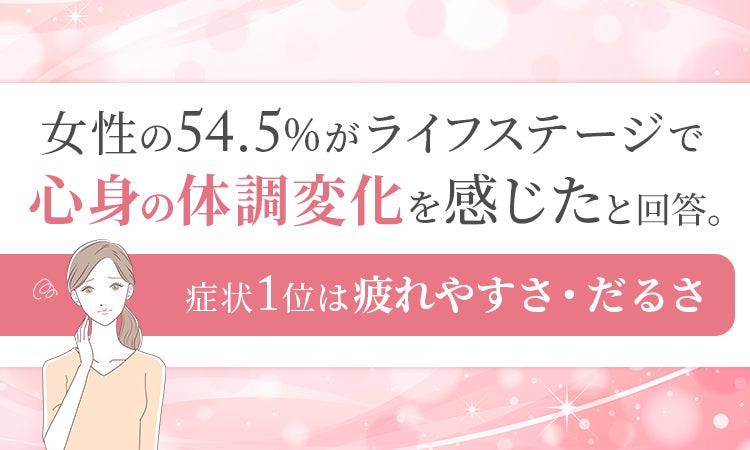
54.5% of women reported experiencing physical and mental changes during life stages
First, we asked whether respondents had ever noticed physical or mental changes during women-specific life stages.
The results showed that 22.0% "strongly felt" such changes, and 32.5% "somewhat felt" them, totaling 54.5%. Meanwhile, 24.0% said they "rarely felt" such changes, and 21.5% said they "did not feel them at all."
Approximately one in two women reported experiencing changes in their mind and body during life transitions. Milestones such as menstruation, pregnancy, and menopause may serve as key moments for women to reflect on their health.
The most common timing for physical changes was "premenstrual (PMS)" at 53.2%
Next, we asked those who reported experiencing physical changes when they noticed them.
The most common response was "premenstrual (PMS, premenstrual syndrome)" at 53.2%.
This was followed by "menopause (physical and mental changes in the 40s–50s)" at 50.5%, and "during menstruation" at 41.3%.
Many women reported discomfort not only during monthly premenstrual and menstrual periods but also during major life milestones like menopause. It appears that many women experience discomfort at multiple stages, not just one.
The most common discomfort was "fatigue" at 70.6%
Next, we asked respondents who experienced physical changes what specific discomforts they felt.
"Fatigue" was the most common, reported by 70.6%.
This was followed by "irritability, low mood, and other mental discomforts" at 62.4%, and "headaches, shoulder stiffness, and back pain" at 50.5%.
Alongside physical fatigue, mental discomforts such as low mood and irritability ranked highly.
These findings suggest that women’s health challenges manifest on both physical and mental levels.
We collected specific feedback on the changes and discomforts women experienced; some responses are shared below.
Please describe any particular concerns regarding timing of physical changes or discomforts.
・"It starts going off about two weeks before my expected period." (Female, 20s)
・"I’ve felt unwell for two weeks before my period, but it’s hard to get others to understand." (Female, 30s)
・"Changes in taste and physical condition during morning sickness, postpartum hair loss, etc." (Female, 30s)
・"After giving birth to my second child, I started noticing fatigue, body shape changes, and weight gain. I’m getting older, and I’m unsure how to manage these changes." (Female, 40s)
・"I’m in menopause. I occasionally get hot flashes. During heatwaves, even with strong air conditioning, the hot flashes make me unbearably hot." (Female, 50s)
These responses highlight discomforts that begin before menstruation and the difficulty of being understood by others.
Additionally, we see that symptoms of concern vary by life stage—such as physical and body shape changes after pregnancy and childbirth, and hot flashes during menopause.
The most commonly cited nutrient for women’s health maintenance was "iron" at 73.5%
Next, we asked which nutrients women believe are necessary for maintaining health.
"Iron" was the most frequently selected at 73.5%.
This was followed by "isoflavones (soy-derived)" at 49.5% and "calcium" at 48.5%.
Iron surpassed 70%, significantly outpacing other nutrients. This reflects a high level of awareness among women who tend to lose iron during menstruation, pregnancy, and childbirth. Isoflavones, commonly found in soy, are known to function similarly to female hormones.
We also asked which nutrient they considered most essential and why; some responses are shared below.
Among these, which nutrient do you consider most essential, and why?
・"Because my menstrual pain improved after I started taking iron." (Female, 20s)
・"I’ve heard zinc deficiency is common among women over 30, so I think it’s necessary." (Female, 30s)
・"I feel protein is essential because it greatly affects mental health and bones." (Female, 40s)
・"Isoflavones. When I was struggling with menopausal symptoms, taking isoflavone supplements improved them significantly." (Female, 50s)
・"Calcium, because it strengthens bones." (Female, 30s)
Iron, calcium, isoflavones—each nutrient reflects personal experiences and health priorities.
FACT BOX
- Source: PR TIMES
- Category: Survey