No Company, Inc. (Headquarters: Minato-ku, Tokyo; Representative Director: Makoto Akiyama), a provider of recruitment marketing support, conducted a recent awareness survey on the theme of "Influence of Popularity Rankings on Job Hunting and Gaps Before and After Joining" targeting new graduates and second new graduates who joined the company between April 2023 and April 2026.
In today's youth, who prioritize time performance (hereinafter referred to as "Tapa") and utilize AI recommendations and SNS searches for company research, traditional recruitment methods of "acquiring talented individuals by increasing name recognition and rankings" are being forced to be re-evaluated.
This report investigates the reality of young people's decision-making shifting from "company popularity" to "compatibility with oneself." Based on the survey results, we will consider the gap between the information disseminated by companies and the information job seekers want to know, as well as the new communication methods required in recruitment activities.
Survey Results Summary: The Era Where "Understanding the Company" Dictates Recruitment, Not Name Recognition
"Companies That Suit Me" Over "Popular Companies" Job seekers' company selection is shifting from being based on popularity rankings and name recognition to emphasizing "whether the company suits them." While the largest number of students answered that they "did not know" about the popular company rankings, information sources for identifying companies that suit them, such as company recruitment websites and university career centers, were prioritized.
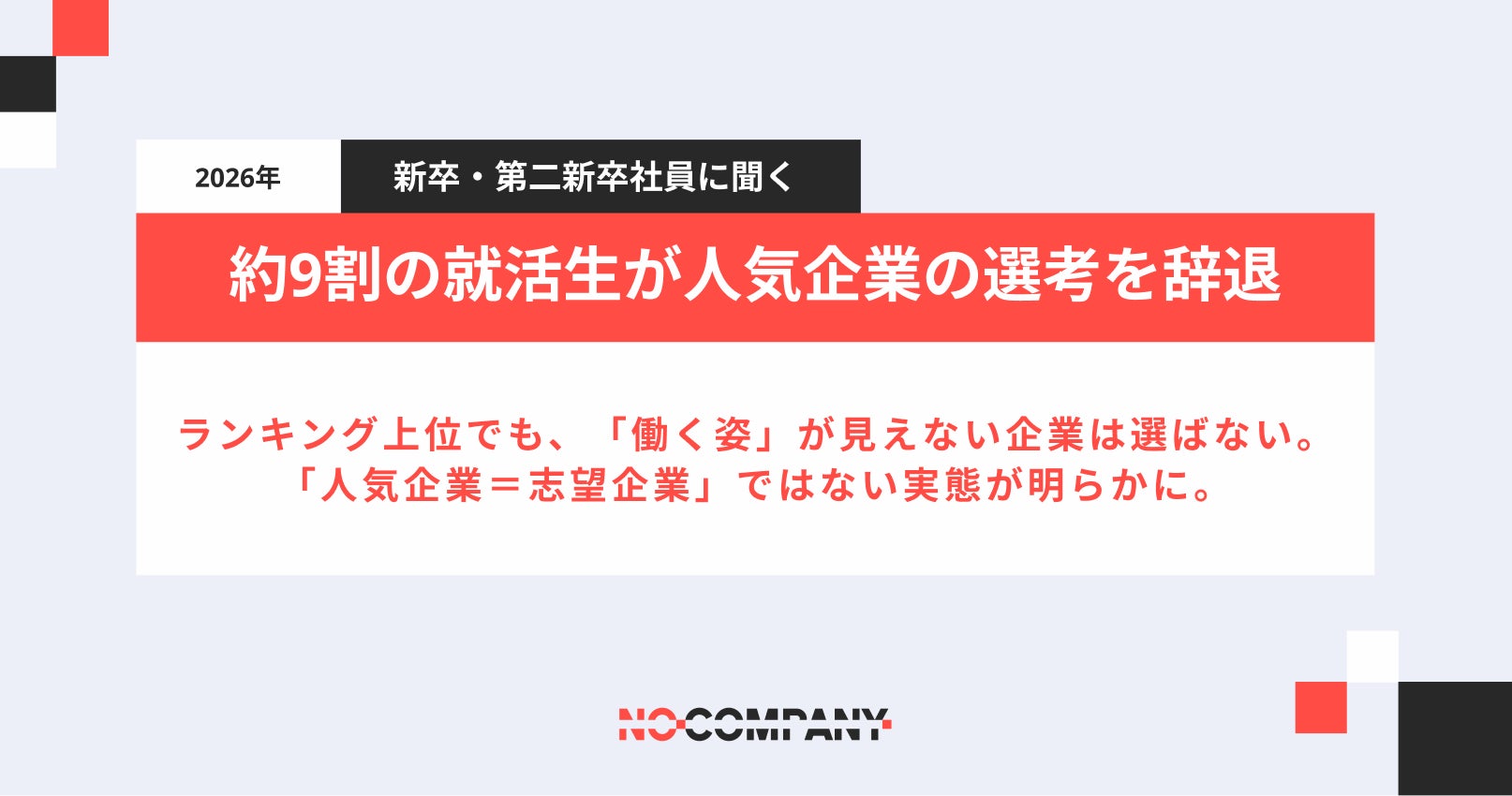
About 90% of Students at Popular Companies Experience Decreased Interest or Withdrawal During Selection Process Among students who applied to top-ranked companies, approximately 90% experienced a "decrease in interest" or "withdrawal" during the selection process. While it is possible to form a large applicant pool based on name recognition and popularity, this alone cannot support students' decision-making.
Cause of Decreased Interest is "Lack of Information Resolution" Common reasons for decreased interest included "explanations were abstract and I couldn't visualize myself working there" and "I felt the culture didn't match mine." Furthermore, about 70% of students feel that company recruitment information "only highlights the good points, and I can't see the real story."
Information Dissemination That Shows "The Company's Daily Life" Determines Recruitment Success The top reasons for post-joining gaps were "relationships with colleagues," "organizational culture," and "unspoken rules." The company's daily life and values, which are not adequately conveyed during recruitment activities, also become factors for early turnover. What is required for future recruitment is not increased name recognition, but information design that consistently conveys the company's reality throughout the entire recruitment process.
From "Uniform Rankings" to "Whether It Suits Me"
In this survey, the primary purpose for using major new graduate navigation sites was "for entry purposes," indicating their continued high functional value as "infrastructure" for job hunting.
However, the reality is significantly different regarding whether the "popular company rankings" announced on these sites directly influence student behavior. Investigating entry behavior using rankings, surprisingly, the most common answer was "I didn't know about the popular company rankings themselves." This was followed by "individual entry" and "used it only as a reference," with only about 30% of students actually moving from the navigation site's rankings to an actual entry. This highlights the hollowing out of the traditional method of "uniformly forming a large applicant pool by being listed in the top rankings."
So, where do today's job seekers start their approach to companies? When asked "What did you utilize most as a trigger (awareness) for entering a company?", the top answer, surpassing information and popular rankings from major navigation sites, was "the company's recruitment website." Furthermore, it is noteworthy that "university career centers" ranked high.
Of course, this result alone cannot definitively conclude that students are re-evaluating career centers. However, in an era of information overload, it can be seen as a sign that students are prioritizing "who is conveying the information and from what position" rather than the company-disseminated information itself.
In recent years, information about job content, systems, and culture has become easily accessible through company recruitment websites and SNS. On the other hand, with many companies presenting their appeal in similar terms, it has become difficult for students to determine "whether it is truly a suitable environment for them."
In such a situation, career centers are one of the few entities that can grasp the career paths and achievements of their own graduates and provide advice based on the student's values and aspirations. The third-party perspective, which is neither corporate recruitment PR nor anonymous reviews, may be why students utilize them as a source of information to assess their compatibility with a company.
The Trigger for a Sharp Drop in Interest is the "Lack of Freshness and Resolution of Information" from Companies
Among students who applied to top-ranked companies, a staggering approximately 90% answered that they "often" or "sometimes" experienced a "decrease in interest" or "withdrawal" during the selection process. The most common reason cited was "an offer from another company," followed by "the company information sessions and interviews were abstract, and I couldn't form a concrete image of myself working there," and "I felt the workplace culture (values and behavioral norms) did not match mine."
Even if a company can form a large applicant pool by investing a huge budget to be listed in the top rankings, the harsh reality is that students will quickly disengage if sufficient company understanding is not fostered in the subsequent recruitment process.
Preventing Post-Joining Regret is "Openness of Primary Information," Not Glamorous Events
When investigating moments when students felt "distrust" or "lack of substance" in company recruitment information, the highest response was "only the good points were emphasized, and the company's 'true intentions' were not visible." This was followed by "I couldn't imagine the actual work or the atmosphere of the workplace" and "abstract expressions (such as 'at home,' 'can grow')". This revealed that companies' pleasant-sounding facades and non-specific expressions are a strong noise (source of distrust) for students with high job-hunting literacy. Furthermore, a certain number of respondents cited "it was too 'polished' on SNS and videos, making it difficult to see the reality," indicating that excessive creativity and one-sided branding even carry the risk of increasing young people's wariness.
In fact, among the "touchpoints that triggered a decrease in interest," personal interactions through "the interviewer in the first interview" and "interactions with HR personnel" ranked higher than events like internships and company information sessions. The moment students see through "how people actually interact" behind the glamour of events and polished content, they feel "disappointed" and withdraw from the selection process.
On the other hand, the disclosure information that led students to judge a company's reliability as "high" and find it attractive was "disclosure of overtime, paid leave, etc., with numbers." This was followed by "conveying the values of supervisors and senior employees, and the relationships and atmosphere of the workplace," and further, "disclosure of challenges as well as good points," "employees speaking in their own words, conveying real voices from the field," "realistic explanations of actual job content and the difficulty of the work," and "anecdotes of overcoming failures and difficulties." These ranked high.
What emerges from these results is that young people are not seeking a beautified corporate image, but primary information supported by data and honestly conveyed, including the hardships of the workplace. By deliberately verbalizing and conveying challenges, work difficulties, and experiences of failure during the selection process, which companies tend to hide as negative, it can paradoxically lead to trust. For young people who prioritize Tapa but seek real information, the actual state of affairs, rather than the ideal image presented by the company, becomes the material for their decision-making.
The Wall of "Unverbalized Culture" in the First Month of Joining
When asked about "points of perceived gap before and after joining," "relationships and communication with supervisors and colleagues," "actual job content and workload," and "organizational culture and unspoken rules" dominated the top rankings, significantly surpassing systems and benefits like "evaluation systems, salary, and work styles."
The background to this gap lies in the company's "insufficient information disclosure" during the selection process, such as "difficulty seeing the reality of field employees" and "information biased towards the good points." As a result, the structure has become clear where many new employees are bewildered by the existence of "unspoken workplace rules that they learn for the first time after joining" and face gaps before and after joining.
Surprisingly, a considerable proportion of these new employees who faced the wall of "unverbalized culture and reality" have already fallen into early-stage turnover crises or decreased engagement, such as "considering resignation," "actively job hunting," or "already resigned."
To prevent these post-joining regrets and mismatches, the top content that new employees wished they had during the selection process was "actual work and daily flow content." This was followed by "content that can be understood with numbers such as overtime and salary," and "content about internal atmosphere and relationships," and "content about the values of supervisors and seniors" were also requested.
Summary of Survey Results: Not Chosen Just for Popularity. Data Shows Young People's True Feelings and Three Transformations Required of Companies
This survey revealed that today's young people are completely shifting their decision-making axis to "Does this company truly suit me?" without blindly accepting a company's "brand (external evaluation)." Traditional "formation of a large applicant pool" by maintaining navigation site rankings or investing solely in visually appealing aspects has reached its limit.
Information dissemination that merely lists superficial information like "systems and benefits" that are easy to compare with other companies is perceived by about 70% of young people as "not showing their true intentions." As a result, the company's reality is not adequately conveyed during the selection process, leading to significant missed opportunities, with approximately 90% of students experiencing decreased interest or withdrawal.
Furthermore, even if they join the company with such insufficient information, they often face the gap between "unverbalized workplace unspoken rules" and organizational culture present in the field, leading to cases where they consider changing jobs at an early stage. The discrepancy between expectations at the time of hiring and reality is one of the causes of early turnover. To acquire and retain talented young personnel in future recruitment activities, companies need to undertake the following three transformations, according to No Company:
1. From "Formation of a Large Applicant Pool" to "Information Design for the Entire Recruitment Process"
The phase of investing in name recognition is over. It is urgent to build an experience design that thoroughly enhances the "resolution of company information" at each touchpoint from entry to selection and offer. The key to preventing selection dropout is not the glamour of events, but how sincerely the company's real information can be presented through "real human beings" such as first interviewers and HR personnel.
To improve this information resolution, the first steps companies should take are "training that involves the field to eliminate variations among interviewers" and "common languageization unique to their company."
Even if HR speaks of a beautiful vision, if the next person, the field interviewer, cannot concretely explain the difficulties of the actual work in their own words, students will see through it as "lacking substance."
2. Convey "The Company As It Is," Not "A Good Company"
Information that can be used anywhere, such as that obtained through internet searches or AI, has no value. What companies consider negative and tend to hide, such as "company challenges," "work difficulties," and "episodes of overcoming past failures and troubles," are precisely the most reliable decision-making materials for today's young people and become a strong attraction (motive) for choosing that company.
It is important to strategically create content by openly disclosing the actual state of affairs rather than using pleasant-sounding words.
3. Verbalize and Consistently Deliver the Company's Unique "Style (Values and Behavioral Norms)" Throughout the Entire Recruitment Process What young people prioritize when choosing a company is not "whether it is a popular company," but "whether it is an environment where they can work as themselves." The material for this judgment is the company's unique values and behavioral norms, in other words, its "style."
Companies need to verbalize their unique values, decision-making processes, and work styles and consistently convey them throughout the entire recruitment process, including recruitment websites, information sessions, interviews, and employee discussions. Visualizing the company's style, which cannot be conveyed by systems and benefits alone, and deepening mutual understanding with job seekers will be the key to increasing acceptance rates and retention rates after joining.
No Company will continue to support the realization of "Style Match" (※), which connects companies and job seekers through essential values, and the design of new-era recruitment experiences (recruitment CX), based on its unique data analysis and marketing perspective.
(※) A state where companies and job seekers are matched based on values and behavioral norms.
◾️ Survey Background
In recent years, the recruitment market for young talent has seen significant changes in the touchpoints between companies and job seekers due to the digitalization of job hunting and the widespread use of AI recommendation tools. In traditional recruitment activities, it was common to focus on "forming a large applicant pool by gathering numbers" by being listed in the top rankings of major navigation sites and increasing company name recognition. However, for today's young people who prioritize Tapa and use the internet and AI to meticulously select "one company that truly suits them," information dissemination that is merely a facade with a good appearance is no longer effective. Even if they enter based on name recognition, cases of declining selection or early turnover are endless due to abstract explanations during the selection process or facing "unspoken workplace rules" after joining. Against this backdrop, companies are strongly urged to "design recruitment experiences (recruitment CX)" by sincerely verbalizing and conveying their company's real image and unique organizational culture (style) in all processes from selection to joining, not just by attracting them with glamorous events and information. Therefore, No Company conducted this survey to clarify the limitations of recruitment activities relying on name recognition and popular company rankings, and the information disclosure methods required in the coming era, through an awareness survey of new graduates and second new graduates.
◾️ Survey Overview
Survey Period: June 4, 2026 - June 6, 2026
Survey Method: Internet Survey
Target Area: Nationwide
Survey Target: New graduates and second new graduates who joined the company between April 2023 and April 2026 Valid Responses: 408
"Style Match" Realized by No Company
As a leading company in recruitment marketing support, No Company realizes matching with suitable talent = "Style Match" by verbalizing and visualizing a company's style (values and behavioral norms) and delivering it to job seekers.
Through dialogue with over 100 companies and 1,000 HR and recruitment personnel, we have accumulated knowledge regarding the values and culture of each company and have been working to explore optimal recruitment marketing strategies and tactics for each.
With the business mission of "Changing Organizations and People Through Style Match," No Company supports companies' HR and recruitment activities through a variety of services based on this philosophy.
No Company, Inc.
A recruitment PR support company that utilizes SNS data, the first of its kind in the Hakuhodo Group. Established on October 1, 2021, as a subsidiary of Spicebox Co., Ltd. (Headquarters: Minato-ku, Tokyo; President and CEO: Eiji Tamura). Leveraging its expertise in SNS data utilization, extensive marketing knowledge as a member of the Hakuhodo Group, and track record, it operates as a leading company in recruitment marketing, supporting corporate recruitment activities and branding in human capital management.
Company Name: No Company, Inc. (English Name: No Company, inc.)
Establishment: October 1, 2021
Capital: 20 million yen
Investors: Spicebox Co., Ltd., etc.
Location: WeWork, 21st Floor, Kamiyacho Trust Tower, 4-1-1 Toranomon, Minato-ku, Tokyo
Representative: Makoto Akiyama, Representative Director and President
Business Content: Recruitment Marketing Support
URL: https://www.no-company.co.jp/
FACT BOX
- Source: PR TIMES
- Category: Survey結果