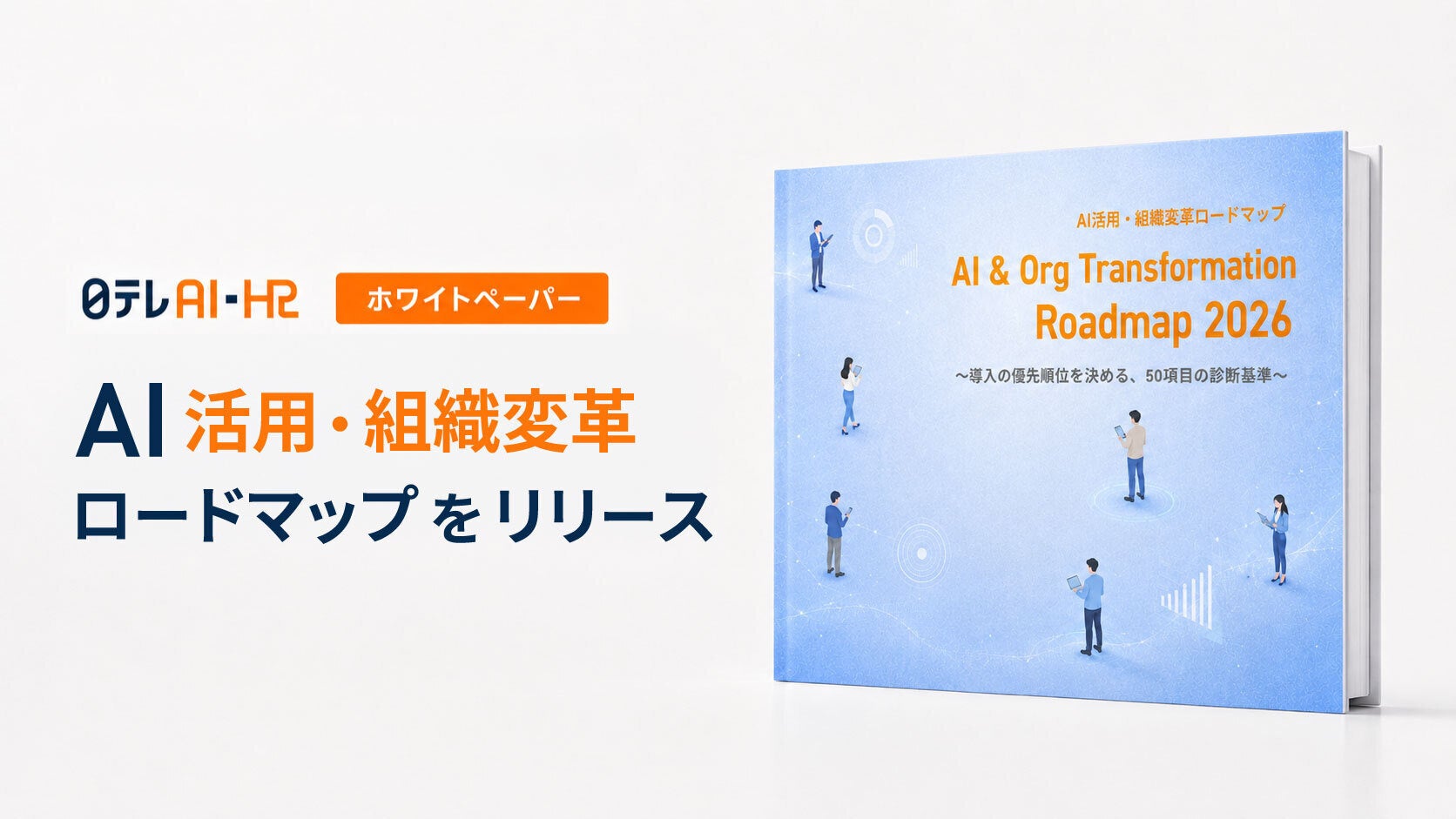
50 diagnostic criteria to understand the current status of AI adoption and prioritize the next steps
NTV AI-HR, operated by NTV HR Comprehensive Research Institute (Headquarters: Minato-ku, Tokyo, Representative Director and President: Hiroyuki Nakamura), has started providing a white paper titled 'AI Adoption and Organizational Transformation Roadmap 2026: 50 Diagnostic Criteria for Determining Introduction Priorities' as of July 9, 2026 (Thursday).
This document explains the points to confirm when moving from the stage of using AI as a mere efficiency tool to the stage of incorporating it into business flows, decision-making, and organizational operations, divided into five phases.
Details of the White Paper 'AI Adoption and Organizational Transformation Roadmap 2026'
https://ai.ntv-hr.com/white-paper/ai-white-paper03/
NTV AI-HR Service Site
https://ai.ntv-hr.com
Visualizing the current status of AI adoption and the next stage to proceed
While the business use of generative AI is expanding, challenges such as 'only some employees are using it,' 'PoC was implemented but not progressed to full-scale deployment,' and 'internal rules or data preparation are not keeping up' are also arising.
To establish AI adoption in the organization, merely introducing tools is insufficient. Themes to address change depending on the stage, including understanding individual usage, risk, PoC purpose setting, internal guidelines, data preparation, permission management, basic AI adoption education for all employees, and in-house development of AI personnel.
This document classifies corporate AI adoption into five phases: 'Exploration,' 'Verification,' 'Infrastructure Preparation,' 'Full-scale Implementation,' and 'AI Native.' Through 50 diagnostic criteria, each with 10 items per phase, companies can organize their current status and the next priorities.
Development Background
Interest in generative AI has grown, and AI adoption has progressed in many companies. However, what is now required is not just using AI as a mere efficiency tool but also linking it with unique data and business flows to utilize it as the organization's overall strength.
To establish AI adoption in the organization, it is necessary to proceed step-by-step from individual prompt trials to exploration, verification, infrastructure preparation, full-scale implementation, and AI nativization. However, if it is not organized which stage the company is in and what should be prioritized next, the efforts may remain as partial trials, making it difficult to lead to organizational transformation.
Therefore, NTV AI-HR has created this document summarizing 50 diagnostic criteria in five phases as a judgment material to proceed from 'an organization that uses AI' to 'an organization that presupposes AI.'
Features of 'AI Adoption and Organizational Transformation Roadmap 2026'
1. Organizing AI adoption maturity into five phases
This document classifies corporate AI adoption into five phases: 'Exploration,' 'Verification,' 'Infrastructure Preparation,' 'Full-scale Implementation,' and 'AI Native.' It organizes the items to be confirmed according to the organization's maturity level, from the stage of touching AI to full-scale deployment, business redesign, and business transformation.
2. Posting 50 diagnostic criteria for determining introduction priorities
The document posts 50 diagnostic criteria, 10 items per phase. It organizes the items to be confirmed at each stage, such as understanding individual usage, PoC success criteria, internal guidelines, and business flow redesign.
3. Presenting a perspective to proceed from 'an organization that uses AI' to 'an organization that presupposes AI'
This document organizes the perspectives for organizational AI adoption, from visualizing individual usage and inventorying field issues to data preparation, permission management, all-employee education, evaluation systems, and AI governance.
4. Supporting the creation of common recognition among stakeholders
The challenges and priorities regarding AI adoption differ among the management layer, DX promotion department, information systems department, and field departments. By utilizing this document as a common judgment material, it becomes easier to discuss the company's current status and the next items to be prepared.
Expected Usage Scenarios
This document can be utilized in the management planning, DX promotion, information systems, personnel and general affairs departments, and various business departments considering AI adoption or full-scale deployment.
It can be used as a judgment material when confirming the current status of AI adoption in the company, considering full-scale deployment after PoC, reviewing internal guidelines and data infrastructure, or redesigning business flows and evaluation systems.
Future Prospects
NTV AI-HR believes that it is important not only to introduce generative AI as a standalone tool but also to design it according to each company's business and organizational structure and create a state where it can be continuously utilized in the field. AI adoption begins with individual trials, proceeds through verification, infrastructure preparation, and full-scale implementation, and leads to organizational and business transformation.
In the future, we will continue to provide practical information and judgment materials related to AI adoption and comprehensively support companies from issue organization, introduction planning, AI environment construction, field establishment, to operational improvement.
Company Profile
Company Name: NTV HR Comprehensive Research Institute
URL: https://ntv-hr.com/
Headquarters Location: Minato-ku, Tokyo
Representative: Representative Director and President Hiroyuki Nakamura
Established: May 1, 2025
Business Start Date: August 1, 2025
Business Content: Video training, recruitment support, personnel consulting, AI adoption support, etc.
NTV AI-HR Operations
Operation: NTV HR Comprehensive Research Institute
Creative & AI Implementation Partner: Tajik Co., Ltd.
FACT BOX
- Source: PR TIMES
- Category: New Product