Sanko Estate Co., Ltd. (Headquarters: Chuo Ward, Tokyo; President: Shojiro Fukushima) announces the release of its 'Office User Report,' summarizing corporate office demand trends in Tokyo's 23 wards for the first half of 2026.
• Target Area: Tokyo's 23 wards
• Survey Point: End of June 2026
▼ This report is also available here:
https://www.sanko-e.co.jp/pdf/data/OfficeUserReport_20260831.pdf
Office Expansion and Relocation DI in Tokyo's 23 Wards
Record high in Q1, sharp decline in Q2
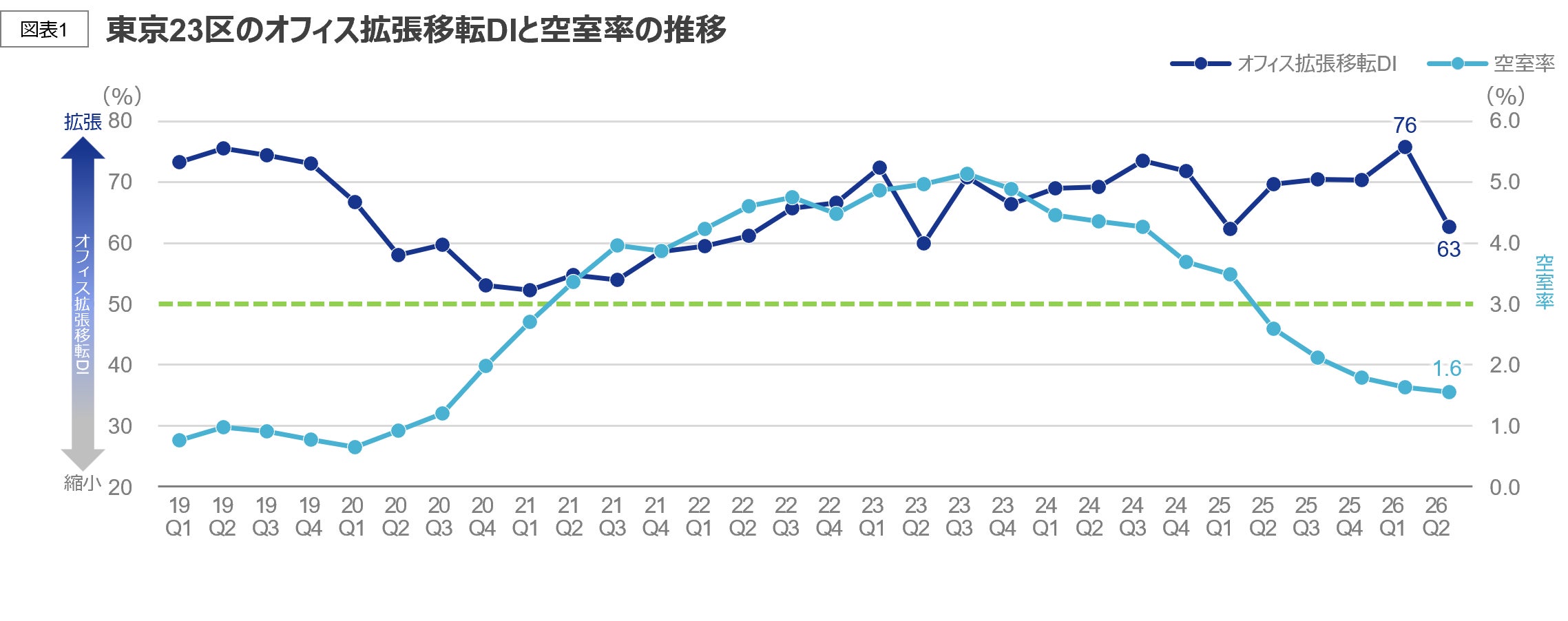
The Office Expansion and Relocation DI fluctuates between 0% and 100%. A value above the benchmark of 50% indicates strong corporate expansion intent, while below 50% indicates contraction intent. In Q1 2026, the DI reached 76%, the highest since Q1 2019. However, in Q2, it declined significantly by 13 percentage points to 63%.
Vacancy rates remain in the low single digits, and available large-scale office spaces are scarce. As a result, tenants seeking expansion face limited options, leading to an increasing number of companies revising their relocation plans. Additionally, rising rental rates and office relocation costs have prompted more companies to reduce leased area sizes without compromising on location or building grade—particularly to support recruitment—thereby controlling total costs.
Industry-wise Breakdown of Expansion and Relocation
Strong expansion intent across all industries
In the first half of 2026, across all industries, the combined proportion of new and expanded office relocations accounted for approximately 70%, indicating robust expansion intent regardless of sector. While the information and communications industry shows a relatively higher proportion of downsizing moves compared to others, proactive relocations aimed at improving location are also observed.
An increasing number of companies are prioritizing in-office communication and collaboration, driven by recruitment efforts, employee engagement, and preparation for the AI era. Consequently, demand for larger office spaces than before remains strong. As more companies view office spending as an investment rather than a cost, rental affordability has increased, particularly among firms with strong financial performance.
Asking Rental Rates: Year-on-Year Comparison
Upward trend intensifies across all scales and building ages
Year-on-year growth in asking rents reached +16.2% for large-scale buildings under 10 years old, a significant increase from +9.7% in June 2025. For large and medium-sized buildings over 30 years old, year-on-year rent growth hit the highest level since 2001. This indicates that upward pressure on office rents is intensifying across the entire market, regardless of size or age. Tight supply-demand conditions are a key factor, along with strong demand for high-quality office spaces and a rise in value-add investments aimed at enhancing the value of existing buildings through renovations. With rising construction costs leading to more cancellations or delays in redevelopment and rebuilding projects, the trend toward higher-quality existing office buildings is expected to accelerate, and the upward trend in rents is likely to continue.
Analyst Perspective
Although the current Office Expansion and Relocation DI has declined significantly, tenant expansion intent remains strong. Companies with strong performance and inflation resilience show increased rental affordability and are able to absorb rising rents. However, the limited availability of suitable office spaces has led to more companies abandoning relocation plans. Additionally, rising new and renewal rents are prompting tenants to reassess their office strategies. In past periods of supply-demand tightness, some companies relocated to suburban areas for cost efficiency or larger available spaces, but such movements are less common now. Moving forward, it will be crucial for companies to strike the right balance among location, rent, and building grade within a limited range of options.
[Reference] Calculation Method for Office Expansion and Relocation DI
The Office Expansion and Relocation DI is calculated by aggregating the number of office moves where the leased area after relocation compared to before is categorized as (1) expanded, (2) same scale, or (3) reduced, using the following formula.
Note: New openings, where pre- and post-move leased areas cannot be compared, are excluded from the calculation of the Office Expansion and Relocation DI.
About Sanko Estate Co., Ltd.
Sanko Estate Co., Ltd. (established May 17, 1977) provides comprehensive support for corporate office strategies. From selecting and brokering rental office buildings to evaluating and proposing optimal workplaces and providing essential project management functions, the company meets a wide range of office-related needs.
https://www.sanko-e.co.jp/
FACT BOX
- Source: PR TIMES
- Category: Survey