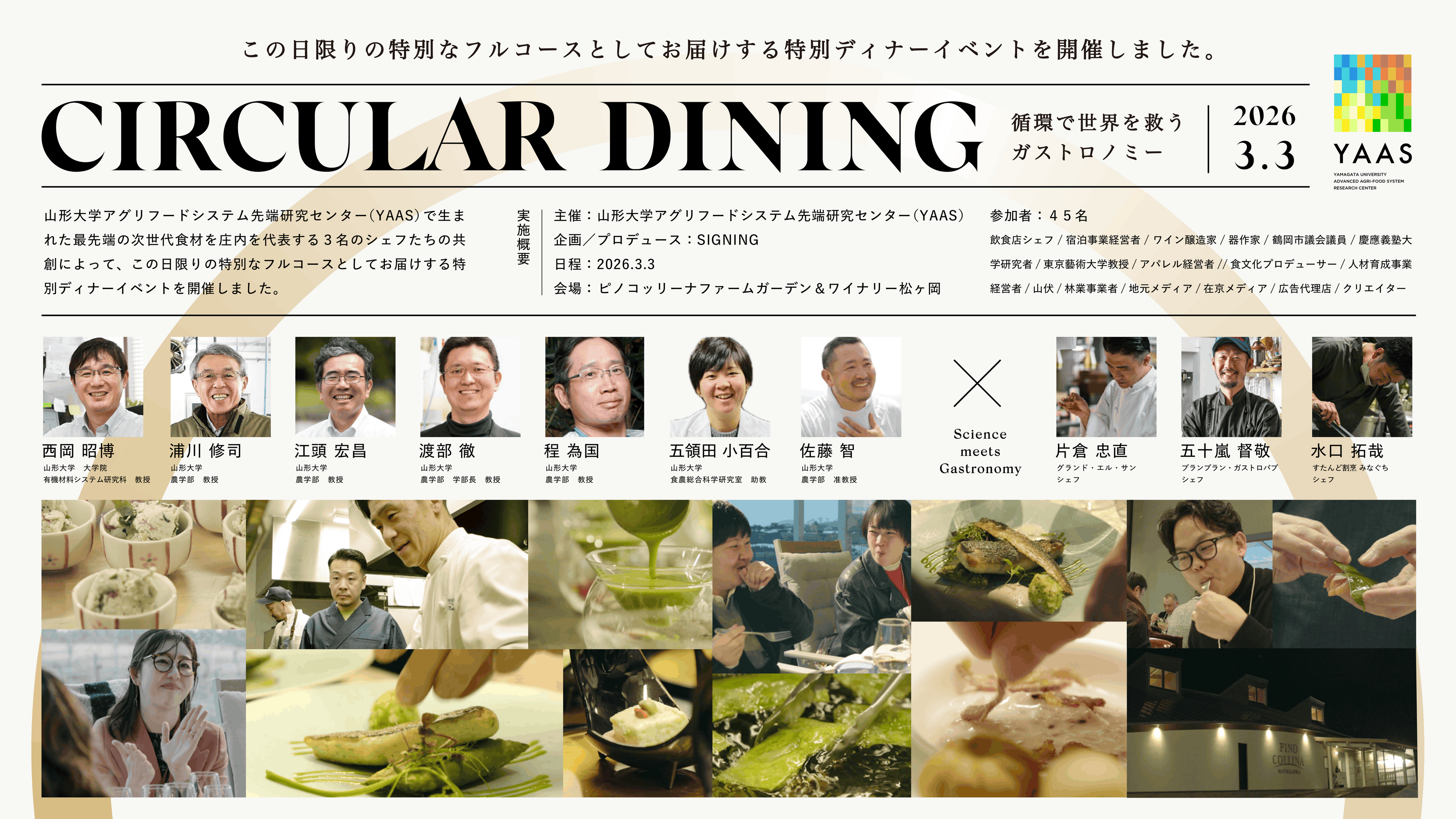
SIGNING Co., Ltd. (headquartered in Minato-ku, Tokyo; President and CEO: Takahiro Maki; hereinafter 'SIGNING'), as a collaborating research partner in the 'Smart Terroir City Initiative'—an industry-academia-government project led by Yamagata University's Advanced Research Center for Agri-Food Systems (YAAS)—hosted a special dinner event titled 'CIRCULAR DINING — Gastronomy to Save the World Through Circularity' on March 3, 2026, in Tsuruoka City, Yamagata Prefecture.
This event was part of an initiative to return university research outcomes to society by transforming cutting-edge research in food and agriculture into a one-night-only full-course dining experience, creatively realized by leading chefs from the Shonai region. This approach provided a new opportunity for the public to experience highly specialized research in an accessible and engaging way.
【Key Highlights】
From 'Research Paper' to 'Dinner Plate'
The event presented research findings not as abstract knowledge, but as 'edible experiences.' Yamagata University's initiatives in circular food systems and next-generation ingredient development were transformed from 'concepts into experiences.'
Science Meets Gastronomy
Forty-five guests attended, witnessing collaboration between researchers and chefs. Dishes featured innovations such as alpha-processed rice flour, heirloom crops, circular rural economies, value-added seafood, and nature-integrated rice farming.
Event Overview
Name: CIRCULAR DINING — Gastronomy to Save the World Through Circularity
Date: March 3, 2026
Venue: Pinocollina Farm Garden & Winery Matsugaoka https://pinocollina.com
Organizer: Yamagata University Advanced Research Center for Agri-Food Systems (YAAS)
Planning & Production: SIGNING Co., Ltd.
Number of Participants: 45
A Tasting Journey Through 'Circularity'
An 11-course menu expressed themes of sustainability, regional circulation, and health as tangible experiences.
Participant Feedback
Attendees gave high praise, with comments such as 'I was amazed by the potential of scientifically-backed ingredients' and 'I felt the new value created by combining research and private-sector creativity.'
Participating Chefs
Grand El-Sun
Chef Tadanao Katakura
After graduating from a culinary school, Chef Katakura learned the fundamentals of Western cuisine at the Keio Plaza Hotel in Tokyo, where he worked for nearly 14 years. He then served as head chef at a hotel wedding company for three years, focusing on product development. He now creates Western-style dishes that highlight seasonal Shonai ingredients, emphasizing ingredient integrity and flavor enhancement. He also contributes to developing Western-style confections using local ingredients and actively promotes Shonai's food culture. Starting in 2026, he will serve as chairman of the Shonai DEC Club.
https://www.el-sun.com
Blanc Blanc Gastronomy
Chef Takiya Igarashi
Born in Tsuruoka City, Yamagata Prefecture, Chef Igarashi believes in 'honoring the inherent flavor of ingredients' through Western cuisine. He crafts course menus that capture the essence of Shonai’s mountains, sea, and plains in each dish. He participates in initiatives promoting U-turn/I-turn migration in Yamagata, young chef networks like 'RED U35,' and activities with the 'Japanese Cuisine Academy,' broadening his professional perspective while actively promoting food culture.
https://blancblancgastropub.com
Stand Kappo Minaguchi
Chef Takuya Minaguchi
Inspired by his chef father, Chef Minaguchi graduated from a culinary school in Yanagawa, Fukuoka Prefecture, and trained at renowned restaurants in Izu-Nagaoka, Tendō, and Ginza. In 2012, he returned to his hometown to take over the family business. At his counter-style restaurant, he serves Japanese cuisine that highlights seasonal ingredients and brings out their natural flavors. Recognized for his deep community involvement and efforts to preserve Tsuruoka’s food culture, he is celebrated as a chef who carries forward local flavors into the modern era.
https://www.instagram.com/takuya_minaguchi/
Participating Researchers and Research Themes Incorporated into Dishes
Effective Utilization of Sewage Resources to Support Food and Agriculture Circulation (Bistro Sewage)
Professor Toru Watanabe, Faculty of Agriculture, Yamagata University
● Goal
Aiming to realize a society where food and agriculture circulate by effectively utilizing sewage resources previously considered 'waste.' We seek to build regionally circular societies by applying treated wastewater and sludge resources to agriculture and aquaculture, contributing to improved food self-sufficiency and sustainable regional economic development.
● Research Content
Developing technologies for the circular use of treated wastewater and sludge resources, including using treated wastewater for agricultural irrigation and converting sludge into fertilizer, to promote effective resource utilization.
● Characteristics as Food Ingredients
Ingredients cultivated using sewage resources are not only high in taste and nutritional value but also rigorously confirmed for safety. For example, farmed ayu (sweetfish) raised on feed containing algae cultivated in treated wastewater offer an aroma comparable to wild ayu.
Development and Production of Next-Generation Alpha-Processed Rice Flour
Professor Akihiro Nishioka, Graduate School of Organic Material System Science, Yamagata University
● Goal
To redefine the value of grains like rice through proprietary alpha-processing (amorphization) technology, expanding society’s access to new food options independent of wheat. We aim to achieve a sustainable food future by improving food self-sufficiency, revitalizing regional agriculture, and enabling use as emergency food during disasters.
● Research Content
A proprietary technology that alpha-processes (amorphizes) the crystalline structure of grains through hydration, heating, and kneading. By breaking down the crystalline structure, this process enhances water absorption and digestibility, enabling the development of foods that absorb water easily and can be cooked with water alone. Rice flour developed through this technology at Yamagata University is easier to handle than conventional rice flour and holds promise for wide application in bread, noodles, and other foods.
● Characteristics as Food Ingredients
'Yamagata University Alpha-Processed Rice Flour' can be easily cooked with just water and excels in water absorption and retention. It remains soft even when cooled and maintains elasticity. Despite being gluten-free, it offers processing properties similar to wheat flour, making it suitable for a wide range of applications including bread and confections.
Circular Rural Economic Zone 'Smart Terroir'
Professor Emeritus Shuji Urakawa, Yamagata University
● Goal
To realize sustainable agriculture and economy by circulating food- and agriculture-related resources within the region. We aim to promote high-value agriculture and pass on rural areas as attractive regions to future generations.
● Research Content
Building systems that enhance regional agricultural products through collaboration between agriculture and the food industry, and creating added value by linking with local processing and distribution. We aim to establish sustainable agricultural models through smart agriculture using ICT and effective use of regional resources.
● Characteristics as Food Ingredients
Processed foods born from this project are high-quality, maximizing the use of regional resources. They are not mere local specialties but high-value ingredients that reflect the region’s terroir and culture.
Preservation and Succession of Local Heirloom Vegetables
Professor Hiromasa Ebisu, Faculty of Agriculture, Yamagata University
● Goal
Japan’s heirloom varieties, threatened by declining and aging cultivators, hold value not only as food but also as media for conveying regional history and culture. Through their utilization, we aim to preserve and pass on these cultural assets.
FACT BOX
- Source: PR TIMES
- Category: Event
- Products / services: CIRCULAR DINING