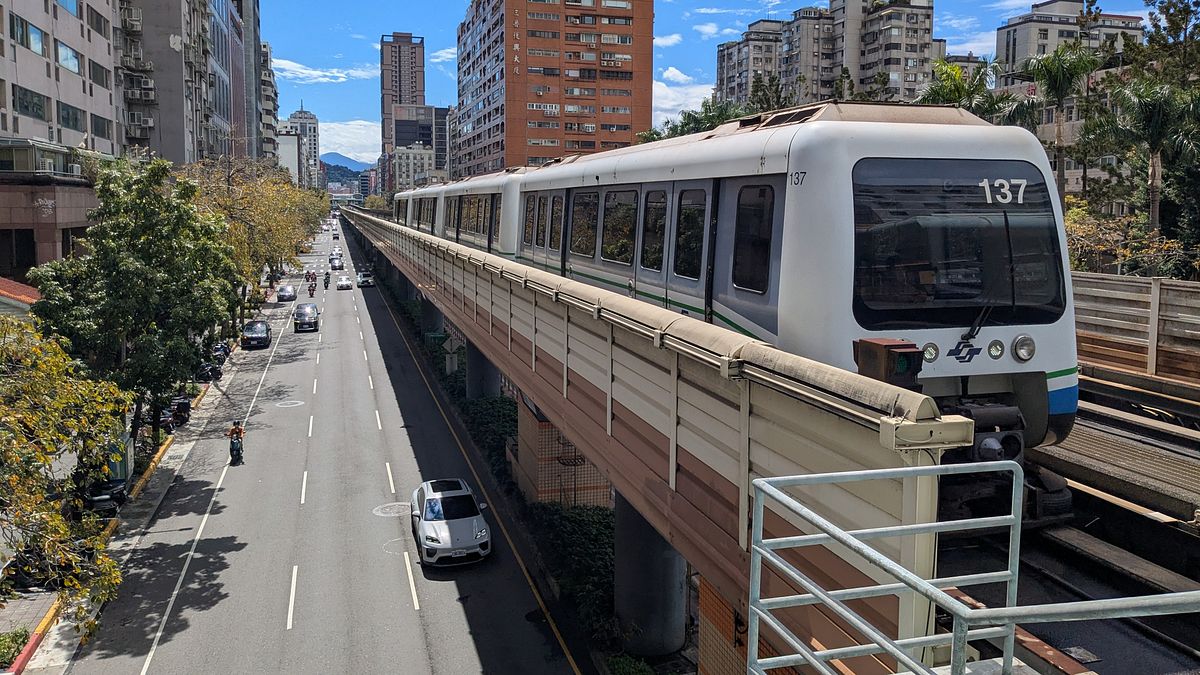
Have passengers riding the Zhonghe-Xinlu Line of Taipei Metro recently noticed that the train carriages 'feel different'? Taipei Metro has announced the official launch of an upgrade program for train arrival displays on the Zhonghe-Xinlu Line, with two trains already completed and fully equipped with large, full-color LCD screens. These new displays provide information in Chinese, English, Japanese, and Korean, and add new details such as exit locations, transfer routes, and carriage positions, enabling passengers to intuitively grasp their travel paths.
Taipei Metro stated that the current arrival displays on the Zhonghe-Xinlu Line have been in use for approximately 15 years and are nearing the end of their service life, prompting the early start of the upgrade project. The full fleet of 33 trains is expected to be upgraded by 2029, with subsequent upgrades planned for the Tamsui-Xinyi Line, Ban-Nan Line, and Songshan-Xindian Line.
Previously, the Zhonghe-Xinlu Line used LED scrolling displays about 6 cm in height, showing only single-line text of the next station. After the upgrade, 27-inch LCD screens are installed above the first and fourth doors, while 48-inch full-color LCD screens are placed above the second and third doors, significantly improving information readability.
The new interface design draws inspiration from metro systems in Japan, South Korea, Singapore, and Hong Kong, incorporating the orange line's identifying color into the display. In addition to station names, station codes, and travel direction, the new screens now show carriage position, exit information, transfer routes, and real-time clocks, supporting four languages—Chinese, English, Japanese, and Korean—allowing both local and international passengers to quickly access travel information.
Additionally, the train head and side displays have been simultaneously upgraded, enabling passengers to easily identify train information even from a distance on the platform.
Taipei Metro emphasized that this upgrade is not merely a screen replacement but involves a comprehensive overhaul of the onboard communication system. Construction teams had to re-route tens of meters of cabling hidden in the ceiling and under seats and reconfigure signals to ensure all displays operate in sync.
Moreover, due to limited space above the doors, the engineering team redesigned the interior panels, conducting repeated measurements, manual sanding, and size adjustments to seamlessly embed the large LCD screens without compromising interior space or passenger flow.
Currently, two trains have been retrofitted, with each renovation taking about one and a half months. The upgrades will proceed in batches, with all 33 trains expected to be fully upgraded by 2029.
Following the reveal of the new arrival displays, online discussions have heated up. Many passengers who have ridden the updated trains have given high praise, noting that the information is more comprehensive and easier to read, enhancing the system's internationalization. Comments include: 'Really impressive, hope other lines follow soon,' 'Rode it today, great improvement,' 'Finally, an upgrade that makes a difference,' 'As a Hong Kong resident, Taipei Metro seems so advanced, 100 points,' 'Wish it could show which carriage is best for transfers like in Japan,' and 'Better late than never, at least progress is being made.'
Many users also hope that the new interface will soon be introduced on the Ban-Nan Line and Wenhu Line to create a more consistent system-wide experience.
However, some netizens argue that improving capacity and ride quality should take priority over display upgrades. Criticisms include: 'Zhonghe-Xinlu Line needs more trains, not extra features,' 'Ban-Nan Line upgrades have been neglected for years—without system-wide integration, this is just a waste of money,' 'More frequent service would actually help,' 'Bring back the missing seats,' 'Too much text, cluttered information,' 'The green lights indicating which side doors open are gone, making it hard for hearing-impaired and elderly passengers,' and 'The screen space is underutilized—escalator info is missing, and text flashes instead of fading smoothly like in Japan.'
Other complaints focus on the Wenhu Line: 'No AC in stations,' 'crowded carriages,' and 'arrival displays only show the terminal station, making it hard to track current location.' Some users labeled the upgrade 'superfluous' and a 'waste of money on meaningless improvements.'
FACT BOX
- Source: PR Times
- Category: News